What You Resist

“What you resist persists.” – Carl Jung

Said in other ways: What you avoid persists; what you fail to learn persists; what remains hidden in your subconscious persists; what trauma traps in your body persists. And very often, we actively invite or create what we most hope to avoid in our lives.

Pogo creator Walt Kelly wrote a parody line that seems apropos – “We have met the enemy and he is us.” While it is true that there are societal and economic obstacles that get in the way of personal improvement, there are also myriad internal obstacles that hold us back. Some are easily changed. Others require layer after layer of courage, honesty, and effort to peel away and release.

All improvement begins with insight. If you don’t see a problem, there is no problem and therefore, no need for improvement. Experts will break insight down into specific categories and steps of recognition leading to action. I’ll keep it simple. Can you realistically connect your action/inaction/decisions/attitude/behavior to the results they are bringing to your life?

We all have a self-protective tendency that allows us to live in denial, sometimes for years. Admitting our flaws and failures can be difficult and painful. It can feel threatening to our self-esteem. And then there’s shame. What do we do with that? As difficult as it may be to level with ourselves, it’s imperative if we want to maximize our potential.

So how do we gain insight?

Get curious! Ask:

  • What’s that nagging thought I keep pushing away? Often, we have an internal knowing we choose to ignore. Sometimes we may even make a great effort to ignore it. If that’s the case, stop those efforts and see what happens.
  • What do I keep accusing my partner of? You may have heard, “every accusation is a confession.” There’s some truth to that. Take each accusation and flip it. Are you talking about them or you (or both)?
  • What will happen if I really lean into what I’m feeling? One way to gain insight is to change something. If you avoid certain feelings, plunge right in and explore them for as long as you can stand it. Your tolerance will grow with practice.
  • What do I feel in my body? Following what’s happening in our bodies often results in insight. It can also free us from recurring trauma responses. Somatic experiencing therapy uses this process.
  • What will I have to change if I gain a piece of self-knowledge? We often remain in a familiar rut because in some convoluted way, it feels positive. Will we have to admit we’re acting just like the parent we swore we’d never act like? Will we lose some of the attention we’re currently getting? Will we have to apologize to a lot of people? Will we lose victim status?

It is true that knowledge may mean we will no longer be able to tolerate our current path. That’s good news! It puts us at an ideal point from which to implement change.

And more good news is that your path for improvement can be whatever you wish it to be. You can be your own hero instead of your own enemy. Get out there, be brave, and get a new cape!

Your best life is calling! Do not resist.

ad

Curiosity is Empowering

Even if you believe it threatens your cat, curiosity is empowering. Actually, take it from a cat. Have you ever seen a cat that trusts your judgment more than its own?

Curiosity leads to greater knowledge.

Knowledge is powerful. Curiosity doesn’t have to lead you so deeply into a single field that you become an expert for it to be beneficial.

Perhaps you become an expert generalist. In the process you may recognize that you have learned the key to marketing to many diverse groups. That’s a valuable skill for every industry.

General knowledge can also equip you to understand the broad effects of policy or the interplay between multiple groups affected by urban planning. You don’t have to know how to wire a motor to understand the importance of the power it provides.

Curiosity can calm a restless mind.

My mind processes many things in rapid succession. It’s like free association in there all day long every day. That makes it tempting to be out of my chair more than I should be. But give me a computer problem, and I will sit for hours trying to puzzle through a diagnosis without realizing how much time has passed.

I’m so curious, I wind up in a concentration zone. And usually, I’m successful at piecing together a solution.

One way to gain power over restless thoughts is to get curious about a problem that needs to be solved. The time spent exploring, learning, and turning around the options will serve to focus your attention and calm the mind.

Curiosity can improve relationships.

Showing genuine interest in another’s life, interests, and feelings can build closeness and trust.

In the midst of an angry or hurtful exchange, becoming curious can give perspective and improve empathy. When you become curious rather than getting sucked into rage, frustration, or sadness, new insights may emerge that help you process the moment in a healthier, more productive way.

Knowing you can move in and out of a situation by using curiosity is a great tool and a powerful feeling.

Curiosity can help you forgive.

If you look back at the worst thing you’ve ever thought, done, or felt from a point of curiosity, it is easier to feel empathy for yourself. A shift happens when you ask, “I wonder why” rather than “how could I have?”

Wondering why is an exploration that can lead to insight. How could I have is an exploration that leads to blame. It’s a tiny shift in semantics and attitude, but it can have a tremendously positive effect, making it easier to forgive yourself. Once you’ve done that, it’s easier to forgive others.

Curiosity trumps denial.

Everyone lives in denial at some point. It rarely serves any of us well.

If you are ill, becoming curious about your diagnosis can help you forge a path that fits your priorities. Remaining in denial will leave you at the mercy of others’ recommendations and decisions.

If you remain in toxic relationships while denying that they’re toxic, you will never find resolution or improvement. Becoming curious about what you can do to help the situation can lead to behavioral changes that either help the situation or clarify that it should end.

When you feel you’re becoming overly stressed, using curiosity to determine how to reduce stressors can improve the quality of each day. It seems ironic that we have a tendency to run from problems rather than face them and ask, hmmm, I wonder why I feel that way; I wonder why that bothers me so much; I wonder how he feels when I say ______? Why avoid when just a tiny bit of curiosity can feel so empowering?

With so many benefits, I can’t think of a reason not to be curious!

Is It Me or Is It Kanye? Practice. Practice. Practice.

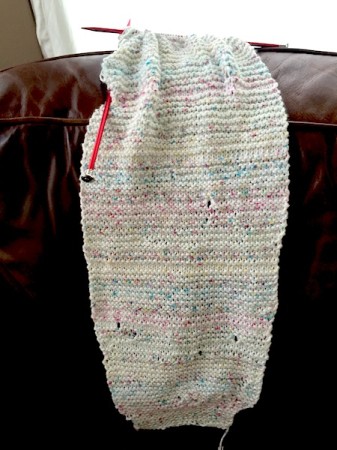
I’ve been wondering if Kanye West is mostly delusional or just sometimes oddly effective. Of course, I’m knitting while I ponder this question which makes me further wonder – is it me or is it Kanye or is it everyone for that matter? Are we all a bit unhinged?

The words in the previous paragraph sound as loosely related as a Kanye West rant. See why I’m concerned? Here’s the deal…

I HAVE been knitting. It’s something I haven’t done in 25 years and really only did once before last week. I made a decently well-constructed pair of wool socks in 1980. Now socks may not be the easiest knitting project for a beginner, but at the time I was determined and willing to put in the concentration to keep uniform tension on the yarn and count rows when required. The ribbing at the ankles turned out perfectly.
sock
Through sheer force of will, I completed the socks, gave them as a gift, and vowed never to knit again. I understood that I had no real talent for it and not near enough patience. I was clear that my greatest contribution to the world would not come from a pair of knitting needles. Yet here I am 30 years later amusing my sister by adding rows to the one my mom had cast on a needle and trying to remember what it means to purl.

I can see what a terrible job I’m doing. The weave is too loose. There are dropped stitches here and there and I have no idea what I’m making. But will I stop, rip out the flawed rows, and start over? Oh hell no! I just keep going as though this is something I feel compelled to do – as if it’s a creation that will somehow add required beauty to the world.
knitting
This is where I begin to see a resemblance to Kanye. Why do I keep putting effort and time into something I know isn’t for me? Why not invest that time in an artistic pursuit at which I know I excel? Am I being effective? Does Kanye make an effective argument when he rants that he wants to make the world better and stop bullying by producing clothes? Maybe he’s already made the world a better place through his music.

So, here’s what I’m really wondering: Why do we sometimes promote our own outdated, unrealistic, or Ill-suited goals to the detriment of real, positive contributions we can make to our families, communities and the world? If this were a rarity it wouldn’t be worth noting. In my realm of personal contact, it is not rare. It is rampant. Of course this may indicate I need a new social circle, but I don’t think my experience is aberrational.

I don’t really plan to answer this question. I don’t have the answer. I believe the answer is rooted in our relationship to ourselves, our truth, and our perception of our place in the world. I think it has something to do with our relationship to shame and vulnerability. I think it has a lot to do with our relationship to fear. And I believe these are the same relationships that left neglected, disrupted, or dysfunctional leave us vulnerable to over indulgence in numbing behaviors – over-drinking, over-eating, over-working, over-scheduling, over-spending, binge watching, and drug dependence.

The question is complex, the answers myriad. But maybe the solution is simple! Practice. Practice. Practice.

Practice stillness. See what comes up.
Practice gratitude. It’s the quickest path to seeing a silver lining.
Practice self-compassion. This is where all real compassion begins.
Practice fearlessness. Sit with your fear as long as you can. Leave it. Come back to it. Eventually, that particular fear will be gone.
Practice truth telling. Allow yourself to see what is. Not what you want it to be.
Practice joy. Experience what makes you feel full, free, warm, and content. Choose those experiences.
Practice problem prevention. Make deliberate choices. Own the choices you make and the reasons you made them.
Practice forgiveness. Forgive yourself for your flaws, poor choices, harmful behaviors.
Practice health. Feed your body nutrients. Move, move, move. Lift. Breathe.
Practice curiosity. This is the path to unlimited possibility.
Practice healing. Learn to release yourself from your emotional habits.

Now, back to my knitting. It’s a great opportunity to practice truth telling, self-compassion, and problem prevention. The truth is, my knitting quality is poor. I don’t need to push myself to do a better job at it or try to convince anyone it’s going to turn out better than they think. I can prevent myself from feeling inadequate by giving up this activity that I recognize is not my forte – an act which is itself a practice in healing because feeling like a disappointment is one of my emotional habits.

Wow, now I feel grateful for this knitting experience! Look what a great opportunity for reflection it provided. And that, Kanye, is how you make peace with what is. You’re welcome.

Forget the Resolutions and Pick a New Year’s Theme

Most of us make New Year’s Resolutions that we won’t keep for more than a few weeks, so maybe it’s time to forget the Resolutions and pick a New Year’s Theme. If we’re to believe media reports, most resolutions involve improved personal appearance or health like losing weight, working out more, eating healthy, or stopping some bad habit. Other common resolutions seek to improve our lifestyle by saving money for the future or ridding ourselves of clutter.

I’m not sure anyone really takes New Year’s Resolutions seriously. Maybe that’s the reason we fail so often. It does seem like a good idea to approach each new year as a new beginning in which we can improve our lives. In fact, I’m a big fan of setting intentions for pretty much anything. Unlike goals, intentions simply require that I be mindful, aware, and follow a process rather than achieve a certain outcome. It’s much harder to fail that way! But when it comes to creating a big picture path for the year, creating a theme can be much more fun! And adding more fun to our lives is always an improvement!

What are some possible themes and how could I implement them?

curiosityCuriosity would be a good theme for the year. It’s a choice that could lead me to watch documentary movies, spend time learning programming on Codecademy, attend lectures, try an escape room game, join a meetup group, try online dating, or read science fiction. It would also be a chance to step back and get curious rather than angry in any confrontational interaction.

peacePeace is a good theme for any year. For me, it usually begins with being mindful of spending my time with people who exude calm and kindness. It also means making a choice to curb my impatience when communicating with tech support and customer service reps.

comfortComfort sounds like a possibility. If I choose it, I’ll be mindful each day when I get dressed to choose fabrics that feel good on my skin, shoes that do not hurt my feet (no matter how cute they are), and waistbands that allow me to breathe. I’ll sleep on sheets that feel good. I’ll eat food that doesn’t hurt my tummy. I’ll choose furniture that fits me well.

yogaStillness is one of my favorites. Being able to sit still did not come easy to me, but has given me some of the biggest improvements in quality of life. Stillness can include a practice of meditation or yoga or can just be simply turning off the TV, computer, or phone, and spending time with yourself.

boundariesAfter some thought, I think my theme for 2016 will be boundaries. It’s an oldie, but a goody. Good boundaries are essential for healthy relationships and give me a guilt-free space in which to say, “no”. Lots of things remind me to be conscious of my boundaries: fences, curbs, ropes, hula hoops, parking spaces, walls, cubicles, carrels, plates, placemats, elevators, swimming pools, basketball courts, tennis courts, porch rails, squares, circles, and doors. Lucky for me, the reminders are everywhere.

Are you ready to forget the resolutions and find a theme that will help you focus on improvement all year long? If so, join me and share your theme!

https://www.codecademy.com/

http://www.meetup.com/