Poor Mental Health or A Normal Response?

The past year has been, and continues to be, emotionally exhausting so how do you know if you’re experiencing poor mental health or a normal response? It’s difficult to watch the news any given day without hearing a story about increasing occurrences of poor mental health. Often, the slant of the story is geared to support a particular policy objective.

I find this rhetoric dangerous and unhelpful. It increases the chance that we will begin to catastrophize normal responses that are, in fact, temporary and healthy. This is especially true if we are already isolated and lacking support. And it’s hard to dismiss worry about our mental health when we’re bombarded by emotionally taxing events one after the other: pandemic, insurrection, natural disasters, infrastructure failures, police shootings, and mass murders.

We know we feel different. Many of us have never been through an extended period of disruption and trauma. If an expert appears in front of us and says these feelings reflect poor mental health, we’re going to believe them. The reality is much more nuanced. and nuance is not the forte of news reporting or social media.

Most of us cling to the idea that if we can just get back to normal, we’ll feel relieved and joyful. But an ongoing experience of trauma is not that easy to shake. Knowing this can help alleviate excessive worry about our state of mental health.

One thing that can provide perspective is to view the effects of trauma as wounds. Think of them like a sprained ankle or a broken bone. If you sprain your ankle, you expect it to swell, bruise, hurt, and prevent you from walking normally for a significant period of time. In order for it to heal, you understand and accept that you’ll have to do things differently for awhile.

This doesn’t usually mean you’ll be crippled for life or never be able to wear those cute heels again. It just means that it is normal and reasonable to change your daily routine to facilitate healing.

If viewing an emotional wound as a physical wound doesn’t work for you, try thinking of a friend who is grieving. Would you be alarmed if they get choked up at unexpected times or don’t have the emotional energy to hang out? No, you’d understand that they feel sadness and loss and need time to work through that before they’re ready for fun and frivolity. And, most likely, you’d understand that their capacity for joy may be temporarily hidden beneath a flood of tears.

The point of all of this is to remind you that certain “negative” emotional states can be a normal and reasonable response to circumstances beyond our control. They are not problematic or signs of poor mental health unless they become chronic, or we use poor techniques for dealing with them.

For example, depression is a normal response to change. Think of Elisabeth Kübler-Ross’s five stages of grief: denial, anger, bargaining, DEPRESSION, acceptance. Depression is an expected, normal phase that represents great progress through the process. But watch the news and you’ll think any amount of depression is a reason for desperation.

The quicker we become aware, acknowledge, and allow ourselves to feel so-called negative emotions, the quicker we can release them and return to a positive state of equilibrium. It is more difficult to do this if we view such states as catastrophic or as signs there is something wrong with us. All of us want to avoid feeling that we’re defective.

We’d often rather hide our distress than acknowledge it. And there may good reason for that. Expressions of vulnerability can make the receiver of the message also feel vulnerable. To avoid that feeling, they may turn away from us when we share our deepest feelings.

If you’ve ever experienced this, you’ll be less likely to attempt to share again. This cycle can result in a significant lack of support for those who are experiencing trauma and attempting to express its effects. And unfortunately, the research of Dr. Brené Brown has indicated that most of us are not comfortable in a vulnerable space.

That means many of us will find that we must be our own best advocates in the arena of mental health. So where do we start? In any moment that I am struggling, I like to first examine what is going well for me before deciding what needs adjustment. This helps give me perspective when determining what I need to do next.

The easiest way to do this is to view myself as a close friend, then ask myself a series of questions: Am I sleeping well and on a regular schedule? Am I keeping my environment clean and uncluttered at the level I would when I feel I am functioning well? Am I eating regularly? Am I making reasonable food choices? Am I making time to move on a regular basis – walk, run, swim, lift weights, row, do yoga, bike, etc? Has my alcohol consumption increased? Do I rely on medication more than I did before? Am I doing too much? Am I able to feel or am I numb? Am I making forward progress at work? Am I able to be alone and feel content? Am I able to connect with at least one person?

If my answers to those questions wouldn’t concern me if they were a friend’s answers, I let go of the idea that I am suffering poor mental health and address anything that may need to change from the point of view of thriving. If I’m not sure, I reach out to someone I trust to help me gain insight.

Mind you, I’m not suggesting that anyone avoid professional help. In fact, I’d encourage you to seek the advice of a professional in lieu of assuming you fit some profile you saw online. My purpose here is simply an attempt to provide a path to find balance to the rhetoric that has become increasingly pervasive and alarmist.

I can’t determine whether you are responding normally, adaptively, problematically, or in the best possible way given a particular set of circumstances. But I know it’s always worth believing in yourself and asking questions before accepting someone else’s take.

If you feel pain over something, that pain is real. If you feel sad about something, that sadness is real. If you feel angry, it is a signal that you feel a need to protect yourself. Accepting that these feelings may be normal and not an indication of anything other than a response to the circumstances in which you find yourself, can be a great start toward thriving.

In this cultural moment when we are all experiencing trauma and there is the cancel culture tendency to only accept a narrow range of beliefs and behavior, it is important to step back, take a moment, and give ourselves permission to feel how we feel even if it’s out of step with the majority. If you are an introvert and enjoy being able to work from home, it’s okay to relish in it just as it’s okay to feel sad about the loss of breakroom chats.

Trust yourself. Trust your process. Just because the world is falling apart doesn’t mean you are. Give yourself some time and space to learn whether you’re experiencing poor mental health or a normal response to a difficult circumstance.

Never Surrender!

Never surrender your best self!!! You may have noticed that in the Preparation for Healing series of posts I have not mentioned the need to surrender, be present in the moment, be vulnerable or forgive.

Many years ago when I began to focus on finding a path to heal, I kept reading that surrender was critical to the process. I simply couldn’t absorb that concept. For me, surrender meant giving up. I had been fighting all of my life to keep the soft, compassionate, loving parts of me from being obliterated by my family environment. To surrender in those surroundings would have cost me myself.
sign
Surrender, being present and vulnerable, and forgiving sound like things an evolved being should embrace. They probably are. They are oft written about and touted by experts. If they don’t sound positive to you, don’t worry. That doesn’t mean there’s anything wrong with you. In fact, it could make perfect sense.

If you live in a family that punishes you for being your best self and you surrender to them, you need assistance with your judgement. If you allow yourself to be vulnerable with anyone and everyone because you crave connections you missed out on, you do yourself a disservice. To strive for forgiveness without first healing is like pouring salt into an open wound. If you have lived for any period of time in a situation that felt dangerous, cruel, or neglectful, the idea that staying present in the moment is positive may, in fact, sound laughable, uninformed, or stupid.

The wounds of previous trauma can make your present feel the same to you as the traumatic times. For those of us who have had such experiences, this is normal. We hold the emotional memories and psychic wounds in our bodies. Our past is never in our past. It is ever present.

This is not our fault. It does not define us. We are not damaged. We are not mentally ill. We have a wound that was inflicted by someone else. If they had broken our leg instead of our spirit, doctors would put a cast on the leg to support it while it heals and law enforcement would charge the person who injured us with assault.

If medical, mental health, and law enforcement entities viewed traumatic wounds in the manner in which they view a broken leg, they would not treat us as disturbed, weak minded, emotionally deficient, or ill. Instead, they would support the parts of us weakened by our wounds until they have healed and hold our attackers accountable. The lack of this type of support is a reflection of a deficiency (blind spot) in our culture, not in us.

Being present, surrender and forgiveness may not be possible at the beginning of the healing process. Until I have learned to release the muscles in my upper back that stay braced for attack, I cannot be fully present in the moment. Until I let go of the anger that covers my constant fear and find friends who treat me with love and kindness, surrender will only harm me. As long as I feel constantly vulnerable, I cannot determine who or how to ask for help, know whose compliments to absorb, or have any idea how to accept love. Constant vulnerability numbs judgement. All of these things are a barrier to forgiveness.

None of us begin in the same place. Some of us are surrounded by those who mean us harm, do not value us, or are oblivious to our pain. These may include our parents, siblings, teachers, physicians, counselors, and ministers. We often create beautiful, intricate, situationally perfect structures to protect ourselves. It is only when we are free from danger that we can learn to see that those beautiful solutions can also hold us back.

If you can’t surrender yet, don’t worry. You may need to grieve that you have not felt safe enough with anyone to do so. If you cannot stay present in the moment, that’s okay. Try a mindful practice like yoga that encourages breathing in sync with movement. If you feel constantly vulnerable, building better boundaries may help. You can eventually work your way toward forgiveness.

The most brilliant definition of forgiveness I’ve ever heard was uttered by a TV character:
“People generally think of forgiveness as the flip side of contrition, the obligatory response to an apology. It is not. To forgive is to answer the call of our better angels and bear our wounds as the cost of doing business. It is that rarest of things, simple and pure…transcendent… without strings.”
— Mary Shannon (Mary McCormack), In Plain Sight, Season 1: Iris Doesn’t Live Here Anymore

Maybe someday I’ll get there.

In the meantime, I keep following the sensations in my body with curiosity. I allow my feelings to bubble up even when they don’t make sense. I let go of my defenses layer by layer. I carefully choose who gets the honor of experiencing my vulnerability. I relish my ability to stay in the moment more often without an emotional flashback. I surrender to the process over and over again, but I never surrender my best self to anyone who does not have my best interest at heart.

https://besselvanderkolk.net/the-body-keeps-the-score.html

https://en.wikipedia.org/wiki/In_Plain_Sight

Is It Me or Is It Kanye? Practice. Practice. Practice.

I’ve been wondering if Kanye West is mostly delusional or just sometimes oddly effective. Of course, I’m knitting while I ponder this question which makes me further wonder – is it me or is it Kanye or is it everyone for that matter? Are we all a bit unhinged?

The words in the previous paragraph sound as loosely related as a Kanye West rant. See why I’m concerned? Here’s the deal…

I HAVE been knitting. It’s something I haven’t done in 25 years and really only did once before last week. I made a decently well-constructed pair of wool socks in 1980. Now socks may not be the easiest knitting project for a beginner, but at the time I was determined and willing to put in the concentration to keep uniform tension on the yarn and count rows when required. The ribbing at the ankles turned out perfectly.
sock
Through sheer force of will, I completed the socks, gave them as a gift, and vowed never to knit again. I understood that I had no real talent for it and not near enough patience. I was clear that my greatest contribution to the world would not come from a pair of knitting needles. Yet here I am 30 years later amusing my sister by adding rows to the one my mom had cast on a needle and trying to remember what it means to purl.

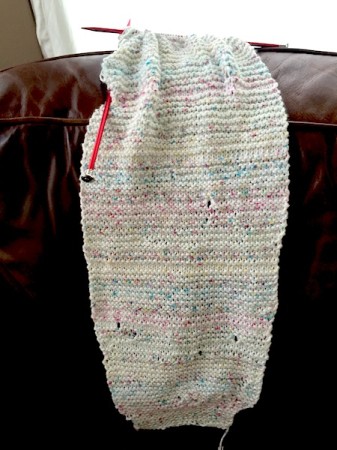
I can see what a terrible job I’m doing. The weave is too loose. There are dropped stitches here and there and I have no idea what I’m making. But will I stop, rip out the flawed rows, and start over? Oh hell no! I just keep going as though this is something I feel compelled to do – as if it’s a creation that will somehow add required beauty to the world.
knitting
This is where I begin to see a resemblance to Kanye. Why do I keep putting effort and time into something I know isn’t for me? Why not invest that time in an artistic pursuit at which I know I excel? Am I being effective? Does Kanye make an effective argument when he rants that he wants to make the world better and stop bullying by producing clothes? Maybe he’s already made the world a better place through his music.

So, here’s what I’m really wondering: Why do we sometimes promote our own outdated, unrealistic, or Ill-suited goals to the detriment of real, positive contributions we can make to our families, communities and the world? If this were a rarity it wouldn’t be worth noting. In my realm of personal contact, it is not rare. It is rampant. Of course this may indicate I need a new social circle, but I don’t think my experience is aberrational.

I don’t really plan to answer this question. I don’t have the answer. I believe the answer is rooted in our relationship to ourselves, our truth, and our perception of our place in the world. I think it has something to do with our relationship to shame and vulnerability. I think it has a lot to do with our relationship to fear. And I believe these are the same relationships that left neglected, disrupted, or dysfunctional leave us vulnerable to over indulgence in numbing behaviors – over-drinking, over-eating, over-working, over-scheduling, over-spending, binge watching, and drug dependence.

The question is complex, the answers myriad. But maybe the solution is simple! Practice. Practice. Practice.

Practice stillness. See what comes up.
Practice gratitude. It’s the quickest path to seeing a silver lining.
Practice self-compassion. This is where all real compassion begins.
Practice fearlessness. Sit with your fear as long as you can. Leave it. Come back to it. Eventually, that particular fear will be gone.
Practice truth telling. Allow yourself to see what is. Not what you want it to be.
Practice joy. Experience what makes you feel full, free, warm, and content. Choose those experiences.
Practice problem prevention. Make deliberate choices. Own the choices you make and the reasons you made them.
Practice forgiveness. Forgive yourself for your flaws, poor choices, harmful behaviors.
Practice health. Feed your body nutrients. Move, move, move. Lift. Breathe.
Practice curiosity. This is the path to unlimited possibility.
Practice healing. Learn to release yourself from your emotional habits.

Now, back to my knitting. It’s a great opportunity to practice truth telling, self-compassion, and problem prevention. The truth is, my knitting quality is poor. I don’t need to push myself to do a better job at it or try to convince anyone it’s going to turn out better than they think. I can prevent myself from feeling inadequate by giving up this activity that I recognize is not my forte – an act which is itself a practice in healing because feeling like a disappointment is one of my emotional habits.

Wow, now I feel grateful for this knitting experience! Look what a great opportunity for reflection it provided. And that, Kanye, is how you make peace with what is. You’re welcome.

Strategic Patience

formulaThis morning I ran across the term strategic patience. It wasn’t used in the context of foreign policy with Russia. This strategic patience was used to describe a technique employed by teachers in which students are asked to remove themselves from electronics and quietly observe a math formula, graph, or painting. Sometimes the duration of the assignment was only 1.5 minutes, but that time had a positive learning result.

Quiet observation, stillness, contemplation, and mindfulness are words I hear fairly often. I know a few people who practice yoga and many who claim to pray, but most everyone I know is also running as fast as they can most of the time. It is rare that anyone sits still or savors a moment alone.

I know that’s probably true of the people around you as well. In fact, University of Virginia psychologist Timothy Wilson and his colleagues at U.Va. and Harvard found in a series of 11 studies that participants generally did not enjoy even six to 15 minutes alone in a room with nothing to do but think, ponder, or daydream.

We become so accustomed to filling every moment, we schedule more and more and more and then start to rush to get it all done. And we convince ourselves that everything we’re doing is important whether or not we appreciate the value it adds to our lives. We have an idea that through this overabundance we are living more fully,varms but are we, or would strategic patience serve us better?

That’s a big question to answer in a blog post. It’s the kind of big question people write whole books about. I’m in too much of a hurry to write a book. I just need to get this post finished so I can move on to the rest of my over-scheduled day. As a result, I’ll limit the rest of this space to sharing what I’ve learned the past few years…by being still.

Being still matters. It’s important. No, it’s CRITICAL.

I don’t know why exactly except that without stillness there is no motion. Contrasts in life are the way we make sense of things. We can’t know sweet unless we know sour. We can’t know fast unless we know slow. We can’t know happiness unless we know sadness. We can’t know success unless we know failure.

Until we are able to sit still with ourselves, we cannot know ourselves fully and not knowing ourselves frightens us. It leaves us susceptible to criticism because we’re not really sure if the criticism is deserved. It leaves us unable to apologize sincerely because we’re not really sure how we feel. It causes us to bristle quickly because each time someone doesn’t follow their prescribed role in our necessarily narrow script, we feel threatened. It causes us to posture rather than stand confidently tall. It keeps us divorced from our vulnerability without which we cannot receive love. And we all want to be loved.

Now, how does any of this relate to cooking? It doesn’t, but strategic patience is ingredient number one for thriving.


https://www.washingtonpost.com/lifestyle/magazine/to-get-students-to-focus-some-professors-are-asking-them-to-close-their-eyes/2016/04/06/b2b019e8-e6ef-11e5-bc08-3e03a5b41910_story.html

https://news.virginia.edu/content/doing-something-better-doing-nothing-most-people-study-shows