What Goes Well With Green

On St. Patrick’s Day, we all wonder what goes well with green! The question is relevant whether you’re cooking or choosing clothes. This St. Pat’s Day, I’m skipping the colcannon and opting for salt potatoes.

Bag of small red potatoes spilling out on table.

This allows me to skip the kale which I do not love. Technically, I could make colcannon with an alternate green and avoid kale, but the swiftness and ease of salt potatoes appeals to my Monday sluggishness.

The first time I learned of salt potatoes, my son told me to put so much salt in the brine I thought the potatoes would be inedible. I was wrong. They were delicious.

Like many dishes, salt potatoes are a result of availability and convenience. In the 1800s, Irish immigrants who worked in the salt mines around Syracuse, New York would bring new potatoes to work and cook them in brine left from solution mining. The high salt content of the water and the small size of the potatoes meant the cooking process was quick and it yielded a filling lunch.

To make salt potatoes, all you need is salt, water, and small potatoes. Yukon Gold potatoes work well, but any new potato can be used. For visual appeal, I like a mix of jacket colors. Once the potatoes are done and in the serving dish, I let a few pats of butter melt across the top. Some people serve with melted butter for dipping.

I’ve never used a recipe for salt potatoes and I haven’t found any two that are exactly the same. Roughly, use a ratio of 2 cups of salt to 8 cups of water. You read that right, CUPS. (See why I thought it would be too salty?) Some recipes prefer 1.5 cups salt to 8 cups water, but others add another .25 – .5 cups of salt to this amount of water. In other words, there’s some flexibility.

Any kind of salt is fine, but some cooks prefer large, coarse grains that result in a more even coating on the potatoes. When the potatoes are done and removed from the brine, the skin will have a cloudy white surface that becomes more pronounced as it dries.

The process is to wash the potatoes. Add 8 cups of water to a large pot. Stir salt into water until dissolved. You can turn the burner on while you’re dissolving the salt. Once salt is all melted and water is boiling, add about 4 pounds of potatoes and boil until done – about 15 – 20 minutes depending on the size of the potatoes. Remove potatoes from brine.

At this point, you can serve with melted butter for dipping or let some butter melt over the warm potatoes. Dipping butter can be plain or enhanced with fresh herbs and/or garlic.

These potatoes are delicious alongside cabbage or any other green. They’re a great starch to serve with beef, chicken, or pork. Leftovers can be reheated or made into potato salad or hash browns.

When you’re looking for something that goes well with green, don’t be afraid to choose frugal, simple, flexible, and delicious salt potatoes!

The Best Supplement May Be A Grain of Salt

When it comes to your health, the best supplement may be a grain of salt. I’m currently participating in a pilot program at the local medical school in which patients meet with researchers to learn about the research process and how we can participate beyond being research subjects. The program is fascinating. It gives us a glimpse into current trends in medical thought, and it makes us highly aware of the limits that plague medical research, the most frequent being time and money.
salt
Limited time and/or money usually lead(s) to smaller studies. Smaller studies are less representative of the population as a whole and thereby less definitive. Studies get published in medical journals, and along the way some ideas take hold in the medical community. Sometimes these ideas are incorporated into standard medical care even when there’s little evidence to support their clinical relevance.

A recent example of this is the practice of testing vitamin D levels when patients report malaise, fatigue or other nonspecific complaints. According to the CDC, the number of blood tests for vitamin D among Medicare recipients increased 83-fold from 2000-2010 and 2.5-fold from 2009-2014 for those with commercial insurance. At the same time, labs performing these tests started reporting normal levels of 20 to 30 nanograms vitamin D per milliliter of blood as insufficient.(1) As a result, many healthy people began to believe they had a deficiency.
fish oil
When numerous studies over the past decade linked low levels of vitamin D to cancer, heart disease, and diabetes, the millions who believed themselves to be deficient began, or were advised, to consume vitamin D supplements. I am one of those who received such advice after routine blood work. The problem is that the existing studies do not provide widely accepted evidence that vitamin D is helpful in preventing or treating these diseases. In fact, current evidence suggests that the main beneficial effects of vitamin D supplements relate to conditions of the muscles, bones, and joints.

And the vitamin D deficiency movement isn’t the first physician advanced idea based on insufficient evidence. Last year, newly issued dietary guidelines removed the restriction on cholesterol consumption because “it is now acknowledged that the original studies purporting to show a linear relation between cholesterol intake and coronary heart disease (CHD) may have contained fundamental study design flaws, including conflated cholesterol and saturated fat consumption rates and inaccurately assessed actual dietary intake of fats by study subjects.”(2)

And the possibly well-intentioned, oft repeated advice to add multivitamins to your regimen because they will make you healthier turns out to be false as well. A growing body of evidence suggests that multivitamins offer little to no health benefits. A study published in the December 17, 2013 issue of the journal Annals of Internal Medicine found that multivitamin and mineral supplements did not work any better than placebo pills.
test tube
We tend to regard science as infallible or research as indisputable. It’s not. We only know as much as we know in this moment. Our knowledge base will always be growing. Today’s theories will sometimes be proven wrong. Some studies will be statistically significant, but clinically irrelevant. Many studies will have too narrow a focus, too small a sample, or too short a term for the results to be taken as definitive on their own.

As patients, we are vulnerable to misinformation bombarding us from corporations that create supplements, food, and medications. Unfortunately, we are also vulnerable to imperfect science and bias within the medical community. To some degree this is unavoidable. This is where a grain of salt can come in handy. Skepticism can lead you to seek additional information.

If you are not medically trained, you cannot assume you know more than your doctor. You can, however, recognize that you have the final word regarding your healthcare. You have every right to ask questions with the expectation of a well-supported, forthright answer. You have the right to your health records. You have the right to seek a second opinion or a third. A second doctor may interpret your test results in a different manner than the first.

And barring an emergency situation, I’ll posit that you have a responsibility to yourself to remain skeptical regarding treatment recommendations until you become well-informed. That being said, the best supplement available for healthcare may be a grain of salt.

Disclosure of Material Connection: I have not received any compensation for writing this post. I have no material connection to the brands, products, or services that I have mentioned. I am disclosing this in accordance with the Federal Trade Commission’s 16 CFR, Part 255: “Guides Concerning the Use of Endorsements and Testimonials in Advertising.”

1)https://www.nytimes.com/2017/04/10/health/vitamin-d-deficiency-supplements.html?_r=0
2)https://www.ncbi.nlm.nih.gov/pubmed/19751443
https://people.hss.caltech.edu/~camerer/Ec101/JudgementUncertainty.pdf
http://www.medlabme.com/magazine-issues/2016/diagnostics/vitamin-d-assays/
https://www.hsph.harvard.edu/nutritionsource/2016/01/07/new-dietary-guidelines-remove-restriction-on-total-fat-and-set-limit-for-added-sugars-but-censor-conclusions/
http://annals.org/aim/article/1767855/vitamin-mineral-supplements-primary-prevention-cardiovascular-disease-cancer-updated-systematic

Herbed Salt is My New Solution!

Herbed salt is my new solution to several of the recurring dilemmas of fall. I love it when the air turns crisp, the sky seems especially blue, and streets are lined in yellow, orange, and red. It means it’s time to think about bringing in the plants, my plans for the holidays, and whether to rake the leaves or compost them.
fall leaves

I decided a few years ago that I wasn’t good at finding a place to put all the pots of herbs inside the house without things feeling haphazard, crowded, or me feeling just plain annoyed. Of course I don’t want to waste any tasty leaves, but it just doesn’t work very well for me to try to preserve the plants over the winter. I feel better all the way around starting over each spring so I allow myself the luxury of buying new plants when the weather turns warm.

Before I let the stems wither, I must face the dilemma of what I will do with those last lovely green leaves as we approach the first freeze of the year. Luckily, I had lunch with my friend Angele this week who mentioned that she used the last of her basil to make basil salt. Thanks Angele! I think you just solved a couple of problems.

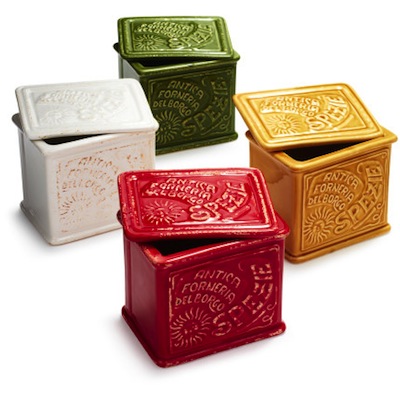
Not only can I make basil salt, I can make rosemary salt, sage salt, thyme salt, parsley salt, mixed herb salt, lemon thyme salt, oh yeah. This sounds fun. All I need is some cute containers and these will make great holiday gifts or stocking stuffers, hostess gifts, and holiday party gifts.
cute containers

Perhaps you’re needing a similar solution. If so, here’s how easy this is:

Herbed Salt
1/3 cup tightly pack herb leaves
1 tbsp of a 2nd herb
1/3 cup kosher salt

Place herbs and salt in food processor and pulse for a few seconds. Spread the mixture in a baking pan lined with waxed paper. Dry at room temperature for 24 hours or bake at 225º for 15 minutes, stir and bake an additional 15 minutes. Cool and pulse again. Store for up to 4 months.

What a great way to use the last of this year’s herbs and get a head start on the holidays. I love it when a plan comes together.

Have a fall solution you want to share? Tell us in the comments below.