Only one thing changed. Why do I feel like EVERYTHING changed?

It’s Saturday afternoon and this weekend I have no water at my house.  My pipes developed a leak that was running even with the faucets off.  Already, I know I’ll have to replace the entire ceiling of my downstairs bathroom and part of the office ceiling. There may be more. Rather than pay a plumber’s emergency rate, I decided to dry out the environment with a dehumidifier over the weekend and have the plumber come next week. The earliest appointment I could get is late Tuesday afternoon.

 On Thursday, I had all sorts of goals for this weekend punctuated by a wedding shower I’m attending on Sunday afternoon. My running list included proofreading some recipes, working on the website, designing some new packaging for an upcoming product, and testing some recipes. I was focused on what I felt I needed to accomplish. 

 I also felt an edge of foreboding and dread knowing that I wasn’t exactly feeling up to tackling such an extensive list right then so I’d have to drag myself kicking and screaming (internally so as not to scare the neighbors) toward those goals. Bummer, but I’m in this spot more than I’d like to admit and I know I can push myself and accomplish any goal I set.  So, I jerked my bootstraps a bit tighter and set forth.

 But there was a problem. Really, problemS. Trickle, gush, slosh – everything changed! My list no longer mattered because there were immediate practical needs that superceded my well-laid plans. 
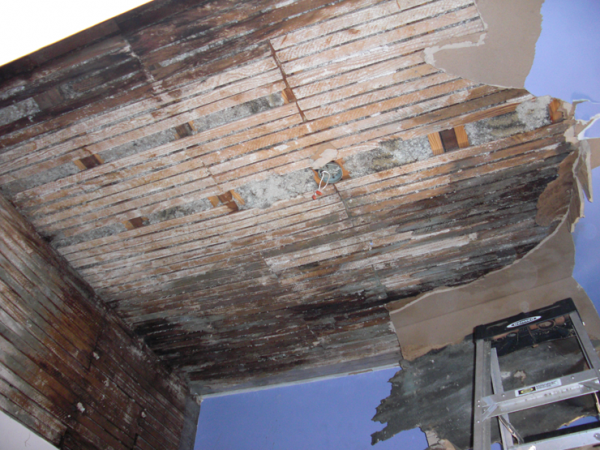
Ceiling
Before the leak, this was a periwinkle blue ceiling.

 My first thoughts in the moment were to mobilize and start a new plan.  My mind began to churn: I’ve had some recent unexpected expenses. How can I avoid going to a hotel?  I can shower at the office, except I have no clean towels. I have a key to my neighbor’s house while she’s gone, so I can borrow some water for tooth brushing and toilet flushing.  Of course, as soon as I have that thought, I get a text telling me to give the key to the dog sitter. 

 Finally, I stop pushing forward. I shift my focus. Breathe. Take a moment. Think about what’s really important.  Oddly, I notice that the moment I shift, I feel more grateful than annoyed.  Thank goodness I know how bad the leak is before I head off to work out of town for the day.  I even begin to smile as I recognize how quickly the importance of my weekend goals pale in comparison to figuring out how to manage the basic tasks of life (Where will I shower?  How can I brush my teeth?  How much water will I have to pour down the toilet for it to flush?  Do I have a clean dress for the wedding shower?). I notice I feel relieved by the chance to ditch my original list and start over.  

 Thank goodness for the occasional curve ball life throws us! When a sudden change gets our attention, and we stop planning the next moment and lean into this one, we may realize that our brains are headed down a totally different path than our hearts. 

 Okay, trickle, gush, slosh, I’m paying attention.  How can I best take care of myself through a weekend without water and still not break the bank?  What are my intentions and priorities? How will I feel if I don’t accomplish a single item on my original list?  Will I be able to sit still knowing a renovation is imminent? Can I avoid revving back up and pushing myself?

 Through the generosity of friends, I have the key to an apartment across town where I can shower and do laundry.  I hauled some water for today, so I’ve been able to make coffee, wash my hands, brush my teeth, and water the plants.  I’ve even gotten the toilet flushing figured out, although it took more water pouring than I remembered to make it work.

 The funny thing is, I keep feeling like everything is broken and I can’t do anything – watch TV, use the microwave, cook on the stove, dry clothes in the dryer, sweep the floor, wash the dishes.  That’s silly.  The gas and electricity work.  There’s no reason at all to stay at Heather’s to dry the clothes.  I can bring them home wet and use my dryer.  I can heat leftovers in the microwave, and if I heat some water on the stove, I can wash the dishes by hand.  Admittedly, it makes more sense to use paper plates, but I’m fascinated by the fact that I feel limited in other areas when only one thing has changed. 

 Yes, it’s one thing that affects many everyday tasks, but it’s only one thing. I feel like it’s EVERYTHING. I can’t seem to find a comfortable rhythm for the day. What felt like plenty of water yesterday seems like way too little today, although in reality I still have an adequate supply. Somewhere down there, I think I feel scared.  Of what? I don’t know. Just uneasy like if one thing shifted something else could too.

 I tell you this because I recognize that this may be how some of you feel when you find out you will be healthier without gluten.  One thing has changed, but it feels like EVERYTHING.  And that feels scary.

 As I explore how to best take care of myself on this off-kilter, scary day, perhaps you’ll find some inspiration for moving through your fear.  

 First, I’ll take inventory. Am I missing anything I need to eat, sleep, bathe, dress, work, or socialize comfortably? At this moment, I have enough water to drink and make coffee tomorrow plus some for tooth brushing, etc.  If I should need more, I have retrieved the keys to my neighbor’s house or I can go to the office.  There’s no real chance of running out.  I have precooked food on hand. I have paper plates. I have washed the dress I want to wear to the wedding shower.  I have purchased the cards and the gifts for the shower.  I have books, TV, and internet for entertainment, or I can go for a walk.  If I want to shower later, it’s a short drive to the apartment.  I have everything I need.

 Next, I will take the time to notice that I feel grateful for how little effort it has taken to procure what I need.  I will sit with that gratitude for a moment.  I may even get out a piece of paper and make a very specific and detailed list of things for which I feel grateful.

 If I feel too restless to be still, or like I’m speeding up into a frenzy, I will plant my feet firmly on the ground and look around.  I may grab a pillow and hold it while I do this. I will look at the colors or objects around me focusing on the tiniest details. Once I can be still, I will explore where in my body I feel the fear that is causing me to feel restless. When I feel the fear localize, I will allow myself to feel it for as long as I can at this moment.  I know that I can trust my body to support me and I know that the longer I can sit with this fear, the less likely it is to be triggered by a similar event in the future. I will exercise the courage to face my fear, but I will choose patience and kindness toward myself.  I will stop when I have reached my limit.  Then, if I need personal contact, I will call a friend.  If I need distraction, I will watch a comedy.  I will acknowledge how proud I am of myself for leaning into fear rather than running from it. If this process lasts for hours or for days, I will be patient with myself and know that eventually it will end. There is no reason to panic.

 If I pay attention, I will be presented with an opportunity to shift my point of view and move toward feeling good.  At that moment, if I choose to let go of fear, anticipation and excitement will replace it and I will be prepared to embrace joy.  Momentary happiness requires no preparation, but joy requires us to embrace our fear and let it go. I know this because sometimes I manage to do just that. I intend to practice this more often. This weekend is the perfect opportunity for me.

I am grateful for my increasing courage.  Are you prepared to join me?

Cheri

How can change begin when you’re struggling?

First I started feeling frightened – a sort of antsy, anxious feeling at the edge of my awareness.  I noticed that I felt hungry, but I wanted to be very disciplined about my meal times so I decided to wait awhile before eating.  I passed the time by reading an article on anorexia (interesting choice don’t you think?) and looking at some photos of me that I had just uploaded to my laptop.  

 Soon after daylight savings times begins each year I have one of these days.  I feel like my natural body rhythm is out of sync.  Oh who am I kidding, I have days where I feel out of sync at least once a week, but I like to blame daylight savings time.  Anyway, it was Saturday and I hadn’t made a plan for the day.

 I found myself feeling hungry and dissatisfied with how I looked in the photos punctuated by a vague awareness that I may share some emotional characteristics with anorexics, plus I felt anxious and unproductive without a goal for the day.

 How often do I feel this way?  Not often.  But to ask how often and stop with that is to miss the point. The reason I don’t often feel anxiously unproductive is that I manage that anxiety by preventing it.

 A preventative approach?  “That’s good, you say.  How do you do it?”  Now before you get ready to start making a list of what I do so you can do it, please read further.  

 I’m a pretty smart cookie and I can make even the most convoluted adaptation sound good – especially to me. Remember we’re talking about fear of change.  So here’s my pattern:  I fill each day with a To Do List no one could possibly complete.  Once I’ve gotten through 75-80% of the list, I allow myself to feel okay about stopping from exhaustion.  I also congratulate myself for being productive thereby making me more likely to repeat this pattern again and again.  Don’t get me wrong, I get lots of outside affirmation for this pattern of behavior as well because I can handle massive amounts of work without blinking an eye.  No one has ever called me lazy.

 The pertinent question isn’t whether I’m productive or whether I’m well-adjusted to societal expectation.  The real question is:  Is this structure that I’ve created to keep me from feeling anxious also preventing me from being true to myself, experiencing joy, and connecting with people in a fulfilling way?  In other words, is my self-protective system for anxiety prevention actually keeping me anxious and stuck along with preventing me from making change?  

 I know some of you will object to the idea that we willfully create structures of protection that we then become afraid to challenge.  Your response may be to say that you know you use anger to protect yourself, but that’s what you learned growing up in an explosive family and while you may lead with anger, you’re never abusive like they were so what’s the big deal?  Your response may be to feel way down deep that you ARE your persona of protection and it is YOU. To allow one thought of you without that persona attached may be to imagine that you will disappear, die, cease to exist, never have love, or be shunned.  If this is the case, it will feel extremely important for you to prevent that thought from reaching your consciousness and you’ll be willing to use any means necessary to prevent such an occurrence.  If that nagging thought should rear it’s ugly head in the back of your mind, you’ll reach for a distraction so fast you may not even realize what you’ve done.

 It is often at this point that our relationship with food enters the picture.  Some of us use food as a distraction from anxiety or discomfort.  We immediately reach for a sweet treat to fool our brain with a sugar-induced euphoria.  Some of us are aware that we need a distraction so we’ll go for a walk or go to the gym.  Then we believe we deserve a reward or can afford a few extra calories, so we’ll eat an extra yeast roll with dinner.  Some of us will add guilt to the formula.  We feel guilty for eating the treat or rewarding ourselves. Then guilt feeds anxiety which sends us back into our protective structure where the surroundings feel familiar.  

 With all these complicated entanglements, our brains may immediately react to a suggested change in diet as if we are being threatened with death.  According to Cynthia Kupper, Executive Director of the Gluten Intolerance Group, surveys of Celiac patients have shown that a high percentage of those diagnosed believe their Celiac diagnosis to be worse than a cancer diagnosis.  In reality those patients are not facing surgery, chemotherapy, radiation, a need for dangerous medication, or immediate danger of losing their lives.  It just feels that way.

 Now let’s go back to that recent Saturday I was facing without a plan.  Was it tempting to fall back into my normal pattern?  Of course it was.  But it seemed like the perfect day to explore a different possibility.  I decided to change the question I constantly ask myself from what do I NEED to do today to what do I WANT to do today?

 What did I want?  I wanted to lessen my anxiety.  I decided to begin by feeding myself since for me hunger works as an emotional trigger. I also know that when I am in the kitchen preparing food my brain settles down and that vague sense of hunger subsides so I decide that cooking is a good way to move into the day in a different way. I was wanting a really tasty cheese cracker to eat with the soup I had in the fridge, so I grabbed some cheddar cheese, some parmesan cheese, the almond flour and some butter.  As I began to cook I felt myself relax.  Forty-five minutes later, I  plopped on the couch in front of some reality TV with a bowl of crackers beside me.  Yum, the result of asking what I want was deliciously cheesy and crunchy.*

 How did I feel?  I had a much better outlook on the day.  I felt less scared, more full, and like being more kind to myself for the rest of the day.  I could have moped through the day annoyed and dragging my feet, as I have been known to do when I’m not willing to push myself down the To Do List,  followed by feeling guilty on Sunday thus allowing myself to get right back to needing to prevent anxiety by overproducing. Instead, I began what turned out to be a relaxing, renewing weekend by asking myself a different question and being willing to follow where the answer led.

 Big changes really are that simple. They can begin by simply stopping yourself from what you “normally” do.  Knowing this may help you if you are struggling to remain gluten-free.  Our brains trick us into thinking change is hard because we get stuck in the patterns we formed early on to protect us… and we’re scared… and scared feels dangerous.  Always remember – big change is just lots of small changes added together and it’s okay to feel scared.  Once you are willing to feel your fear long enough to do one thing differently, you will have discovered the secret to embracing change.  Rest assured you will not lose yourself in the process, it just may feel that way for a brief moment as you begin to let go of old patterns of behavior.

 The other thing you should know is that I was able to shift fairly quickly on that recent Saturday because I have spent several years preparing myself and learning how to be comfortable with, and let go of, those stories I tell myself that hold me back.  And you will soon be able benefit from my experience so that you can have success with change in a much shorter period of time than I did!  I have taken those years of experience and developed a set of emotional and social support tools to guide you along the way.  They’re called the Cooking2Thrive® Essential Utensil Support Tools and they’ll soon be released for publication. Wouldn’t it be easier to take that first step toward change if you knew that there was a guide to prepare you for the next step and the next?  That’s just what you get with the Essential Utensil Support Tools.  Be the first to learn the secret to becoming your best, healthiest self without a struggle.  Keep checking back here.  We’ll let you know the minute they’re released and how you can get them!  


Cheese Crackers
Empire Waist Cheese Crackers


*My cheese crackers are now called Empire Waist Cheese Crackers and they’re fantastic!