Let The Sun Shine In

Today, I feel like I’m going back to kindergarten to sing, so let the sun shine in…face it with a grin…smilers never lose and frowners never win! Why? Like this song, I want to talk about focus.

hand writing with pen in journals on table

I recently had the experience of sharing my guest room with someone who noticed every single bad thing that happened to them. Even the slightest inconvenience was viewed as a personal attack. In their world, everything was personal, and all negative events were deliberate attacks. They put a lot of energy into selling this version of events as the only possible way to view things.

The free drink someone sent over to their table? Didn’t register. The line of thinking being they deserved that free drink because it didn’t even begin to make up for the guy at the car dealership who talked to them like they knew nothing about cars earlier in the day. And on top of that, the woman at the bank misled them and on and on and on and on. All day. Every day.

Needless to say, they were miserable. It was an awful way to live. And there were some real difficulties. But there were good things happening every day as well. Just like the free drink, the positive was minimized or ignored totally.

When we suffer a traumatic event or a long-standing hardship, habit can creep in. We can begin to focus on the negative things that are happening. That focus turns our heads away from kindness, connection, and support that promote healing and positivity. We can get in such a groove that we keep good things at bay.

We often hear about practicing gratitude. It’s a great thing to do! But we may also need to practice receiving kindness, love, praise, and connection.

During hard times, we may learn to stay braced for yet another blow. This can mean we don’t fully embrace a kind gesture or supportive words. We may express quick appreciation while breezing through the good feelings we can absorb by lingering in the moment. Think of how many times you’ve brushed away a compliment to shift the focus elsewhere.

It’s not selfish to fully embrace kindness, support, and help. And it doesn’t just help us. It helps the giver too.

If you’ve never tried letting the sun shine in, create a receiving journal. For 30 days, keenly observe and record kindness, positivity, laughter, and serendipity. Don’t try to turn bad into good. Just be willing to see the good. Then sit with it. Linger in feelings of satisfaction, contentedness, lightness, happiness, and warmth. Stick with each feeling as long as you can.

Once a week, go back and review all the positivity you’ve experienced that week. Try to put yourself back in the emotional space you were in as you remember each experience. At the end of 30 days, see if you feel better.

I’m not suggesting this will be a quick cure-all for anything, but letting the sun shine in is good advice. And the more you practice receiving, the more you will receive because you’ve become more adept at letting in the good.

Where our focus goes, so do our lives. While it may sound hokey to say let the sun shine in, face it with a grin, in practice, it’s effective. Let’s do it with the gusto of a four-year-old singing!

https://www.youtube.com/watch?v=bhyX4TOOgKY

ad

Deliver Comfort

Food delivery services make it easier than ever to deliver comfort. In tough times of illness or loss, joyous times of birth, and busy times of family visits, it can be a great relief to have a meal that just shows up ready to eat and tailored to your specific diet.

With members scattered, it’s easy to forget that we can provide that sort of comfort to physically distant family and friends. You may think of services like GRUBHUB, DoorDash, and Uber Eats as useful for having a restaurant meal delivered to your doorstep, but they can also be used to send comfort across the city or country.

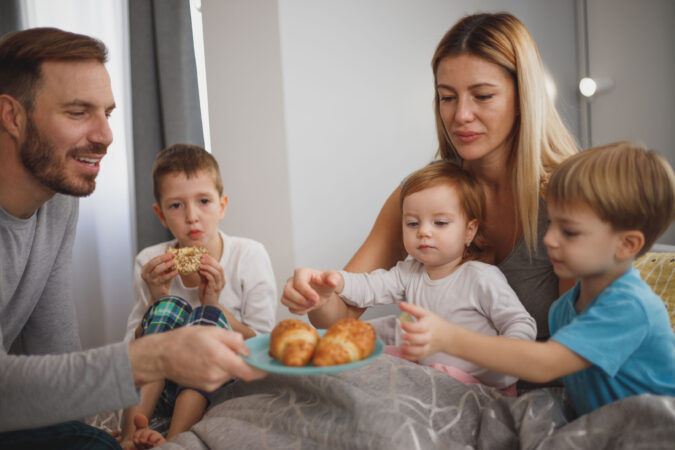
Family eating croissants on bed.

When I send food to someone who needs a break, there are a few things I keep in mind. First, I don’t want them to have to put in a lot of effort. With that in mind, I ask as few questions as possible.

The way that might work is I call or send a text that says, I want to send you a meal. I’m thinking I’ll DoorDash you a seasonal chopped salad and curry chicken salad summer roll from Goop Kitchen or something else if you prefer. You choose the time.

This usually results in the recipient letting me know what they’d rather have. But since I started the thought process, they only have to edit my ideas rather than come up with something. I usually have a second restaurant and main dish chosen in case the situation calls for it.

The initial conversation is a great time to move to my 2nd concern – making certain I have any allergies or other restrictions (including likes and dislikes) properly noted. Once that’s done, I move on to a third consideration – maximizing the dollars spent.

If you’re paying a delivery fee, it makes sense to buy more, not less. I buy enough for at least two meals and sometimes three. Using the list of restrictions as a guide, I add items to whatever the recipient has chosen.

If they choose a salad and soup, I’ll add a sandwich or quinoa bowl. If they want a BBQ brisket plate, but mentioned they can’t decide between that and a stuffed potato, I’ll order both.

I also review the kids’ menu. The options are often only slightly smaller than an adult version, but the price can be significantly cheaper.

When buying for a whole family, I look at restaurants that offer a family style or catering menu. I also consider boxes of croissants, muffins, sausage rolls, petit fours, or loaves of banana or pumpkin bread – snacks that can easily fill in gaps between meals or be served to visitors who stop by.

Most delivery services have expanded to deliver from pharmacies and convenience stores. In lieu of food, I may send a few household staples – tissues, toilet paper, paper towels, soap, glasses cleaning wipes, disinfecting wipes, disposable razors, travel size shampoo, toothpaste, lotion, or makeup remover wipes. Buying travel size means it’s okay if the brand is not their favorite. It’s something to tide them over if they run out when things seem overwhelming.

Pharmacies also have chips, sodas, flavored water, ice cream, sewing essentials, batteries, magazines, baby wipes, diapers, trash bags, coffee, tea, peanut butter, laundry items, pain reliever, band-aids, and games. If there are children in the house, modeling clay, puzzles, art supplies, and bubbles are great choices.

When a friend with two young children came to town for his dad’s funeral, I put together a basket of art supplies and left it on my porch along with a pack-n-play for them to use. I had all the items on hand. It was a small gesture, but greatly appreciated. And that’s the point.

With the availability of delivery in a majority of towns and cities, it’s never been easier to offer comfort even when you live far away. You may not hit perfectly with every item, but the gesture will let your friend or family know you care and that you’re more invested than just sending a gift card (an option appropriate for many situations).

You can deliver comfort from the tip of your fingers, watch the driver on a map as they approach the recipient’s home, and know that you’ve done something to ease a burden or celebrate a joy. That’s a great feeling and pretty magical when you think about it.

The Toll it Takes

It’s okay to acknowledge the toll it takes to be healthy. Huh? Sounds wrong, I know. If it’s taking a toll, is it healthy?

In an ideal world, discovering, then practicing, habits that lead to better health would not take the toll that it often does in the real world. This would be true even when a patient has an underlying condition that requires specialized steps toward health.

Diagnosing would look for the root cause. Diagnosis would be efficient, kind, and lead to individually tailored wellness plans. Change in standards of care would happen in a reasonable time frame when supported by research. Support systems would be readily available. Friends and family would be accepting and helpful. Institutions would not just require, but happily offer, accommodation.

If you have any sort of disability, chronic disease or condition, allergy, sensitivity to foods or medicines or chemicals, it is unlikely that you haven’t had a fight on your hands to get one or more of the above. I’m reminded of a three-year-old boy in my state who was told by a restaurant that he could not eat with his feet in spite of the fact that he has no hands. (1)

finger pointing at man with exclamation points over his head

Like that situation, some fights are large and public. But often, the struggle is quieter and hidden – having to convince your doctor that any macrolide antibiotic makes you puke or itch; trying to get your healthcare provider to mask because you care for an immunocompromised family member who you could expose to everything the provider has been exposed to; being told your symptoms are all in your head when you’re suffering from a parasite; seeing the eyerolls when you push for food that doesn’t hurt you. When combined, insidious, dismissive, and cruel responses to your health needs over time may consume more of your day than the healthy habits you implement.

Does that tip the scale in favor of the status quo? Of course. Fighting for yourself may be a positive step, but it takes energy. Healing takes energy. Being proactively healthy takes energy. Your job and family take energy. And, as we all know, energy stores are limited. Not only that, emotional energy and physical energy are linked so when we become discouraged, we may also feel physically tireder.

Even those with seemingly boundless energy may be forced to skimp on time they would otherwise spend in creative, life-enhancing endeavors. And the thing is, when we get overwhelmed, sad, depressed, or grief-stricken by a situation we didn’t create but are doing our best to navigate, we often get ostracized, criticized, abandoned, or demonized. It’s hard not to take that personally. But taking it personally only exacts a greater toll on our psyche.

When we’re exhausted, marginally supported, and feeling as though every day includes a struggle, it’s impossible to see that the people, institutions, and systems who increase our burden as the problem. But very often they are:

People may not face our truth because it challenges their beliefs, comfort zone, or reality.

Institutions may not address their shortcomings because changes challenge the bottom line, top management, or generally accepted myths.

Systems may not accommodate because they need an underclass on which to pin flaws, cracks, or deliberate inequities. The needy are to blame for their own problem. If you exact a great enough price, this can even become a self-fulfilling prophecy.

Humans are adept at creating categories that allow us to feel good about avoiding responsibility, slighting those who are less fortunate, denying others’ reality, and dismissing others’ pain. In short, we’re great at self-deception. And, as a whole, we increasingly lack the courage and fortitude required to question ourselves.

Pretending something isn’t true or doesn’t exist is a fast and easy way to let ourselves off the hook and ignore those who suffer the weight of what is. In a world that prefers pretend, it’s no wonder the toll of trying to be healthy and maintain healthy relationships goes unacknowledged, or is dismissed, or minimized.

If you begin to feel the cost of trying to be healthy may not be worth what it costs you, we get it. We struggle with the sense of grief and loss that comes with this recognition. We feel anger that over 20 years has brought little change to how disease is approached. And we know the exhaustion that comes from advocating for ourselves through systems that remain stacked against us.

The toll it takes to be healthy in an unhealthy culture is huge, not because there’s something inherently wrong with people who struggle, but because the deck is stacked against them. (Yes, there are some who will use this statement to avoid responsibility for not trying.) If you have no hands, we shouldn’t make it more difficult to eat with your feet. But we do.

The toll is real. It’s okay to observe this in action, feel how you feel about it, and say so. If someone chastises you, it does not make your experience wrong. It does not make speaking out wrong. It merely tells you something about who you’re dealing with. You can choose what to do with the information.

Beyond yourself, supporting others who are in a similar boat can be a kindness rarely afforded and hugely appreciated. When you have the ability to provide support, please do. When you need to pull back and reserve energy, it’s okay to say so.

Granting each other grace encourages healthy habits. Each tiny kindness lessens the price of the journey. As you become aware of the toll it takes, please remain aware that you and your health are worth the cost. You deserve to be your best!

1)https://www.indy100.com/news/arkansas-ihop-branch-bans-boy-with-no-arms-because-he-eats-with-his-feet-8379356

Pandemic Tool of the Day

Each day for the past week, I’ve designated a #pandemic tool of the day. This started as a silly hashtag I’d send in texts whenever I accomplished something that felt significant during this pandemic: managing to order toilet paper or getting safety advice from a doctor working on the front lines. I quickly realized how grateful I am when I have the tools I need.

I already knew that the right equipment makes developing recipes easier and more pleasant. Now, I’m paying attention to other tools I might otherwise take for granted.

tools

Sunday’s tool of the day: #20_ft_jumper_cables. Thank goodness I had them on hand. My car was parked behind my truck and the battery was dead. There was no way to maneuver the vehicles to face each other. he extra cable length allowed me to start the car easily anyway so I could go…well, nowhere.

That tells you how little I’ve been driving. Luckily, I can work at home so the lack of driving doesn’t mean I have lots of extra time on my hands. It just means I am choosing to stay home to stay safe.

Monday’s tool of the day: #toilet_seat. I have no idea why I bought two toilet seats the last time I bought one, but I was very grateful to have that extra on hand when a seat broke on Monday.

Keeping that purchase may have seemed foolhardy in a Marie Kondo world. It did not bring me joy…until I needed it. Then it changed my world in the best of ways! And I didn’t have to risk the virus to get one.

Tuesday’s tool: #walmart_grocery_app. As you may recall, I was an early adopter of ordering groceries online. In January, I switched from pickup to delivery. At the time, I didn’t know that less than two months later my family would get orders from a cardiologist to stay home to protect my granddaughter.

The early adoption meant all I needed to change was to go no contact. Before that was offered as an official option, I made the change. Once DoorDash assigned a driver for a delivery, I sent a text to that driver telling them to sign for me and leave the groceries by the door. Eventually, the app caught up.

Wednesday’s tool: #paw_patrol_shovel. You won’t even have to ask a kid to help in the garden when you have a PAW Patrol shovel! Just hope they haven’t been watching old reruns of Hogan’s Heroes.

My cousins and I dug a huge hole in my grandmother’s yard one day after watching that show. We were planning a whole tunnel system, and we didn’t bother to ask permission. By the time we were discovered, the hole was four feet wide and three feet deep.

We knew by the fierceness with which my grandmother stomped her foot once we had gone too far. It’s the maddest I can ever remember seeing her.

Thursday’s tool: #pulse_ox. Seems as though silent hypoxia plagues many Covid-19 patients long before they feel shortness of breath. Measuring oxygen saturation levels early and seeking medical treatment sooner can mean a better outcome.

Em’s oxygen levels have to be monitored periodically so we’re quite familiar with the use of a pulse oximeter. It doesn’t require any special skill and may help some patients avoid the need for a ventilator. https://www.nytimes.com/2020/04/20/opinion/sunday/coronavirus-testing-pneumonia.html

Friday’s tool: #technology. Without technology, I wouldn’t be able to see two of my grandchildren as they change and grow. I couldn’t order groceries online. My entertainment and news sources would be less plentiful. And I wouldn’t be able to do much of my job from home.

Rounding out the week, Saturday’s tool: #masks. I wear masks when I do certain projects around the house. My glasses tend to fog or shift so that I’m looking through the bifocal. I sometimes feel claustrophobic. I have to admit, I don’t love them.

In spite of that, they are the most important tool of the week! My friend who is director of pulmonary and critical care at a local hospital advises that the best way to protect yourself is to stay at home and only enter stores where masks are required and people actually wear them. Although his department gets the worst of the worst cases of Covid-19, he feels safer at the hospital than the grocery store!

I’ve been recruiting mask makers for that hospital. They are constantly in need. A friend is sending me some to use when I take a walk. Knowing that I can protect those around me is enough reason to make my peace with an accessory I don’t love.

Who knows what today’s tool will be? Scissors, tongs, power cord, remote, ladder, cultivator, magnetic letters, pitcher, needle nose pliers, fishing pole, earplugs, and hammer are contenders as are thoughtfulness, kindness, courage, laughter, and generosity.

The pandemic tool of the day will reveal itself in time. I’m looking forward to that moment of excitement and gratitude when I realize I have just what I need.

Disclosure of Material Connection: I have not received any compensation for writing this post. I have no material connection to the brands, products, or services that I have mentioned. I am disclosing this in accordance with the Federal Trade Commission’s 16 CFR, Part 255: “Guides Concerning the Use of Endorsements and Testimonials in Advertising.”