Travel Tip #10 – Carry the Little Things

EVOOWhen it comes to any plan, it’s often the little things that make it or break it. Now that my condo hotel is reserved, I’m ready to start making lists of things I need for my upcoming trip. Of course I’m going to start with the food. I could start with a list of clothes to pack, but cooking sounds like more fun than doing laundry!

First I’ll make a loose menu plan. Once that is done, I’ll divide the ingredients into items I’ll carry with me and those I’ll buy on location. When making that decision, I always consider my mode of transportation and the potential availability of ingredients on location. If I’m making a road trip to a remote area, I may opt to carry more with me and buy less once I get there. If I’m flying to an urban area, I may only carry snacks for the plane.

My next trip is via car to a condo style hotel in a small city. A quick search tells me there’s a Whole Foods there so I’ll be able to pick up anything I need once I get there – even gluten-free snacks. Does that mean I don’t need to carry anything with me? Not exactly.

I want to carry some snacks for the road, a couple of time-saving home prepped items, and some tiny little containers of things like olive oil, spices, salad dressing, or other condiments. It drives me crazy to have to buy a bottle of olive oil that would last a month or two when I only need enough for three or four meals.

Here’s how my carry along lists are shaping up for this trip:

Carry Along Car Snacks
Used cottage cheese containers filled with golden raisins & raw almonds
Snack size Brie or Gouda cheese
Gluten-free crackers or pretzels
Gluten-free protein bars
multi spice
Carry Along for Later
Frozen gluten-free Cooking2Thrive Success, Biscuits!
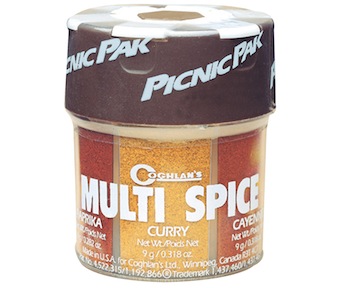
Coughlan’s Multispice Container with paprika, curry, cayenne, garlic salt, black pepper, and salt
– Available for $8.09 from http://www.coghlans.com/products/multi-spice-9961 Either a 6 pack of Backpacker’s Pantry Organic Olive Oil available for $4.80 from http://www.backpackerspantry.com/products/four-person/snacks-and-extras/organic-olive-oil-6-pack.html
or a 1.75 oz bottle of EVOO for $2.01 from http://www.minimus.biz/FoodMain.aspx

I’m actually so enamored with the cute little containers from Minimus.biz, I may order all kinds of little things I need, and some I don’t really need, for this trip. They have hot sauce, cute little jars of ketchup for $1.37 each, bottles of mustard for $1.42 or packets of Guldens Spicy Brown Mustard for 13¢ each. There’s real mayonnaise; honey in tubs, packets, or jars; Parmesan cheese packets; vinegar; balsamic vinegar packets for 32¢ each; and A1® Steak Sauce in adorable 1.4 oz bottles for $1.97 each. And yes, you can buy single bottles. In the specialty food section of the Minimus.biz website, you can find gluten-free salad dressing packets for 93¢ each, sugar free foods, and much more.

ketchup

But I digress. The point is that I can carry trip sized olive oil, balsamic vinegar, and spices without having to buy little containers and fill them myself. This saves me time, doesn’t break the budget, and keeps me from wasting a bunch of food. Not to mention, these little tiny packages are CUTE! For me this is a win all the way around.
mustard

If you prefer to pack your own spices, there are specialized containers available like the GSI spice missile with waterproof caps and shaker modules available from http://gsioutdoors.com/products/pdp/spice_missile. The price starts at $9.95 for 2 compartments and you can add more sections for cumin, cinnamon, tarragon, etc. This flexibility allows you to be more specifically prepared for your desired travel menu.
spice container

While I don’t need every detail tied down for a trip, I feel better when I start with a few things in place. Having a food plan is one of the things that’s important to me. Now that I know I can carry the little things, I am ready to finish the menu plan.

So what is my travel menu? Check out Travel Tip #11 coming next week.

Disclosure of Material Connection: I have not received any compensation for writing this post. I have no material connection to the brands, products, or services that I have mentioned. I am disclosing this in accordance with the Federal Trade Commission’s 16 CFR, Part 255: “Guides Concerning the Use of Endorsements and Testimonials in Advertising.”
Travel Tip #8 Speed Up Your Trip Through Security and Keep Your Clothes On!

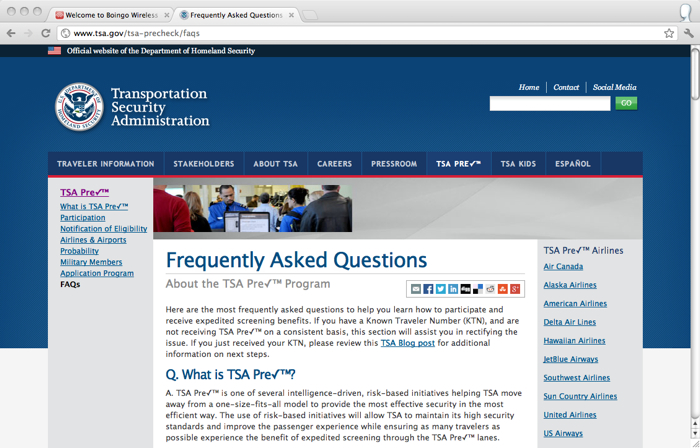
Did you know you may be able to speed up your trip through security at the airport? If, like me, you feel like you’re always running behind once you’ve packed the snacks and headed out the door, you can benefit from participating in TSA Pre✓™.

TSA FAQ

If you qualify for this program, you’ll walk to a very short line, show your boarding pass and walk though a metal detector while your bag is being X-rayed. No removing items from your bag or clothing from your body. Let me qualify that – you might have to remove a trench coat, but if you want to wear your fancy boots that take forever to put on or take off, go right ahead because they will stay on your feet. You can also manage to avoid the full body scanner.

It’s unbelievable how much more pleasant a trip through the airport becomes when you remove the stressor of the regular TSA line. The requirements as listed on the TSA website are:
Q. Who is eligible for TSA Pre✓™?
A. Travelers that are eligible for TSA Pre✓™ include:
•U.S. citizens of frequent flyer programs who meet TSA-mandated criteria and who have been invited by a participating airline.
•U.S. citizens and lawful permanent residents with a Known Traveler Number (KTN), sometimes referred to as a trusted traveler number.
•U.S. citizens and lawful permanent residents who are members of the TSA Pre✓™ application program.
•Members of the U.S. Armed Forces, including those serving in the U.S. Coast Guard, Reserves, and National Guard.
•Department of Defense and U.S. Coast Guard civilian employees.
•Members of the following U.S. Customs and Border Protection (CBP) trusted traveler programs:
•All members of Global Entry.
•U.S. citizens, lawful permanent residents and Canadian citizens who are members of NEXUS.
•U.S. citizens and lawful permanent residents who are members of SENTRI.
TSA will determine an individual’s eligibility for TSA Pre✓™ on a flight-by-flight basis through an intelligence risk-based analysis of passenger data. A comparison of the four DHS Trusted Traveler programs is available here.

Currently, there are 11 airlines that participate in the program. I inadvertently was approved for a recent trip by using a 3rd party online booking site and leaving a checkbox checked. If I had known how much I’d like the service, I would have been demanding it, searching for that checkbox, and feeling stressed if I couldn’t find it. Serendipity is a wonderful thing!

If you feel enough pressure planning ahead for your dietary, workout, and health routine needs for a trip, you can now get rid of some stress by taking the easy way through the airport. I highly recommend it.

Anyone else use this service? Has it worked as well for you as it has for me?

For more information, visit:
http://www.tsa.gov/tsa-precheck/faqs

Disclosure of Material Connection: I have not received any compensation for writing this post. I have no material connection to the brands, products, or services that I have mentioned. I am disclosing this in accordance with the Federal Trade Commission’s 16 CFR, Part 255: “Guides Concerning the Use of Endorsements and Testimonials in Advertising.”
Get Cooking with this Tip – Plan Ahead, But Not Too Much!

Get cooking with this tip – plan ahead, but not too much! Today’s post is for all of you who want to provide your families with healthy, wholesome food every day, but just can’t quite figure out how to find the time to cook.

I feel your struggle! I spent over 20 years building businesses, raising kids as a single mom and taking up the slack when my employees were sick or on vacation. I was determined to have a social life as well. Every minute of every day seemed jam-packed. Sometimes I felt like adding one more thing would be the straw that would break me.

While I’ve shifted the way I live over the past couple of years, I just had two physically grueling weeks moving and consolidating 2500 square feet of office into under 500 square feet. We didn’t hire movers so there was a lot of lifting, carrying, loading and unloading. I am tired. Perhaps that’s why I’m thinking about the little things that make it possible for me to throw together a meal quickly.

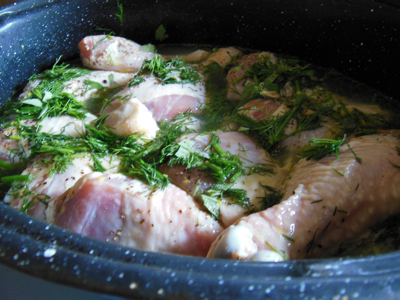
One of the things I do is plan ahead a little, but not too much. How does this help me? This morning planning ahead means marinating some chicken legs. I know that this will make the meat more flavorful, and I know that prepping it this morning means all I have to do this evening is pop them in the oven for 35 – 40 minutes.
chicken

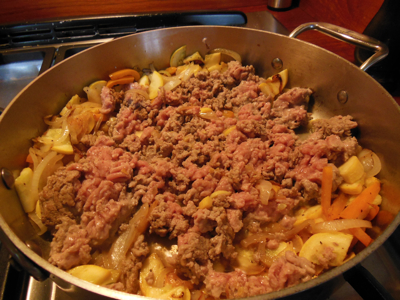
Now that I’m in the kitchen, I realize I’m starting to get hungry. It’s midmorning and the perfect time to throw together a one-pot meal I can run to for lunch today and tomorrow. I grab an onion, olive oil, an orange bell pepper, a couple of summer squash, and some ground turkey. This will be an evolving dish. I haven’t yet decided on the flavorings.
one-pot

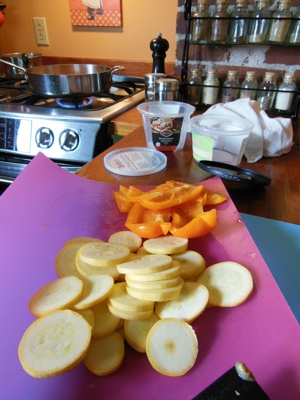
I clean all the vegetables, slice the onion and while it’s sautéing in olive oil, slice about a third of the bell pepper and one of the squash. I add them in stages to the onion and sprinkle with salt & pepper. After a few minutes, I push all the vegetables to the outside of the skillet and place the ground turkey in the middle to brown. Periodically I have to break it into smaller pieces with the spatula. During the time in between stirs, I finish slicing the bell pepper and the other yellow squash.

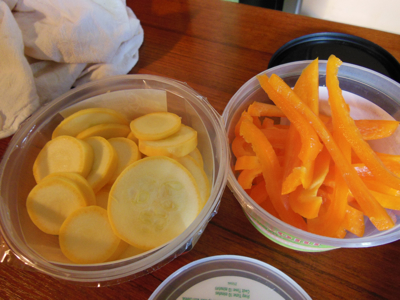
I don’t need the pepper and squash for my one-pot meal, but knowing that when I come home from work tired, I sometimes just can’t get my mind around cleaning and chopping veggies, I recognize that prepping these now means I am more likely to cook them for dinner this week, or dip them in hummus for a healthy snack.
squash

NOT having too specific a plan for the squash and bell pepper helps me not feel overwhelmed. All I need to do right now is stir my one-pot meal and slice these puppies. Then I’ll put them in one of the many plastic containers I keep in the cabinet in precarious stacks that fall on Ben’s head when he opens the cabinet doors. I like to think of this as reflex training. I can usually manage to catch them as they fall. Ben just thinks it’s annoying.

I finish off the one-pot meal by adding some frozen English peas, a handful of shredded Parmesan, Asiago, and Romano cheese blend, salt, pepper, and a little water & let it simmer for about 12 minutes. While the timer runs on the 12 minutes, I have time to pop the chopped veggies into containers and put them in the refrigerator, then clean up the kitchen.
veg for fridge

When I get home and am already hungry I won’t have to think about what I’m going to cook, all I have to do is turn on the oven and throw the drummies on a baking sheet. In the same amount of time I would spend driving to a restaurant, ordering, and getting my food, I’ll have cooked chicken. I can pair that with a piece of fruit, a salad, sliced tomatoes and cottage cheese or raw vegetables dipped in my favorite dressing and have a healthy meal without cooking anything else. I’ll also have time to steam asparagus or broccoli while the chicken bakes.

As a backup plan, I’ll have whatever is left of my one-pot meal. I can stretch it by adding some fresh kale, pasta or rice. Or I can throw together a frittata full of turkey, vegetables, and cheese. The key is not being too attached to a specific meal plan so that my mind is free to see all the possibilities instead of the impossibility of pulling off whatever plan I had that may no longer work.

Have another tip? Please share it with us in the comments below.

Quick Guide to Sauces

Today’s post gives you a Quick Guide to Sauces for those days when you feel a little saucy like I do today. When I dine away from home, I prefer locally owned restaurants with really tasty food. That may mean eating tacos asada in the back of a mercado, barbecue in a dilapidated house, or ossobuco in on of those F-A-N-C-Y places. No matter what the menu, I’m careful to avoid sauces that may contain gluten.

A sauce is simply liquid, a thickening agent, and flavoring, plus a possible bit of fat from rendered meat, butter, or olive oil. If a sauce contains gluten, the culprit is usually the thickening agent. Some sauces are automatically more suspect because the traditional recipes contain flour. To make it easier for you to navigate a restaurant menu without having to ask your server a million questions, let’s take a look at the traditional composition of some common sauces so you can narrow the field.

buerre noisette
Green Bean Casserole with Buerre Noisette

You don’t have to go to a high-end restaurant to find a sauce – hamburger steak, roast beef, and mashed potatoes are often topped with gravy. Unless you are in a specialty restaurant that deliberately cooks without wheat flour, avoid gravies. You don’t even have to ask; hey will be thickened with a flour=based product more often than not.

Restaurants that incorporate French technique will often offer variations of 5 basic sauces known as mother sauces: Béchamel, Velouté, Espagnole, Hollandaise, and Tomaté (tomato). There are many variations that fall under these 5 categories. For instance, béchamel is hot milk (the liquid), white roux (the thickening agent which contains flour), and onion, cloves, and nutmeg (the flavoring). Béchamel with added cream and herbs becomes a Cream Sauce. Béchamel enriched with Gruyere and Parmesan cheese becomes Mornay. Add sautéed and puréed onions plus tomatoes and the result is Soubise.

You get the idea. The key here is that the base sauce is thickened with roux which contains flour which contains gluten. Any time you see these on a menu, they will most likely contain gluten and are best to be avoided. If you REALLY want one, you can always take the time to verify with the kitchen, but you can save yourself time and trouble by avoiding the category.

Here’s a quick reference list:
Béchamel – thickened with white roux. Variations: Crème Sauce • Cardinal • Mornay • Soubise • Nantua • Cheddar Cheese • Mustard

Velouté – thickened with roux. Variations: Chicken Velouté • Veal Velouté, Suprême Sauce • Allemande • White Wine Sauce • Normandy • Bercy • Hungarian • Mushroom • Aurora • Poulette • Shrimp • Curry • Herb Seafood Sauce

Espagnole or Brown sauce – thickened with roux then often further refined into a demi-glace. From the demi-glace come the following variations: Marchand de Vin (Red Wine Reduction) • Bordelaise • Robert Sauce • Charcutièere Sauce • Lyonnaise Sauce • Chasseur • Sauce • Bercy Sauce • Mushroom Sauce • Madeira • Périgueux • Port Wine Sauce

Hollandaise – thickened with eggs. Variations: Aurore Sauce • Béarnaise Sauce • Créme Fleurette • Dijob Sauce • Foyot Sauce • Choron Sauce • Maltaise Sauce • Mousseline Sauce • Paloise

Classic Tomato Sauce – sometimes thickened with roux. Variations: Chaufroid • Spanish Sauce • Creole Sauce • Meat • Portuguese Sauce • Provençal Sauce

That’s a lot of sauces, but of course there are more:

Aioli is a version of Provençal Sauce but in American cuisine has come to be used as a term for flavored mayonnaise.

Alfredo – traditionally Parmesan cheese and butter but American versions often have cream and flour, roux, or starch.

Arrabbiata – garlic and tomato base usually served on pasta

Au jus – means with it’s own sauce. In American cuisine, this refers to light sauce for beef often served on the side made by skimming the fat off the juices left from cooking the beef and bringing them to a boil.

Avgolemono – thickened with egg

Barbecue – most commonly made with a tomato purée or vinegar base, but sometimes tomato paste containing flour is used.

Beurre Blanc – emulsified butter sauce with a vinegar reduction

Beurre Noisette – a brown butter sauce. Meunière sauce is a variation of the brown butter sauce, but meunière is also a technique that includes dredging in flour so trout meunière will most likely have been dredged in flour even though the sauce contains none.

Carbonara – composed of cream, eggs, Parmesan cheese, and bacon bits most often served with pasta

Chateaubriand sauce is usually a Bernaise or Bordelaise although the traditional sauce is a variant of Bercy Sauce.

Chimichurri – green sauce with vinegar base

Clam sauce – usually made with minced clams and sometimes a tomato sauce

Cocktail sauce – ketchup base

Coulis – made with puréed and strained vegetables or fruit

Crème Fraîche – matured, thickened cream

Duck Sauce – fruit base

Duxelles – mixture of finely chopped mushrooms, shallots, and herbs slowly cooked in butter until it forms a thick paste

Fumet – fish stock with lemon, white wine, peppercorns, white onion, and parsley

Gastrique – caramelized sugar deglazed with vinegar used to flavor sauces

Genovese – onion base sauce usually served over pasta

Gremolata – parsley base with lemon zest and garlic

Harissa – Tunisian hot sauce usually made with hot chiles, garlic, cumin, coriander, caraway, and olive oil

Marinara – tomato base

Mayonnaise – combines oil, egg yolks and vinegar. Variations include: Fry Sauce • Buffalo Wing Sauce • Marie Rose Sauce or Russian Dressing • Ranch Dressing • Rémoulade • Tartar Sauce • Thousand Island Dressing • Fancy Sauce • Honey Mustard (sometimes)

Mignonette – white wine & vinegar base

Miso – fermented soybean paste comes in 3 categories – barley, rice or soybean all of which are developed by injecting cooked soybeans with a mold and then aging them

Pesto – crushed basil, pine nuts, and Parmesan cheese

Ragù – meat based. Variations include: Ragù alla Bolognese • Ragù alla Napolentana • Ragù alla Barese

Rouille – aîoli with added olive oil, garlic, saffron & chili peppers and sometimes breadcrumbs

Salsa – often tomato based and typically piquant, it usually contains no thickening agent other than the vegetables or fruits from which it’s made. Variations: Red Sauce • Pico de Gallo • Salsa Cruda • Salsa Verde • Salsa Negra • Salsa Taquera • Salsa Criolla • Salsa Criolla • Salsa Brava • Guacamole • Mole (the kind in a jar almost always contains wheat) • Mango Salsa • Pineapple Salsa • Chipotle Salsa • Habanero Salsa • Corn Salsa • Carrot Salsa • Mojo • Piri Piri • Sambal

Sofrito – tomato base

Soy sauce – fermented paste of boiled soybeans, roasted grain, and mold

Teriyaki sauce – soy sauce base

Tzatziki or Cacik– strained yogurt or yogurt base

Hopefully this list will save you some time and trouble when reading menus and deciding what to order. If you dine at chain restaurants or purchase sauces from the grocery store, remember formulations may be different from traditional recipes. Often they will contain added starches or wheat to make the texture of the product stand up to lengthy stays on warehouse shelves. Please be sure to read the labels.

Do you have a favorite sauce that we missed? Please let me know so we can add it to our Cooking2Thrive® Quick Guide to Sauces.