
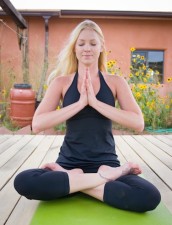
 If the gym isn’t your cup of tea, yoga is a perfect home workout. We’re all aware that regular exercise is important to overall health so it’s important to find a workout that works for you. A couple of years ago, I was swimming laps 3 – 4 times a week. Swimming is a great low-impact workout which I needed because of a knee injury. Then came the day that I jumped into the pool to get started, landed on that leg, and re-injured my knee. On top of the damage the chlorine was doing to my hair and the constant lane sharing, I’d had enough. I needed a new workout routine.
At my age, I’m aware it’s important to have some sort of resistance training as well as with aerobic exercise. I began searching for a good mix of the two. After months of experimentation, I now have two weight lifting routines and three or four yoga routines I rotate on a regular basis. I chose these workouts because I can do them at home and because they make me feel good. If your workout makes you feel good, obviously, you’re less likely to skip it. I now work out 5 – 6 days per week.
About 4 years ago, I attended a yoga class for seniors once a week for a few months. At that point, I didn’t even own a yoga mat. I just went to the class, threw $5 in a basket and borrowed a mat. I felt weak and shaky sometimes, but the routine wasn’t all that difficult and I enjoyed it when the instructor rubbed our foreheads during Savasana at the end. I wasn’t really hooked, but this low-key introduction helped me get past the fear that I wouldn’t be able to do the poses.
When I decided to seriously explore yoga as a primary workout, I started with two DVDs featuring Bethenny Frankel. I jumped right into the 40 minute session instructed by Kristin McGee. Occasionally, I’d switch over to the DVD led by Mike McArdle. As I became more proficient with the routines, I also became more aware of the pace and the tone of each workout. I noticed that I preferred Mike’s instruction. I also got curious about other instructors. Once I realized how many yoga options were available on Amazon Video, I was like a kid in a candy store.
There are almost 3000 yoga videos available from Amazon Video. Almost 400 of those are included free with Amazon Prime and you can watch them as many times as you want. Even if you watched nothing on Amazon Prime, but a single workout, that workout ends up costing you about 25¢ per year. I don’t know of any club you can join for 25¢ per year.
The only equipment required for these yoga routines is comfortable clothing, a yoga mat, and a way to access video. A blanket, block, or strap is sometimes helpful as well. It’s not hard to find a yoga mat for under $20 or a beginner’s kit with a mat, block, and strap for $35 – $40. And if you’re not leaving the house, there’s no clothing or gas budget required. You’re bound to have something comfortable to wear stuffed away in a drawer.
I’ve previewed quite a number of yoga workouts. If I don’t immediately feel both relaxed and challenged, I move on to a different option. I prefer those that move at a slower pace with an instructor who fully demonstrates proper alignment and form. My current favorite is, Yoga for Beginners: Poses for Freedom and Renewal with Kanta Barrios which I can watch free with Amazon Prime. It’s 30 minutes designed to tone the muscles and strengthen the core. Full of plank to Chaturanga to cobra to downward-facing dog sequences, the poses may be for beginners, but I don’t feel like I’m slacking. In fact, the reviews of this video sometimes complain that it’s too hard for beginners.
When I want a longer workout, I choose Yoga for All. Also available free with Amazon Prime, these sessions are each about an hour in length and feature 3 instructors simultaneously demonstrating beginner, intermediate, and advanced versions of each pose. Season 1 contains 4 episodes: Basic, Core, Strength, and Vinyasa. I follow the intermediate instructor and modify to the beginner level when working on an area in which I’m weak.
Obviously, your preferences may differ from mine, but with so many choices you’re bound to find something that will suit your personality, goals, and fitness level. And if your preferences change as you become stronger and more flexible, video content providers offer a never ending stream of prospective selections.
Once you land on a possible workout, be sure to watch the whole session before practicing it. This will get you attuned to the rhythm and manner in which you’ll be instructed. While you still may be a bit behind the instructor at first, a full viewing reduces frustration and allows you to more fully concentrate on form from the beginning.
Yoga makes it easy to target any part of your body that needs improvement. Have back problems – there’s a yoga workout for that. Need to relax your hips – there’s a yoga workout for that. Have digestive trouble – there’s a yoga workout to improve it. And no matter where you practice, yoga can help you gain strength, flexibility, and balance.
If you wake up stiff and sore; if you have plantar fasciitis pain; if you are losing flexibility; if you want to improve balance or breath control, yoga is a great workout to explore. You can workout when you want. Target any part of your body. Gain strength, tone, flexibility, balance, and breath control. Avoid prying eyes. Learn to be mindful. Save money. Feel amazing.
All of this is possible when you practice at home. Yoga really is the perfect home workout.
Disclosure of Material Connection: I have not received any compensation for writing this post. I have no material connection to the brands, products, or services that I have mentioned. I am disclosing this in accordance with the Federal Trade Commission’s 16 CFR, Part 255: “Guides Concerning the Use of Endorsements and Testimonials in Advertising.”


 This morning I ran across the term strategic patience. It wasn’t used in the context of foreign policy with Russia. This strategic patience was used to describe a technique employed by teachers in which students are asked to remove themselves from electronics and quietly observe a math formula, graph, or painting. Sometimes the duration of the assignment was only 1.5 minutes, but that time had a positive learning result.
 but are we, or would strategic patience serve us better?