
When you’re in distress, it’s hard to notice what feels good. If your head hurts, it draws your attention. If your tummy hurts, it draws your attention. If you suffer a loss, the resulting sadness, emptiness and fear draw your attention. When four or five difficult things happen during a short period of time, the feeling in your gut may be so stressful it can become increasingly difficult to notice what feels good.
I suppose it’s the same phenomenon as the squeaky wheel. If some part of us is screaming for attention, that’s where our energy goes. Unfortunately, over a long period of time this shift in focus can become a habit. When the focus on distress becomes intolerable, we tend to do anything we can to avoid feeling it. We often numb ourselves with work, shopping, sex, exercise, binge-watching, gaming, alcohol, or drugs.

Is there a way to feel the good in the midst of hardship?
You’ll find a lot of things written about practicing gratitude. I’ve written some myself. You’ll find a lot of information about being present in the moment. You’ll find resources on showing up authentically and practicing vulnerability. You’ll hear psychological professionals toss around the term self-care. You’ll hear religious leaders espouse prayer. Yeah, yeah, yeah. There is merit to all of these practices, but if you’re white-knuckling yourself into doing them, you may need to go backward to go forward.
Over the past few years as I’ve become able to sit still, able to practice yoga, able to know that intellectual insight will follow trusting my body’s signals, I have become increasingly aware that ease, comfort, stability, and balance are often present when I slow down and shift my focus.
After noticing a feeling of tension in my back, I may notice a feeling of ease in my right abdomen. If I hold onto that feeling of ease, I may feel my back relax. When I feel anger or agitation begin to bubble up, I may notice that synchronizing my movement and breathing causes the tension to quickly dissipate. Remembering that when some part of my body is working, another part is at ease allows me to shift my focus to notice ease more often.
It is this noticing of physical ease and comfort that helps me unknot the discomfort in other parts of my body. The unknotting of my mind always follows. Yes, always. The shift is often tiny. The key is making the space to notice. It is in the noticing that I reconnect with my body. It is in the noticing that I reconnect with real emotions. It is through breathing that I build resilience, confidence, and safety.
Notice that the only connection here is with myself? Notice there is no analysis required? Notice that I don’t try to figure anything out? Notice that I am not forcing myself to do anything? I can simply breathe and notice. Breathe and notice. Breathe and notice.
I have gone back to absolute basics. It sounds so simple. It is and it isn’t. If you’re like me and surrender feels like giving up, it’s one of the hardest concepts in the world! It has literally taken me years to even begin to surrender and I am still a beginner.
If you stabilize your world through control, hold your breath, or muscle through difficult situations, this post may seem like the most ludicrous thing you’ve ever read. When you reach the point that all of that muscling through leaves you with anxiety and constant panic, come back. Read it again.
The bottom line is, yes there is a way to feel good during hardship. It comes from what some would call receiving. That term confuses me, so I’ll call it noticing — noticing breath, ease, comfort, accomplishment, a feeling of solidness your legs provide, a feeling of strength, a feeling of contribution, a feeling of connection, a feeling of competence, a feeling of possibility, and a feeling of power.
When you’re noticing those things, you are not noticing a feeling of tension, a feeling of heaviness, a feeling of pain, a feeling of sadness, a feeling of loss, a feeling of fatigue, a feeling of panic, a feeling of overwhelm, a feeling of anger, a feeling of powerlessness, a feeling of helplessness, a feeling of loneliness, a feeling of worthlessness, a feeling of doom, a feeling of bracing for the next shoe to drop, etc.
You are not wrong for feeling any of these things, but in an odd way, noticing the opposites will allow you to stop avoiding, fighting, numbing, or trying to move away from “negative” feelings (feelings are feelings and all are okay). All feelings can then move freely instead of remaining stuck in our physiology and psyche.
How all of this works is understudied, but we are learning that yoga practiced specifically to reconnect trauma patients with their bodies affects change in their brain scans. We are also learning that gut neurons communicate with the insula in the brain — the area believed to control compassion and empathy, perception, motor control, self-awareness, cognitive functioning, and interpersonal experience.
Body, brain, emotions, and perception share a complex relationship. We can’t necessarily think or talk our way through an emotional problem, set good boundaries, or move on from trauma without reconnecting with our bodies. When we reconnect, our gut flora may affect our perceptions.
The easiest path I know to feeling better is to start with basics – eat a variety of as fresh as possible food with minimal sweets, stay hydrated, sleep at least 8 hours per night, incorporate yoga for trauma and/or guided meditation into your exercise plan, and strengthen your boundaries.
Then…
Notice the feeling of being nourished by your food. Time your eating so that you never feel distressed by hunger.
Notice how you feel when you awake rested and how you feel the first moment you become tired. Do not push past your tired feeling. Take a nap or go to bed.
Choose yoga that emphasizes your control over the process, moves slowly, and has an instructor with a soothing manner and voice.
Practice giving yourself permission to prioritize yourself. Notice how that feels.
Use a physical boundary to help yourself visualize your limits. Verbalize your boundaries when needed.
Notice a feeling of ease each time you notice a feeling of tension.
Notice how you feel when you make a decision that’s unlike previous decisions in similar situations. If you feel peaceful, calm, relieved, energized, freer, happy, joyful, or even neutral
With these simple steps, you may be surprised how quickly you begin to automatically notice what feels good! That can have a very positive effect on the feeling in your gut!
https://www.scientificamerican.com/article/gut-second-brain/
http://besselvanderkolk.net/the-body-keeps-the-score.html
http://www.cooking2thrive.com/blog/yoga-perfect-home-workout/
http://www.cooking2thrive.com/blog/gratitude-is-my-best-defense/
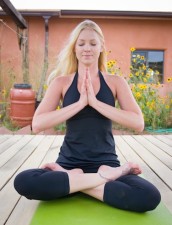 If the gym isn’t your cup of tea, yoga is a perfect home workout. We’re all aware that regular exercise is important to overall health so it’s important to find a workout that works for you. A couple of years ago, I was swimming laps 3 – 4 times a week. Swimming is a great low-impact workout which I needed because of a knee injury. Then came the day that I jumped into the pool to get started, landed on that leg, and re-injured my knee. On top of the damage the chlorine was doing to my hair and the constant lane sharing, I’d had enough. I needed a new workout routine.