Measure or Pour

When teaching kids to cook, is it better to measure or pour? I’ve always liked teaching kids to cook using measuring cups and spoons. It’s a great way to teach and visualize fractions. It’s an opportunity to point out how things work better if you follow a certain order of operations. Beyond math-related functions, it’s a chance to learn cooking vocabulary and how to read recipes.

Determined African American girl rolling dough with flour covered arms.

But a lot of cooking is smell and feel and knowing what a certain kind of dough should look like. That information can’t be found in a recipe. It has to be experienced. And sometimes the temperature and humidity in your kitchen will mean you need to alter a recipe. It seems equally important to allow kids to learn simple cooking and baking by eyeballing quantities.

Perhaps the best choice is both measuring and pouring. I know it means spending more time in the kitchen in possibly messy circumstances that will require additional cleanup time. On balance, you’ll gain the opportunity for presenting family traditions, math lessons, and English lessons in addition to overt cooking instruction.

In preparation, you’ll need to get comfortable with winging it. If that’s not your thing, try cooking dinner a night or two by using only what you can remember of a recipe. Pay attention to what you forget or tend to use too much of. Nothing about this is critical so don’t be afraid to laugh.

Once you have a bit of confidence, add fresh ingredients and children. Try making the same dish  with and without following a recipe. Add unexpected changes that smell like a good combination. Play, play, play.

If we’re truly going to limit processed food, we have to get the kids comfortable in the kitchen. I know some restaurant owners whose mom let them play bake in the kitchen when they were quite young. She says the results weren’t always good, but they were learning and having fun. I’d offer they were gaining comfort and confidence.

When you’re comfortable and confident in an environment, you’re able to focus and learn. It’s the ideal state for absorbing new information.

Now’s the time. Get the kids in the kitchen. Let them measure and pour to their heart’s content. They’ll probably use too much salt, too much sugar, and definitely too much vanilla. It’s hard to judge how fast it will pour when you’re not used to the size and weight of the bottle.

They’ll love using a grater and microplane. Buy a protective glove if you’re worried about them cutting themselves. Show them how to zest citrus and squeeze juice without getting seeds in the food.

Demonstrate peeling garlic and slicing onions. If you’re nervous, buy some kid-safe knives and show them how to keep their fingertips out of the way.

Measure or pour, you’re not just prepping food. You’re prepping your children for being cooks. That’s a huge step along the way to incorporating fresh ingredients into their diet. The benefits are huge!

My Kitchen is a Sticky Mess

My kitchen is a sticky mess. Today my doorbell grandchildren showed up for a cooking lesson with soda and candy in hand. We’ve all learned a lot.

There was a simple plan in place. One of them had agreed to help me with a pork tenderloin recipe at 3pm. That plan went by the wayside when 3 of them showed up at noon. Of course they were hungry. After I shared my tuna croquettes and green peas with them, there was a flurry of activity in the kitchen.

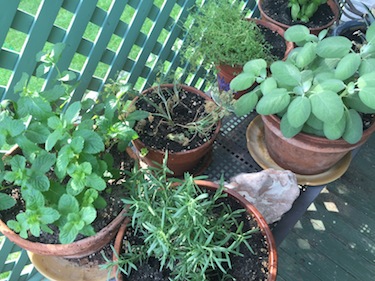
The oldest brother mixed the glaze for the pork tenderloin while the middle brother chopped celery and red bell pepper for a white bean tzatziki salad. I sent the youngest to the back porch for some dill. Of course, he had no idea which plant that was. Not wanting to end up eating something ornamental and poisonous, I joined him on his search.
Herbs
We started our exploration of back porch flora with mint. I had him smell each herb. We identified them by name and discussed what each might be used for. Of course no lesson is straightforward with this crew. We got interrupted several times with questions from the other two. Eventually, the conversation culminated in a pesto tasting.

Before we arrived at pesto, I had to demonstrate what 3/4 cup means. I had given one of the kids a 1/4 cup measuring cup and a recipe that called for 3/4 cup of tzatziki. He was at a loss for how 1/4 cup related to 3/4 cup. I must admit this had me shaking my head a bit. After all, these kids are 12, 13, and 14.

Anyway, that led to a more general lesson on fractions. We filled a one cup measuring cup with water from a 1/4 cup measuring cup, counting each time until it registered that there are four 1/4 cups in one cup. Eventually, that led to a recognition that 2/4 and 1/2 are the same. We tried doubling a recipe that called for 2/3 cup flour and it still took a minute for them to grasp that 4/3 equals 1 1/3 cups. Cooking is such a practical way to deal with fractions. A few bad batches of biscuits and you’re bound to step up your math game.

Then it was my time to learn. The oldest taught me how to make a drink he invented that combines orange soda with candy and ice. The drink was tart and tasty, but it’s going to require a real food processor or blender. Today, we made it using the larger of my food choppers which was up to the task in the beginning, but totally burned out before we were done. During the process, orange soda was transferred to every surface in my kitchen and half of those in the breakfast room. I still feel like I’m sticking to my computer and my phone.

I also learned about the risqué videos kids watch on Instagram – unfortunately, by seeing one with my own eyes. I learned that you cannot allow any cursing or it’s out of hand in less than a minute. I learned that Stewart sometimes likes to wear a little bling. Most importantly, I learned that every single one of you with multiple teenagers must have nerves of steel and astronomical grocery bills.
Bling
Now it’s the end of the day. I am tired. My kitchen is a sticky mess and we’ve all learned a lot. That’s often the way it goes in the kitchen.