When teaching kids to cook, is it better to measure or pour? I’ve always liked teaching kids to cook using measuring cups and spoons. It’s a great way to teach and visualize fractions. It’s an opportunity to point out how things work better if you follow a certain order of operations. Beyond math-related functions, it’s a chance to learn cooking vocabulary and how to read recipes.
But a lot of cooking is smell and feel and knowing what a certain kind of dough should look like. That information can’t be found in a recipe. It has to be experienced. And sometimes the temperature and humidity in your kitchen will mean you need to alter a recipe. It seems equally important to allow kids to learn simple cooking and baking by eyeballing quantities.
Perhaps the best choice is both measuring and pouring. I know it means spending more time in the kitchen in possibly messy circumstances that will require additional cleanup time. On balance, you’ll gain the opportunity for presenting family traditions, math lessons, and English lessons in addition to overt cooking instruction.
In preparation, you’ll need to get comfortable with winging it. If that’s not your thing, try cooking dinner a night or two by using only what you can remember of a recipe. Pay attention to what you forget or tend to use too much of. Nothing about this is critical so don’t be afraid to laugh.
Once you have a bit of confidence, add fresh ingredients and children. Try making the same dish with and without following a recipe. Add unexpected changes that smell like a good combination. Play, play, play.
If we’re truly going to limit processed food, we have to get the kids comfortable in the kitchen. I know some restaurant owners whose mom let them play bake in the kitchen when they were quite young. She says the results weren’t always good, but they were learning and having fun. I’d offer they were gaining comfort and confidence.
When you’re comfortable and confident in an environment, you’re able to focus and learn. It’s the ideal state for absorbing new information.
Now’s the time. Get the kids in the kitchen. Let them measure and pour to their heart’s content. They’ll probably use too much salt, too much sugar, and definitely too much vanilla. It’s hard to judge how fast it will pour when you’re not used to the size and weight of the bottle.
They’ll love using a grater and microplane. Buy a protective glove if you’re worried about them cutting themselves. Show them how to zest citrus and squeeze juice without getting seeds in the food.
Demonstrate peeling garlic and slicing onions. If you’re nervous, buy some kid-safe knives and show them how to keep their fingertips out of the way.
Measure or pour, you’re not just prepping food. You’re prepping your children for being cooks. That’s a huge step along the way to incorporating fresh ingredients into their diet. The benefits are huge!
My kitchen is a sticky mess. Today my doorbell grandchildren showed up for a cooking lesson with soda and candy in hand. We’ve all learned a lot.
There was a simple plan in place. One of them had agreed to help me with a pork tenderloin recipe at 3pm. That plan went by the wayside when 3 of them showed up at noon. Of course they were hungry. After I shared my tuna croquettes and green peas with them, there was a flurry of activity in the kitchen.
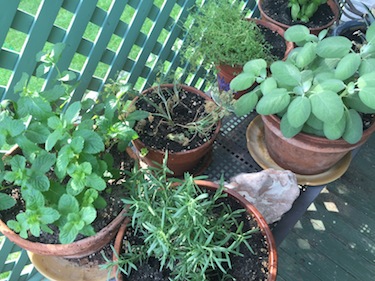
The oldest brother mixed the glaze for the pork tenderloin while the middle brother chopped celery and red bell pepper for a white bean tzatziki salad. I sent the youngest to the back porch for some dill. Of course, he had no idea which plant that was. Not wanting to end up eating something ornamental and poisonous, I joined him on his search.
We started our exploration of back porch flora with mint. I had him smell each herb. We identified them by name and discussed what each might be used for. Of course no lesson is straightforward with this crew. We got interrupted several times with questions from the other two. Eventually, the conversation culminated in a pesto tasting.
Before we arrived at pesto, I had to demonstrate what 3/4 cup means. I had given one of the kids a 1/4 cup measuring cup and a recipe that called for 3/4 cup of tzatziki. He was at a loss for how 1/4 cup related to 3/4 cup. I must admit this had me shaking my head a bit. After all, these kids are 12, 13, and 14.
Anyway, that led to a more general lesson on fractions. We filled a one cup measuring cup with water from a 1/4 cup measuring cup, counting each time until it registered that there are four 1/4 cups in one cup. Eventually, that led to a recognition that 2/4 and 1/2 are the same. We tried doubling a recipe that called for 2/3 cup flour and it still took a minute for them to grasp that 4/3 equals 1 1/3 cups. Cooking is such a practical way to deal with fractions. A few bad batches of biscuits and you’re bound to step up your math game.
Then it was my time to learn. The oldest taught me how to make a drink he invented that combines orange soda with candy and ice. The drink was tart and tasty, but it’s going to require a real food processor or blender. Today, we made it using the larger of my food choppers which was up to the task in the beginning, but totally burned out before we were done. During the process, orange soda was transferred to every surface in my kitchen and half of those in the breakfast room. I still feel like I’m sticking to my computer and my phone.
I also learned about the risqué videos kids watch on Instagram – unfortunately, by seeing one with my own eyes. I learned that you cannot allow any cursing or it’s out of hand in less than a minute. I learned that Stewart sometimes likes to wear a little bling. Most importantly, I learned that every single one of you with multiple teenagers must have nerves of steel and astronomical grocery bills.
Now it’s the end of the day. I am tired. My kitchen is a sticky mess and we’ve all learned a lot. That’s often the way it goes in the kitchen.
When I was in junior high school, all girls were required to take a class called Home Economics and all boys were required to take Wood Shop. Well, to be truthful, I never took Home Ec because I opted to take an extra science course instead.
What did I need Home Ec for? I was told that what they did in that class was learn to cook and sew. I already knew how to do those things. My grandmother taught me to sew when I was 9. My mother was delegating her baking to me even before that. I was ready to learn something new. I was off to take a new science class in which I excelled. Why? I was well prepared. All those lessons I learned in the kitchen had prepared me for science, math, and process thinking.
As we watch our kids become less and less skilled in these three areas, I often wonder how closely related it is to the fact that many of us no longer cook. Perhaps we should consider getting the kids back in the kitchen so they’ll be better prepared for school.
Double a recipe and your daughter will quickly come to understand why adding and multiplying fractions are critical skills. Without understanding common denominators, how can she know that 1 1/4 cups plus 1 1/4 cups equals 2 1/2 cups? But once she has learned these conversions while cooking, there will be no need to resist expanding on that knowledge in math class. Certainly the familiar – “Why do I need to learn this, I’ll never use it in real life?” – argument will be nullified. Want to help her even more, have her make one and a half recipes of cookies. The division required provides an opportunity to use even more advanced math skills.
Throw some salt in a pot of water that you need to hurry up and boil. Your son just learned that you can lower the boiling point of water by adding salt. Put some baking soda in lemon juice and let him watch a frothing chemical reaction that doesn’t threaten to destroy your house or poison its occupants.
There are endless chemistry and physics lessons inherent in cooking. You can point them out, or just let your children learn without knowing they’re learning as they watch solid fats melt into liquids, lemon juice curdle cream, or heat cause baking soda to release carbon dioxide and make a cupcake rise. Even if you don’t specifically discuss the science behind these reactions while you’re cooking, you are creating a repository of knowledge that will make these concepts seem familiar when it’s time to take a chemistry class. This knowledge will help remove the fear of being in the lab and lay the foundation of curiosity for a formula that explains how the acids in baking powder react to create carbon dioxide.
If you have a child who wants all the food to look pretty, you can focus on the art and design lessons in cooking. Mix red and yellow food coloring and the kids can immediately see the resulting orange color. Explore scale and proportion by layering cakes. Experiment with different piping tips, brushes, or “found” tools to create texture in frosting, cookies, or crackers. Build houses, make dough people, or create an entire edible village. For this lesson, innovation and creativity are your guides. Let the ideas flow freely. Feel the excitement that collaboration brings when one idea sparks another.
No matter what lesson you’re attempting to learn in the kitchen, you will learn about process, procedure, and order of operations. If you begin without any plan and ignore a certain order of operations, you will not get the results you expect or want. That doesn’t mean you have to follow every recipe to the letter, or that you must know exactly what you’re going to cook for dinner before you walk into the kitchen. It means you must think through and understand the process. Process thinking helps you to recognize that what you do now should be determined by what you want to happen next, and next, and next…until the end of the process – a finished dish or a coordinated meal. Of course this type of thinking is beneficial in all areas of life. We reach a specified goal with much greater ease when we understand that today’s decision can be determined by our priorities for what will happen next, and next, and next, then allow the process to support us.
My grandmother didn’t talk about process, she just instructed me to always read through an entire recipe before I ever started to get out ingredients, pans, or bowls. There were several reasons for this. One was to make sure that all the ingredients were available in the kitchen. One was so I would only get out what I needed and make less of a mess in her kitchen. One was so that I wouldn’t dump dry ingredients and liquids together until it was time to do so and create a batter that had to be thrown away. She couldn’t stand to waste food. She also wanted to make sure I would properly preheat the oven and prepare the proper baking dish in advance. She didn’t like to waste time either. Once I was competent to prepare individual dishes, I carried this same process thinking into creating a timeline that allowed me to create a coordinated meal in which my all dishes were ready for the dining table at the same time and piping hot.
As a project manager, I have used the reverse timeline to great success when handling complex, detailed, and deadline driven assignments. Communicating instructions based on what must happen one or two steps past that specific instruction streamlines the process and narrows the margin for error. Understanding the process also allows me to be more swift and flexible in finding solutions to problems because I have a clear understanding of what is critical and what is not in achieving a desired result. These are skills I desire in all employees. These are skills I developed in the kitchen before I reached junior high. I simply built on them in secondary school, college, and at work.
I suspect the boys in my junior high were learning a great deal about process thinking in Wood Shop too. If they failed to allow for the thickness of a piece of wood in their overall measurements, they would not cut boards to the proper length when building a cabinet. If they didn’t understand how the equipment worked, they could lose an appendage. I’m certain that these skills serve them well whether they became bankers, writers, carpenters, or electricians.
We worry so much about declining standardized test scores and how to fix the schools. In spite of much discussion, we have made little headway. Perhaps the solution to improvement is quite simple, and possibly delicious. Get the kids in the kitchen and get things cooking!