Garbage In Garbage Out

We said it all the time when I was growing up – garbage in, garbage out. That could mean what we read affected how we wrote. It could mean setting up a math equation incorrectly would yield an incorrect answer. It could mean that if we entered meaningless data, the computer would spit out garbage results.

black background with irregular white swirl

We often learned the hard way just how true the statement was. What is startling to me currently is that we don’t seem to recognize garbage as garbage. And when someone questions the garbage, we double down and choose fantasy if it serves our purpose. This is concerning.

I’m not saying people can’t view things differently or have a different opinion about things. Each of us will naturally perceive a given situation in a slightly different way. But I’m seeing people detaching their realities from documentable facts.

If you’re five and still have an imaginary friend, that may be okay. But if you’re an adult making life altering decisions, we’re in a dangerous ballpark.

Skepticism is good. Discernment is critical!

Want to tell me to hush, you’ll just use AI? Think of it this way. If you are not discerning, you can’t use AI well. You’ll be fooled when it fails a task only slightly less complicated than the car wash test. https://cybernews.com/ai-news/ai-car-wash-test/

If friends, instructors, or mentors keep harping on you learning critical thinking, they may believe you lack discernment. If you’re making life decisions then suffering consequences others deem predictable, you may need to improve your insight and judgement.

The good news is, discernment can be cultivated.

Start carefully observing what’s around you in real life. In other words, open your lying eyes and believe them.

Get as close as you can to the facts. When someone in your circle starts ranting about a person or event, before forming an opinion, get information directly from the source or a source as close to the facts as you can get.

Dig deep. Let curiosity take you to find background information that gives context or history.

Read widely. Whether or not you agree, it’s good to explore different trains of thought. If you read something that seems plausible, vet some sources and explore it further.

Put your feelings aside. Just because you feel a certain way about them doesn’t affect the facts. Don’t ignore a field expert just because you don’t like their life philosophy unless you can document that that philosophy is prompting them to spread misinformation.

Ask questions. Consult friends, colleagues, or acquaintances who are not in your primary circle. Do they have additional information you can explore? What are their thoughts on the issue?

Be skeptical about everything including your motives. Sometimes, we allow ourselves to be led astray because we don’t want to challenge long-held beliefs or because we’re having an intellectually lazy moment.

Read old books and documents. It may be hard to gather facts in this age of misinformation. Reading a variety of old books and studying historic documents in museums can help inform your opinion. Use what you learn as a standard for judging new information.

Accept that you can’t always get what you want. Life is hard and tough decisions are sometimes required.

Reject hubris. Recognize that whether or not you have influential friends, hold a position of power, or can buy anything you want, you are not more deserving than anyone else. This will help prevent you from amassing facts solely to support your self-importance.

Yesterday, I read 3 or 4 recently published articles and realized when I finished I had learned exactly nothing. These articles weren’t harmful, but they also weren’t helpful. Sometimes things that waste your time are garbage too.

There’s a wealth of learning to be had. There’s important work to be done. And there’s tons of fun along the way. But it’s safest if you avoid consuming garbage.

Garden Preserves

When the garden delivers its bounty, you may need to make garden preserves. Even though many of the seeds I planted this year didn’t germinate, I have an abundance of some things. If you’re more successful than I am, you may need a way to preserve the bounty.

swiss chard with stems tied in bow

Preserves typically refers to cooking something with sugar, usually fruit, so that it will last. I can’t think of anyone I know personally in my adult life who has made fruit preserves. They’re more likely to have frozen, dried, or in rare cases, pickled something. Not being great at freezing, cooking is a better option for me.

During a busy week, making a cobbler or pie may seem daunting. But preserving berries doesn’t have to involve rolling a crust, mixing biscuits, or locating gluten-free oats for a crumble topping. All you need to do is cook the berries.

If you know you’re going to make a pie or cobbler later, add sugar or brown sugar, water, a little corn starch, and a squeeze or lemon or lime and cook briefly. Once the mixture cooks down, you’ll have a compote you can use for your pie or cobbler. It can also be used to top pancakes or bake into a breakfast bread.

I don’t always use refined sugar. Sometimes, I substitute honey or a mixture of honey and maple syrup. And I like to mix blackberries and blueberries.

But berries aren’t the only item I have in spades. Arugula is also abundant. I love a peppery salad, but I can’t consume it fast enough. Cooking works for arugula as well. Not only can it be sautéed, it makes a great addition to potato soup. If you want a hearty stew, add cabbage and chicken to arugula potato soup.

It’s fun to cook new assortments of greens together – chard, bok choi, dandelion, spinach, kale – in varying proportions.

Cucumbers are also prolific producers. I love to use them in cold soups, pico de gallo, popsicles, and to line the bottom of a glass of Hendricks gin in addition to the more traditional salad treatments. I also dip them in hummus or ranch dressing and eat them all by themselves. With so many options, I don’t need to pickle, freeze, dry, or ferment.

Fresh vegetables and fruits will last longer than those trucked to your local grocery, but if they’re approaching the end of freshness and time is short or energy low, it’s okay to let go of a dream day of baking in favor of a quickly cooked compote. Or throw some greens in a frittata if they start looking wilted.

If you’ve done all the cooking you can, give your neighbors a treat. My garden gifts often result in a hot meal unexpectedly delivered to my door a few days later.

I’m always amazed how much food can be grown in a small space. My garden often yields enough excess for garden preserves.

ad

Disclosure of Material Connection: I have not received any compensation for writing this post. I have no material connection to the brands, products, or services that I have mentioned. I am disclosing this in accordance with the Federal Trade Commission’s 16 CFR, Part 255: “Guides Concerning the Use of Endorsements and Testimonials in Advertising.”

In Defense of Aprons

Today, I write in defense of aprons. I am a spiller. I ruin more solid color tops than you can imagine. Somehow, I manage to stain them with things that won’t come out. The fastest, easiest solution is to cover up with an apron.

African American family of four cooking in mismatched aprons.

Aprons are useful parts of a uniform in hair salons, art studios, carpentry shops, flower shops, laboratories, and healthcare settings, as well as coffee shops, kitchens, and bakeries. And they aren’t just useful and protective, they can be decorative too.

I have several hostess aprons from the 1950s or 60s. They are half-aprons that tie at the waist. They sport ruffles and rickrack. They may be embroidered or have an applique. Some are holiday themed. Some are sheer. Most have pockets. Some patterns in vintage aprons were familiar because the aprons were crafted from reused cloth. Our grandmothers were the original upcyclers.

No matter your style, there will be an apron to suit you. They aren’t gender specific. They come in tons of fabrics and cuts. If you like pockets, your apron can have pockets. If you like more protection for your shirt, choose a vest style apron with a zipper or snaps. If you don’t want ties at the neck or waist, choose a cross-back style or a smock.

Aprons make great gifts. You can have them personalized with a name, find them branded for a category or a specific product, or choose one that sports your favorite quote or quip.

Beyond protection from the spills I make in the kitchen, new fabrics add protection from heat in open-flame commercial kitchens. And healthcare settings use aprons to protect patients and technicians from radiation.

If you think aprons may are cool, but may be out of style, do not worry. Last year, aprons were a 3.8 billion industry and are on pace to reach 6.2 billion worldwide by 2035.1

Some of you may have a collection of aprons you’ve received as gifts through the years. Put them on decorative hooks or an adapted coat rack where you won’t forget to reach for one. Put some outside where they’re easy to grab on your way to the grill. Cycle through them. If they get stained, cut them off and let the kids use them for crafting.

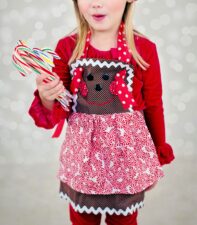
girl in red shirt and gingerbread man two layer apron with rickrak holding candy canes

Have family aprons made instead of family pjs for fun holiday photos. Then everyone can help prepare your holiday meal!

Recycle old family quilts into aprons for the family. They’re an easy project for teaching the youngsters to sew.

An inexpensive apron can save your more expensive clothes, hold utensils or tools, and make a fashion statement. Given the large numbers that are sold each year, they don’t need defense from me, but I’ll speak up for them any day.

1) https://markwideresearch.com/apron-market

Appearance or Substance

Which do you look for, appearance or substance? Appearance may make something look a certain way to certain people, but it doesn’t necessarily mean anything. As we have been inundated with the headlines we’re fed by algorithms and news outlets that need clicks, the effect of shallow, surface ideas, idle ramblings, and suppositions have insinuated themselves into conventional wisdom.

light blue background with illustration of computer monitor with webpage layout including video

Less and less information is examined closely before publicly-shared opinions are issued. Once that happens, fact-based presentations carry less weight and it becomes easier to believe misinformation.

It also becomes easy to substitute another’s supposition for fact or delude ourselves and substitute another’s supposition for fact. Social media algorithms prey on the rage factor that often results from this and builds upon itself. Clickety, click, click, click.

Conventional wisdom used to spawn clichés like, don’t judge a book by its cover because we knew that appearance didn’t necessarily represent the substance of the tome. Now, we worry about the time spent on phones.

But isn’t how we spend that time on the phone just as critical? If we limit ourselves to 10 minutes per day, but spend that 10 minutes consuming shallow, biased, misleading information it can still cause harm.

When you’ve done careful, in-depth research and know your facts are solid, it’s difficult to have a conversation with someone who got their information on the same subject from reels. I understand reels are more entertaining, but they’re fed to you by something that doesn’t care whether the content is accurate or misleading.

One result of relying on reels is that medical or psychological terminology can morph into inaccurate descriptions. A person recently described themself to me as an empath, but nothing I know about them and nothing they said would indicate they fit the term I’m familiar with.

They said they believed this because of a reel they had watched. Further examination revealed they were conflating empathizing and being an empath.

According to Psychology Today, my experience was reflective of the influence of a reel similar to one on gaslighting forwarded to Adi Jaffe, Ph.D. that “was well-produced, with clean edits, beautiful shots, and audio. There was only one problem — it greatly distorted the whole concept it was discussing. Instead of defining gaslighting (which itself is not truly a clinical psychology term), the video insisted that when someone close to you tries to sell you on their (presumably different from your own) worldview, they are gaslighting you. But that’s not what gaslighting means at all. Traditionally, when someone tries to gaslight you, they are purposely lying to you about reality in order to make you mistrust your own sense of reality. The whole concept of gaslighting is about a deliberate distortion of truth to gain a psychological advantage over another. Having a different viewpoint from someone else is not gaslighting!”1

These may be only two examples, but I encounter something similar multiple times per week. The proliferation of misunderstanding in a large portion of the population means you I often get caught off guard because people have a vastly different understanding of terms I’ve known for years.

The discomfort this creates for me is unimportant. The disconnect between health facts and fiction created through amplified misunderstanding and misinformation presents a danger greater than we may realize.

Valuing substance over appearance can help guide you to more reliable information and sources. There are licensed professional experts creating substantive online courses (some are free) that deal with the same issues you see in reels. Choose those.

There are professional experts on Bluesky. Find some. Vet them. Follow the ones who are credible. Same with Substack and podcasts. There’s nothing wrong with getting information online. It’s the quality of that information that matters.

To be safe, choose substance over appearance.

1)  https://www.psychologytoday.com/us/blog/all-about-addiction/202505/tiktok-therapy-the-pros-and-cons-of-social-media-psychology