Paradox

Current events constantly remind me of paradox. Each day presents many to consider, but perhaps the most poignant is the only certainty is that nothing is ever certain.

Two images of same man side by side. On left, looks normal. On right, looks like zombie.

Uncertainty is causing businesses small and large distress. It has increased anxiety among those whose health insurance is provided by Medicaid or subsidized by the ACA. And it contributes to delays in making decisions.

We like to believe that there are constants, things we can count on that will never change. That idea provides a feeling of safety, security, and comfort. But it is mostly an idea or a framework of ideas that we each create. Very little is, in fact, certain.

And while there are a few mostly certain likelihoods – the sun will come up, something will provide shade, it will be dark at night, the weather will change – institutions no longer function as expected, we seem to have less shared values, and our communities are not as cohesive as they once were. All of this can leave us feeling as though we are unmoored, ungrounded, lost at sea.

Life will be easier if we embrace uncertainty as a friend, not a foe. But how can we do that when every day feels dangerous?

Here are a few things that can help:

  • Accept that we can never know or predict accurately what any given day will bring.
  • Understand that we can only control ourselves.
  • Know your value and values.
  • Set good boundaries.
  • Develop, review, and revise priorities.
  • Ask for help when needed.
  • Absorb accolades and compliments.
  • Practice gratitude.
  • Be reliable and faithful to others in the way you desire them to be for you.
  • Laugh at the absurd.
  • Laugh at irony.
  • Cry for your losses.
  • Grant yourself grace.
  • Grant others grace.
  • Hold people accountable.
  • Pause before posting.
  • Say no so you can say yes.
  • Hold your ground and be willing to compromise.
  • Choose to let go.
  • Adjusting isn’t losing. Let yourself adjust.
  • Choose your battles.
  • Eat well. Sleep enough. Drink lots of water.
  • Embrace nature.
  • Make time to do regularly do something you enjoy.

While all of these can help, sitting with fear may be the skill most needed to prevent paralysis from uncertainty. Fear is not permanent. All emotions are fleeting. Some linger for a long time, but all of them come, go, morph, and shift.

The quickest way to diffuse fear is to feel it. Feel it. Sit with it. Stay in that spot until the fear dissipates. It will. And obviously, we’ve encountered another paradox – the quickest way to not feel fear is to quickly let yourself feel fear.

Can we say that uncertainty is a certainty? Of course we can because today is all about paradox.

Good Health

With the MAHA movement, perhaps we should be asking: What defines good health? It’s easy to assume we all have the same definition of health. But is that true?

closeup of dictionary page with the definition of dictionary

The top 3 definitions of the word health according to The American Heritage® Dictionary are:

health /hĕlth/

noun

  • The overall condition of an organism at a given time.
  • Soundness, especially of body or mind; freedom from disease or abnormality.
  • A condition of optimal well-being.

Merriam-Webster defines it as follows:

health

nounˈhelth  also ˈheltth

  • 1a: the condition of being sound in body, mind, or spiritespecially:freedom from physical disease or pain
  • 1b: the general condition of the body
  • 2a: a condition in which someone or something is thriving or doing well:well-being
  • 2b: general condition or state

Medical Dictionaries recognize health as a range of potential within an environment: “a relative state in which one is able to function well physically, mentally, socially, and spiritually in order to express the full range of one’s unique potentialities within the environment in which one is living.”1

While all are similar, there are some notable differences. American Heritage does not mention the spirit, only the body and mind. Merriam-Webster mentions the spirit, but emphasizes physical disease and pain. Of the three, the medical dictionary is the only one to mention potential and environment.

Why does defining health or good health matter?

To Establish The State We Wish to Achieve

Keeping it simple, if you don’t know what it is, you can’t recognize when you have it.While that’s stating the obvious, we spend lots of time, energy, and money trying to achieve good health. If we don’t define what it is, not only may we fail to recognize it when we achieve it, we can’t devise a reasonable plan to get to the state we strive for.

To Create Reachable Goals

Health, good health, and optimum health are not the same for everyone. I don’t have the same health potential as someone with a different genetic makeup, history of illness, background of injury, exposure to environments, and reliance on medication. That’s why the medical dictionary uses words like unique potentialities and environment. Understanding what’s realistic for me is key to developing appropriate and achievable goals.

To Make Sure My Health Choices Reflect My Priorities

I may not have the same priorities as my physician. This can mean I request an alternative route to get to the same goal. My doctor might prefer I take a certain medication that will get a result quicker. I may prefer a lengthier path that leads to the root cause of my issue. As a team, we can devise a treatment plan in line with my priorities.

Other priorities may extend beyond my personal health in order to protect vulnerable family members, those with disabilities, and the elderly.

To Balance Time Spent On Each Component Of Health

If I spend too much time working out, I may not have time to prepare food that most benefits me. If I only focus on physical health, I may neglect social connections, creative projects, or practices that contribute to a positive state of mind.

To Get Results

Without any clear definition, goal, or plan, there’s no way to measure results. Even if our health plan is mostly about the process, we won’t know whether we’re on track unless we’ve outlined that process & where we hope it to take us.

There’s no better time than now to define good health, determine our priorities, and develop a plan to meet our health goals. This will make the path more clear as information becomes murkier.

1 https://medical-dictionary.thefreedictionary.com/health

ad

Mix and Match

A recent restaurant appetizer reminded me how delicious it can be to mix and match. When we arrived at the restaurant, I was hungry with a capital H! The first thing that caught my eye was the word gluten-free next to the hummus and tzatziki crispy flatbread.

When the platter arrived, I expected separate containers of hummus and tzatziki with flatbread to dip into one or the other and maybe a few olives on the side. Instead, just the right amount of hummus had been spread onto the flatbread and was topped by a smear of tzatziki. The mixture of flavors in each bite was delicious!

While both flavors are Mediterranean, hummus hails from the Middle East. Tzatziki is a staple of Greek cuisine. They’re more often served as neighboring accoutrements than companion toppings. This experience was a great reminder that mixing and matching is an easy way to bring variety to your go-tos.

Burger with multiple toppings on plate with fries and glass of beer in background.

Here are a few mix and match possibilities:

The family meal staple lasagne’s mix of Italian herbs like oregano and basil can be amplified by the addition of Mexican spices like chili powder and cumin.

Chocolate and cayenne pepper take dessert favorites like brownies and ice cream to the spicy side.

If you like your salads cool, use your ranch dressing to cool down your pizza.

Afraid to go dairy-free because you love cereal? Pour some orange juice over those flakes. We’ve been doing this for years in my family. You can even use mandarin oranges and the juice they come in.

While you have the orange juice out, use some to dip your chocolate cookies.

For those who are upping the protein and limiting the carbs, a little strawberry jelly on your scrambled eggs, omelet, or frittata can make you forget about reaching for a piece of toast.

Be sure to feed your kids ants on a log so they won’t think celery paired with peanut butter and raisins is weird.

Add a squeeze or two of fresh lemon juice to vanilla icing before you drizzle it on cinnamon rolls. It brightens the flavor and keeps it from becoming too sweet.

A neighborhood restaurant serves a burger called The Jamn Skippy. It adds feta, caramelized sumac onions, and seasonal berry jam to a grass-fed beef burger.

The Jamn Skippy name might make you expect peanut butter, but you have to go down the street to a smash burger food truck to get your burger topped with peanut butter, jalapeño jelly, pepper jack cheese, jalapeños, lettuce, and bacon. They call it the Ooey Gooey Stack. And it is.

Taking this tasty walk reminds me of my dad’s favorite combos – salted peanuts in Pepsi, cornbread in buttermilk, and cheddar cheese on apple pie. But nobody really thought those were weird. After all, his mom made chocolate gravy for her biscuits.

Whether you think the combos are weird or not, when you’re tired of repeating the usual flavors, reach for something out of the ordinary to try. Your next mix and match experiment could turn into your favorite combo!

https://www.cooking2thrive.com/blog/perfect-pair/

Wash

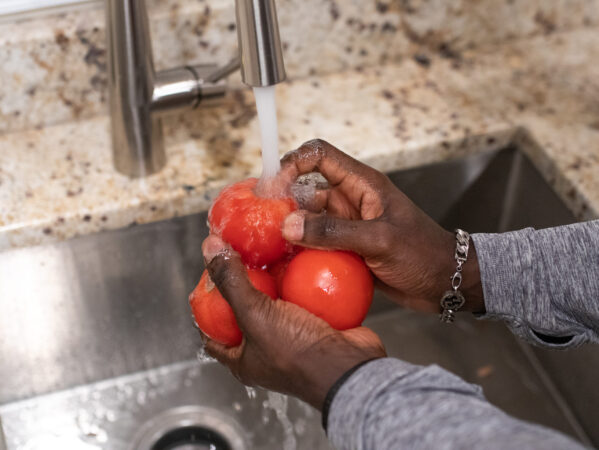
Wash your hands. Wash your veggies. Wash your fruit. If it’s raw and you’re not going to cook it – clean it. This morning, a new list of recalls crossed my screen. It’s a good reminder that contaminated raw fruits, vegetables, and eggs can make you sick.

close up of black man's hands washing tomatoes in sink

Instead of a quick rinse in water, consider using some kind of veggie wash product to remove an additional layer of contamination. This may not remove every organism, but it will help minimize potential exposure to undesirable substances.

In certain circumstances I wear a mask to handle fruit. I’m most likely overdoing the safety factor, but with berries that mold quickly and citrus, I’m doubly careful. 

I understand the risk of inhaling enough fungus or mold to be problematic is low, but I remember my mother having a lung lavage to rid herself of a fungus growing there. Her doctors speculated that she had inhaled the fungus from unwashed citrus fruit she peeled.

Mold, fungi, and bacteria can travel in and on food. Histamines can multiply as food ages. We rely on farmers or supermarkets to handle food properly. But we should always keep in mind that the food we purchase may not have been kept at the ideal temperature. It may also be older than we imagine. And if you grow your own vegetables, cleaning removes soil as well.

In addition to the food itself, keeping utensils, cutting boards, and countertops clean will help prevent contamination from one item to the next. I know it may seem like you’re generating more dishes to wash without much benefit, but one round of salmonella will convince you the extra effort is worth it.

My great aunts used to make sure all the dishes they handwashed were rinsed in scalding water. I use this technique in the RV where I’m trying to keep the volume of water usage low. I still scrub with soap, but I want the double protection of rinsing with boiling water.

It absolutely drives me crazy to watch TV cooks wipe their hands off on a cloth towel when handling meat and then go back to handling knives and other utensils without actually washing their hands. I understand a kitchen set with rolling cameras means handwashing creates a disruption that requires more editing but showing this also teaches new or potential cooks bad habits.

Modeling healthy habits and kitchen cleanliness for our children is beneficial. We don’t want them sending us to the hospital the first time they cook us a meal! And learning by repeated, consistent example can be effective even if we don’t reinforce the lessons verbally.

I guess that brings us to the question of the five second rule. It’s not as bad as it sounds depending – how clean are your floors, do you have pets in the house, does anyone track in agricultural waste, and what is it you dropped – these are all factors that affect the safety of the policy. If you are pet free and mop often, five seconds probably won’t hurt anything.

On the other hand, if you break an egg onto the floor and do not disinfect the spill, you may contaminate other things that touch the floor.

Each of us has our own sensibilities when it comes to cleanliness. If you’re going to eat it, clean is better as long as you’re cleaning with ingestible cleaners. And high temperature cooking will kill most bacteria.

If you don’t want to wash your hands as often, wear gloves – keeping in mind that gloves can also spread contaminants from one surface to another.

In short, keeping it clean in the kitchen means wash, wash, wash.

ad