Is It Safe to Graze on These Snacks?

If you must be gluten-free to be healthy, you always have to ask: Is it safe to graze on this? In order to answer that question, I always start with the label. I recently purchased a Graze Dark Chocolate Cherry Tart snack. I was in a hurry, so I saved the label reading for later.
graze
I liked the natural looking package and I absolutely LOVE dried cherries, almonds, and chocolate. These are ingredients that can easily be gluten free and that I often use when I prepare dessert. The only noted allergens on the label are soybeans and tree nuts. Buying this didn’t seem like too big a risk.

When I got home and had time to read the label, I saw that the chocolate buttons include something called “cocoa mass”. I didn’t know exactly what cocoa mass was, but I recognized that it needed to be further investigated. I visited the Graze website.

After visiting the site, I still don’t know what cocoa mass is, but I found this statement located next to the list of ingredients:
“allergens
Graze is not suitable for people with allergies. All of our food is packed in the same place, so cross-contamination between any of our ingredients is possible. Our snacks may contain traces of gluten, eggs, peanuts, soya, milk, nuts, celery, mustard, fish and sesame.”

This statement appears next to the list of ingredients for each and every product on the website. It’s interesting to note that there’s not enough of some of these allergens to require a notation on the label, but there’s enough for the company to feel it necessary to note their possible presence in the product. I appreciate the fact that they’ve done so in a clear, visible manner.

Where does that leave you?

It’s always safest to err on the side of caution when you encounter an unknown ingredient. I also avoid products that say they are processed on the same equipment as wheat, rye, and barley or may contain trace amounts of these ingredients. If a label does not list any gluten containing ingredients, questionable items, or cross contamination possibilities, I trust that it’s okay to consume even though it may not be labeled gluten-free.
 
While I like the Graze story of 7 friends who quit their jobs to create better snacks, I cannot recommend these snacks to anyone who is gluten-free. On the other hand, if you’re not limited by the allergens, eat up!

Choose from mixes full of nuts, seeds, dried fruit, superfoods, veggies, and protein. The flavor combinations sound interesting and the packages are easy to carry. Graze has a subscription service, so you can have them delivered right to your door.

If you have celiac disease or gluten intolerance, it’s not safe to graze on these snacks, but you don’t have to miss out on enjoying dried cherries, almonds and chocolate!

Disclosure of Material Connection: I have not received any compensation for writing this post. I have no material connection to the brands, products, or services that I have mentioned. I am disclosing this in accordance with the Federal Trade Commission’s 16 CFR, Part 255: “Guides Concerning the Use of Endorsements and Testimonials in Advertising.”

https://www.graze.com/us/shop/dark-chocolate-cherry-tart?format=multipack#tab-ingredient-tab

A Baby Food Mill Can Provide Peace of Mind

kitIf you have a family history of food allergies or intolerance, a baby food mill can provide peace of mind because you know exactly what’s in the food your baby is consuming. My mom suffered from what we then called Hay Fever to the extent that her nose ran all the time and would get raw from wiping it with tissues. She solved the raw nose problem by walking around with silk panties hanging out of her nose. I kid you not and I wish I had a photo. Maybe you’ll believe me if I show you this current photo of her with a diaper on her head. She says she was cold. Don’t ask me.
mom
At the time, I can’t remember her attributing the, let’s call it, Silk Panty Situation to foods. It seemed to be more an allergy to ragweed or driving the truck when it was time to haul hay. The latter part resulted in me learning to drive very early and having my first wreck, passengers included, when I was 9. But that’s another story altogether. Back to our discussion of allergies…

When Ben was a tiny baby, he suffered from constant congestion. I mean significant congestion that made it difficult for him to breath through his nose. His pediatrician put him on asthma medication. That made him hyper, fussy, and kept him from sleeping. After a few exhausting weeks of a constantly awake, crying baby, I decided there had to be a better solution.

Through some trial and error, I figured out that if I would avoid dairy products in my diet, Ben’s congestion would disappear. This made some sense. By then we already knew that James did not tolerate dairy well. I decided that I could go without ice cream for a year while I breastfed if it meant Ben could breath without meds and I could get a night’s sleep.

James’ history, and subsequently Ben’s, wasn’t the only reason I followed the American Academy of Pediatrics (AAP) recommendations for food introduction to prevent allergies, my sister had a history of turning beet red when she consumed foods containing basil or magnesium. I wanted to make sure that I gave the kids the best chance I could to avoid problems in the future.

As they currently do, the APA then recommended breast milk only for the first 6 months. Once it was time to introduce solid food, I opted for the most control possible over the ingredients and invested in a baby food mill. That simple device allowed me to know exactly what I was feeding my children and it was easy on the budget. I could feed James & Ben the same food their dad and I were eating, but in a baby friendly form.
baby food grinder
Baby food mills are still a good option for the same reasons. While it’s now much easier to buy organic baby food from the supermarket, many brands are only 95% organic, some contain preservatives, and the cost ranges from 23¢ to 48¢ per ounce. When you get to Stage 2 foods, most prepackaged options are blends that may or may not appeal to your child thereby limiting your selection and their nutrient variety.
green grinder
There are many brands of food mills and they come in several shapes and sizes. Most are small enough to be easily carried along on an outing and some even come with a travel pack. In the most common design, you pull the top bowl section upward, fill the tube below with food and as you turn the handle, the food moves up into the bowl section ready to feed to your infant. The components then come apart to be cleaned in the dishwasher.
white grinder
If you want the option of using the mill for other food processing jobs, you can choose an OXO model with 3 interchangeable blades. There are electronic versions as well if you’re a fan of specialized power kitchen gadgets.
oxo
Once you’ve chosen the model that best suits the needs of your family, all you have to do is fill it with freshly prepared food – organic when possible and devoid of sugar, as well as excessive salt or fat. According to the AAP, new eaters only need one or two tablespoons of food at a time increasing to 3 – 4 tablespoons as the child grows. They also recommend that you avoid feeding an infant under 4 months old fresh spinach, beets, green beans, carrots, and squash because of the naturally occurring nitrates. If you follow their recommendation of breast milk only for a minimum of 4 months, this should not be an issue.

There is no evidence that introducing foods in a particular order will prevent allergies. In order to quickly recognize an allergic response, it is best to introduce foods one at a time and feed only that food for 2-3 days before moving to the next food. If your child experiences, diarrhea, rash, vomiting, congestion, hives, or irritability that disappears once a particular food is removed, your child may be allergic to that food.

For those of you who are celiac or have gluten intolerance in your family, your children are at increased risk of being gluten intolerant due to shared genetics. Because gluten intolerance causes an immune response, it is not the same as an allergy. It may be best not to introduce any baby cereals other than possibly rice and oats until the child is older, if at all.

While I can’t say James and Ben are a representative sample of kids who grow up eating table food rather than packaged baby food, they are both chronically healthy. Using a baby food mill helped keep me on budget and give me the peace of mind that I was providing them with the best nutrition possible.

Judging by these photos of James’ first meal of solid food, he was well prepared for the event and satisfied by the content!
jamesone
james 2
james 3

Check out these food mills:

http://www.kidco.com/products-page/preparation/f810/

http://ep.yimg.com/ty/cdn/happybaby/kidcofoodmillinst.pdf

http://www.kidalog.com/categories/Mealtime/

http://www.munchkin.com/fresh-feeding-starter-set.html

http://www.oxo.com/p-476-food-mill.aspx

For more information regarding infant feeding suggestions and guidelines, see these resources:

https://www.aap.org/en-us/advocacy-and-policy/aap-health-initiatives/HALF-Implementation-Guide/Age-Specific-Content/Pages/Infant-Food-and-Feeding.aspx

http://ebooks.aappublications.org/content/nutrition-0

https://brightfutures.aap.org/pdfs/Guidelines_PDF/6-Promoting_Healthy_Nutrition.pdf

http://www.healthychildren.org/English/ages-stages/baby/feeding-nutrition/Pages/Switching-To-Solid-Foods.aspx

http://pediatrics.aappublications.org/content/116/3/784.full

Disclosure of Material Connection: I have not received any compensation for writing this post. I have no material connection to the brands, products, or services that I have mentioned. I am disclosing this in accordance with the Federal Trade Commission’s 16 CFR, Part 255: “Guides Concerning the Use of Endorsements and Testimonials in Advertising.”

Common Sense Trumps Gluten Intolerance vs. FODMAPs

Gluten intolerance may not even exist or how common sense trumps gluten Intolerance vs. FODMAPs argument…

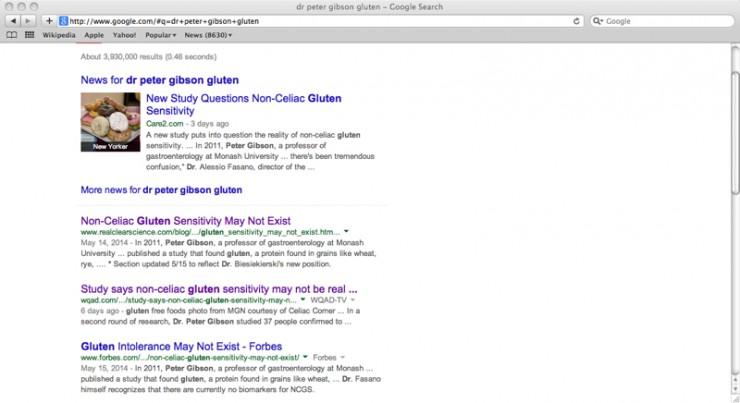
Yesterday I was on the phone with a friend who asked, “By the way, did you see how the first doctor to study gluten has recanted and says he got it wrong? Gluten doesn’t bother very many people, so most people should keep eating it. The diet’s just a fad.”
search

I had no idea what he was talking about. He emailed me a link to this article – http://gizmodo.com/your-gluten-intolerance-may-actually-be-from-somethin-1580781192 – that discusses a 2013 study by Dr. Peter Gibson of Monash University in Australia from which the doctor concluded that some gluten intolerance symptoms might be caused by a group of carbohydrates called fermentable oligo-di-monosaccharides and polyols or FODMAPs rather than gluten.

This short blip of information really didn’t give enough detail about the study to draw any conclusion, but it did contain another link to this article by Casey Chan posted May 15 on “Sploid” – http://sploid.gizmodo.com/being-gluten-free-is-dumb-because-gluten-insensitivity-1577178094. Here’s the title and first paragraph:

“Being gluten free is dumb—and gluten intolerance may not even exist

If you have Celiac, this obviously doesn’t apply to you. Don’t eat gluten. But if you don’t have Celiac—and that’s 99% of the human population, mind you—there’s no reason to be gluten free. You’re wasting your time. Even the scientist who started this gluten free craze thinks it’s useless to be gluten free. Seriously. People, the father of gluten free think it’s bullshit.”

It continues: “According to ‘Real Clear Science’, Gibson had subjects with ‘gluten intolerance’ but weren’t Celiac take part in an experiment that fed them a high gluten, normal gluten, low gluten and placebo diet for a week and found that there was ‘absolutely no specific response to gluten.’

What happened was that everybody reported pain, bloating, nausea and gas to similar degrees. No matter what they ate—gluten or placebo—they felt sick. The problem wasn’t with gluten, it was with their brains. Basically, it’s the nocebo effect. People psych themselves out and start believing they’re sick.”

Whenever someone attempts to communicate the results of a scientific study to me using words like “dumb and bullshit”, I have to wonder about their intent. Certainly, they cast a negative light on the term gluten intolerance, but to what purpose and to make what point?

Perhaps it’s just to stir things up – create controversy for the sake of controversy. Perhaps it’s to justify drinking better tasting beer. Perhaps it’s a way to tell us we’re all stupid and the writer is not. I have no idea.

What it told me was several things:
1)I needed to find the actual study so that I could better understand the methodology and the findings.
2)Mr. Chan fails to understand that Celiac is the end-stage phase of a disease process about which we are gaining more and more information. To refuse to recognize a disease until it reaches end stage seems a bit like saying you can’t have heart disease unless you’ve had a heart attack so that shortness of breath or chest pain you’re feeling must all be in your head.
3)Whether it is gluten that’s the culprit, FODMAPs, wheat germ agglutinin (WGA), bacterial overgrowth, yeast overgrowth, or something yet undiscovered causing bloating, gas, pain, motility problems and inflammation, it is a misrepresentation of the results of the study to say that wheat containing gluten had no real effect on the 37 subjects studied. Otherwise, why conclude that a low FODMAP diet, which by definition would not include wheat, was helpful? Which brings me to
4)If eliminating wheat from the diet is a recommendation resulting from this 2013 study (as indicated on the Monash University Gastroenterology Department’s Website), then isn’t that the important thing we need to know for patients to be healthy? In fact, a gluten-free diet would put these subjects closer to the suggested diet than a traditional one so whether or not you want to disparagingly label it a fad, a gluten-free regimen in these cases would be more helpful than harmful.

It is good for researchers to reexamine the issue. It is good to keep our minds open about the results. It will be normal for quite some time for scientists to present what appear to be conflicting results from studies. We are in an early phase of this research game. Eventually, the pieces of the puzzle will fall together and we can say more definitively what is causing certain symptoms for certain people. In the meantime, the preponderance of research indicates that eliminating at least wheat and rye from the diet is beneficial to those who suffer from gastrointestinal pain, bloating, nausea, and motility issues.

Why not use common sense and stay away from the foods while the experts sort out the specifics?

From Monash University’s website: http://www.med.monash.edu/cecs/gastro/fodmap/diet.html

Sample Low FODMAP meal ideas
Editor’s note: Notice that Dr. Gibson’s department recommends gluten-free items below.

Breakfast
Gluten-free or spelt toast with vegemite, strawberry jam (sweetened with sucrose)
Cereal (oats, porridge, cornflakes*, rice bubbles*)
Tea or coffee (lactose-free milk if you have lactose malabsorption)
Serve of suitable low FODMAP fruit
* add oat or rice bran for extra dietary fibre
Lunch
Gluten-free or spelt sandwich with fillings (ham/salad, tuna/ salad, cheese/salad, egg/ lettuce)
Soup homemade with low FODMAP vegetables
Fresh salads with dressing (olive oil, lemon juice) and plain meat
Gluten-free pizza with low FODMAP vegetable toppings
Dinner
Meat/fish/tofu plus low FODMAP vegetables/ salad plus potato/rice/gluten-free pasta/rice noodles
Snacks
One serve of suitable fruit (cantaloupe, banana, grapes, strawberries, orange)
Yoghurt (lactose-free if you have lactose malabsorption)
Gluten-free biscuits and cakes

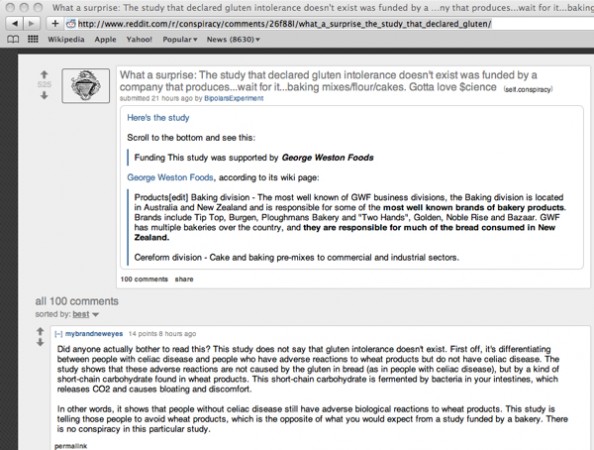
And for you conspiracy theorists:
http://www.reddit.com/r/conspiracy/comments/26f88l/what_a_surprise_the_study_that_declared_gluten/
conspiracy

http://www.realclearscience.com/blog/2014/05/gluten_sensitivity_may_not_exist.html

Disclosure of Material Connection: I have not received any compensation for writing this post. I have no material connection to the brands, products, or services that I have mentioned. I am disclosing this in accordance with the Federal Trade Commission’s 16 CFR, Part 255: “Guides Concerning the Use of Endorsements and Testimonials in Advertising.”

Should I let my gluten-intolerant child play with play dough?

Every kid loves to play with play dough! When I was small, my grandmother would whip up a batch using flour, water, salt, and food coloring. My cousins and I were quickly entertained and, per Granny’s instructions, confined to the kitchen table so that she was free to do her chores without interruption.

We made the usual snakes, tiny people, cookie cutter shapes, cakes, and pies. Because we knew the play dough was edible, we didn’t hesitate to put it up to our lips when pretending to eat a play dough cookie.

At my own house we played with commercially produced Play-Doh®, as did my children when they were younger. Although there’s no longer any metal or cardboard involved, I still love those bright yellow containers with the tight fitting lids and the distinctive smelling dough inside.

Play Dough

Clearly I’m not alone because Hasbro produces over 100 million cans of Play-Doh per year.(1) With that much Play-Doh around, unless your child never leaves home, there’s virtually no chance for him to avoid an opportunity to play with some.

If your child is gluten-intolerant or has Celiac disease, is it okay for him/her to join in the play dough fun?

According to the Hasbro Play-Doh website, the dough is “primarily a mixture of water, salt, and flour. It does NOT contain peanuts, peanut oil, or any milk byproducts. It DOES contain wheat.” The site continues, “PLAY-DOH compound is non-toxic, non-irritating & non-allergenic except as noted: Children who are allergic to wheat gluten may have an allergic reaction to this product. Also, due to the high salt content in PLAY-DOH compound, the product can be harmful to pets if ingested.”

Could you take this to mean you should absolutely forbid, and vigilantly prevent, your child’s exposure to this substance? You could take it that way, but such a drastic response may not be necessary unless your child has a wheat allergy that may lead to anaphylaxis and anaphylactic shock.(2)

If your child is not allergic, but has an autoimmune intolerance to gluten there is no reason for concern unless she eats the Play-Doh. Gluten molecules are too large to be absorbed through the skin.(1) Even a brush of play dough on the lips will likely transmit less gluten than allowed in an item labeled “gluten-free” in a country that has an allowable standard.(3)

A toddler is more likely to eat Play-Doh than an older child, and some particular children are prone to put everything in their mouths whereas others are not. Since a toddler’s environment is more closely controlled anyway, it may be possible to keep them in a mostly Play-Doh free environment until they are older. If you know your older child has a habit of ingesting foreign items, then it may be good to explain in stronger terms to this child, the potential danger of eating Play-Doh. Otherwise, why not just let them play?

It is difficult enough for a child to feel “different’ because he has to eat differently. When there’s no significant immediate danger, why even mention an adverse possibility? Again, you know your child. If you think it’s necessary to tell them not to eat the Play-Doh then tell them, but for most kids saying nothing is probably the best strategy. You can always sterilize the cookie cutters once the Play-Doh has been put away.

It’s always great to discover something we DON’T have to be worried about. For the gluten-intolerant and those with Celiac Disease, playing with Play-Doh is perfectly safe as long as you don’t ingest it. Go get the kids; it’s time to make something fun!

Email pictures of your kid’s play dough creation to support@cooking2thrive.com, and we’ll post it here on the blog.


(1)http://www.hasbro.com/playdoh/en_US/faq.cfm

(2) http://www.nlm.nih.gov/medlineplus/mplusdictionary.html

(3)http://thehill.com/blogs/regwatch/healthcare/284929-gluten-free-labeling-rules-head-to-white-house


Disclosure of Material Connection: I have not received any compensation for writing this post. I have no material connection to the brands, products, or services that I have mentioned. I am disclosing this in accordance with the Federal Trade Commission’s 16 CFR, Part 255: “Guides Concerning the Use of Endorsements and Testimonials in Advertising.”