Grab & Go

How can I grab & go if I must avoid gluten, histamine, FODMAPS, and dairy? It’s a great question! And a pertinent one if your family gets hangry like mine.

While it may seem be easier than ever to avoid gluten, the task becomes more difficult as restrictions compound. Some restaurants offer a salad base to turn a sandwich into a salad. That’s great unless the salad contains a significant amount of mushrooms, spinach, or finely chopped tomatoes that are high in histamine. And you’ll probably have to ask them to hold the cheese to avoid dairy and problematic plant-based cheeses. Then there’s the matter of fruit in salads – some are high in histamine and some are full of short-chain carbohydrates known as fermentable oligosaccharides, disaccharides, monosaccharides and polyols or FODMAPs.

Of course you can eat at home, but grab & go can be complicated there too. Canned tuna & chicken, deli meat, sausage, polish sausage, ham, and hot dogs are typically high in histamine. Pickles are out. Packaged salad toppers with candied nuts and dried fruit are out.

Although it requires a bit of effort, there are ways to mitigate the inconvenience and have grab & go options at the ready when mealtime slips up on you.

Here are some ideas:

Gluten-free instant oatmeal is shelf-stable, filling and easy to carry. Keep some in the pantry to fill in gaps when someone gets too hungry.

Imagine® shelf-stable chicken, bone, or vegetable (contains a small amount of tomato) broth can be heated in the microwave and served in a mug as a satisfying drink to take the edge off of hunger.

Keep some gluten free bread or bagels on hand or in the freezer and nut butters in the pantry. If you haven’t tried peanut butter on warm toast, give it a try. It’s surprisingly good!

Replace sandwich meat with pre-grilled or blackened thinly sliced chicken breasts or steak. Trim away any fat, season with salt, pepper, and garlic. Bake or grill the chicken just until done. Sear the steak in a skillet and finish in the oven. Cook two or three times as much as you normally would. Freeze in daily portions. Thaw a day or two before you run out of easy-to-grab foods.

Chicken can be eaten on a sandwich with lettuce, fresh cucumber slices, and fresh basil leaves. It can be sliced or shredded and served inside a wrap with hummus (if tolerated), and fresh red bell pepper slices.

The fastest, easiest way to have these proteins available is to buy and prepare larger than normal quantities when you’re cooking the items anyway. The same is true of beef or pork roast which can be sliced and then frozen for later use on salads, sandwiches, and in wraps. Purchase an additional pound of roast to prepare when you’re making roast for dinner.

Keep a supply of low histamine vegetables that can be enjoyed raw – carrots, zucchini, cucumber, lettuce, green onions as well as low histamine/low FODMAP fresh fruit – blueberries, kiwi, and raw nuts (if well tolerated).

Purchase an extra half-dozen or dozen eggs along with your regular purchase. Boil the extras and keep them in the refrigerator. You can even pre-peel them once they’re cool so that they’re truly grab & go. They can also be used in egg salad or a green salad.

Bake and freeze a dozen muffins. Thaw in the microwave as needed or take a weekly portion out of the freezer and allow to thaw in the refrigerator for everyday use.

You can also make and freeze pancakes fitting your needs that can be used as a wrap for breakfast sandwiches.

As long as you keep it simple, staying ahead of the game doesn’t require too much time and effort. Tack a few tasks onto things you already have planned. Keep a few strategic items in the freezer and pantry. Before you know it, dietary compliant grab & go will seem like a piece of cake.

Disclosure of Material Connection: I have not received any compensation for writing this post. I have no material connection to the brands, products, or services that I have mentioned. I am disclosing this in accordance with the Federal Trade Commission’s 16 CFR, Part 255: “Guides Concerning the Use of Endorsements and Testimonials in Advertising.”
Common Sense Trumps Gluten Intolerance vs. FODMAPs

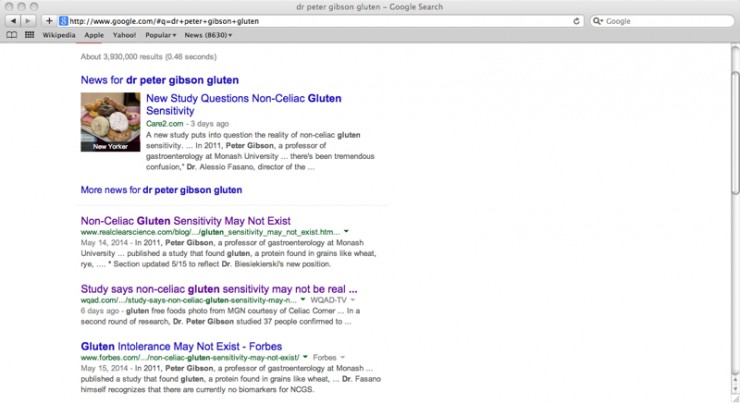
Gluten intolerance may not even exist or how common sense trumps gluten Intolerance vs. FODMAPs argument…

Yesterday I was on the phone with a friend who asked, “By the way, did you see how the first doctor to study gluten has recanted and says he got it wrong? Gluten doesn’t bother very many people, so most people should keep eating it. The diet’s just a fad.”

search

I had no idea what he was talking about. He emailed me a link to this article – http://gizmodo.com/your-gluten-intolerance-may-actually-be-from-somethin-1580781192 – that discusses a 2013 study by Dr. Peter Gibson of Monash University in Australia from which the doctor concluded that some gluten intolerance symptoms might be caused by a group of carbohydrates called fermentable oligo-di-monosaccharides and polyols or FODMAPs rather than gluten.

This short blip of information really didn’t give enough detail about the study to draw any conclusion, but it did contain another link to this article by Casey Chan posted May 15 on “Sploid” – http://sploid.gizmodo.com/being-gluten-free-is-dumb-because-gluten-insensitivity-1577178094. Here’s the title and first paragraph:

“Being gluten free is dumb—and gluten intolerance may not even exist

If you have Celiac, this obviously doesn’t apply to you. Don’t eat gluten. But if you don’t have Celiac—and that’s 99% of the human population, mind you—there’s no reason to be gluten free. You’re wasting your time. Even the scientist who started this gluten free craze thinks it’s useless to be gluten free. Seriously. People, the father of gluten free think it’s bullshit.”

It continues: “According to ‘Real Clear Science’, Gibson had subjects with ‘gluten intolerance’ but weren’t Celiac take part in an experiment that fed them a high gluten, normal gluten, low gluten and placebo diet for a week and found that there was ‘absolutely no specific response to gluten.’

What happened was that everybody reported pain, bloating, nausea and gas to similar degrees. No matter what they ate—gluten or placebo—they felt sick. The problem wasn’t with gluten, it was with their brains. Basically, it’s the nocebo effect. People psych themselves out and start believing they’re sick.”

Whenever someone attempts to communicate the results of a scientific study to me using words like “dumb and bullshit”, I have to wonder about their intent. Certainly, they cast a negative light on the term gluten intolerance, but to what purpose and to make what point?

Perhaps it’s just to stir things up – create controversy for the sake of controversy. Perhaps it’s to justify drinking better tasting beer. Perhaps it’s a way to tell us we’re all stupid and the writer is not. I have no idea.

What it told me was several things:
1)I needed to find the actual study so that I could better understand the methodology and the findings.
2)Mr. Chan fails to understand that Celiac is the end-stage phase of a disease process about which we are gaining more and more information. To refuse to recognize a disease until it reaches end stage seems a bit like saying you can’t have heart disease unless you’ve had a heart attack so that shortness of breath or chest pain you’re feeling must all be in your head.
3)Whether it is gluten that’s the culprit, FODMAPs, wheat germ agglutinin (WGA), bacterial overgrowth, yeast overgrowth, or something yet undiscovered causing bloating, gas, pain, motility problems and inflammation, it is a misrepresentation of the results of the study to say that wheat containing gluten had no real effect on the 37 subjects studied. Otherwise, why conclude that a low FODMAP diet, which by definition would not include wheat, was helpful? Which brings me to
4)If eliminating wheat from the diet is a recommendation resulting from this 2013 study (as indicated on the Monash University Gastroenterology Department’s Website), then isn’t that the important thing we need to know for patients to be healthy? In fact, a gluten-free diet would put these subjects closer to the suggested diet than a traditional one so whether or not you want to disparagingly label it a fad, a gluten-free regimen in these cases would be more helpful than harmful.

It is good for researchers to reexamine the issue. It is good to keep our minds open about the results. It will be normal for quite some time for scientists to present what appear to be conflicting results from studies. We are in an early phase of this research game. Eventually, the pieces of the puzzle will fall together and we can say more definitively what is causing certain symptoms for certain people. In the meantime, the preponderance of research indicates that eliminating at least wheat and rye from the diet is beneficial to those who suffer from gastrointestinal pain, bloating, nausea, and motility issues.

Why not use common sense and stay away from the foods while the experts sort out the specifics?

From Monash University’s website: http://www.med.monash.edu/cecs/gastro/fodmap/diet.html

Sample Low FODMAP meal ideas
Editor’s note: Notice that Dr. Gibson’s department recommends gluten-free items below.

Breakfast
Gluten-free or spelt toast with vegemite, strawberry jam (sweetened with sucrose)
Cereal (oats, porridge, cornflakes*, rice bubbles*)
Tea or coffee (lactose-free milk if you have lactose malabsorption)
Serve of suitable low FODMAP fruit
* add oat or rice bran for extra dietary fibre
Lunch
Gluten-free or spelt sandwich with fillings (ham/salad, tuna/ salad, cheese/salad, egg/ lettuce)
Soup homemade with low FODMAP vegetables
Fresh salads with dressing (olive oil, lemon juice) and plain meat
Gluten-free pizza with low FODMAP vegetable toppings
Dinner
Meat/fish/tofu plus low FODMAP vegetables/ salad plus potato/rice/gluten-free pasta/rice noodles
Snacks
One serve of suitable fruit (cantaloupe, banana, grapes, strawberries, orange)
Yoghurt (lactose-free if you have lactose malabsorption)
Gluten-free biscuits and cakes

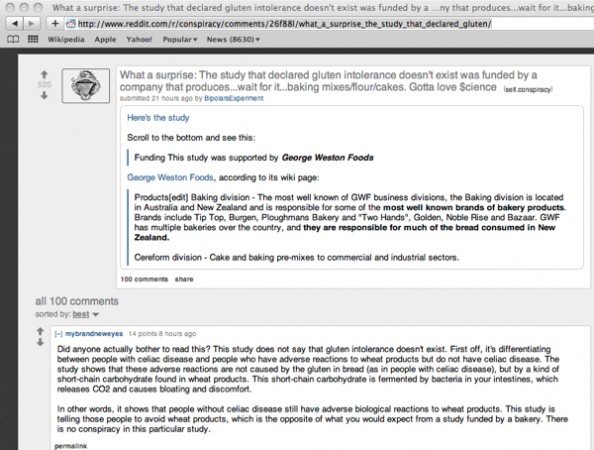
And for you conspiracy theorists:
http://www.reddit.com/r/conspiracy/comments/26f88l/what_a_surprise_the_study_that_declared_gluten/

conspiracy

http://www.realclearscience.com/blog/2014/05/gluten_sensitivity_may_not_exist.html

Disclosure of Material Connection: I have not received any compensation for writing this post. I have no material connection to the brands, products, or services that I have mentioned. I am disclosing this in accordance with the Federal Trade Commission’s 16 CFR, Part 255: “Guides Concerning the Use of Endorsements and Testimonials in Advertising.”