Kitchen Basics – How Do You Choose?

When you don’t have much space, how do you choose the kitchen basics? I’ve been looking at the possibility of purchasing the cutest cabin with the greatest view! The overall size is about 500 square feet which means the kitchen is TINY!

View
It may be tiny, but this kitchen packs in usability with a skinny 4 burner stove, a small refrigerator/freezer, and bottom cabinetry. A fairly long counter contains a sink and bottom cabinets with doors while its top offers adequate, if not ample, workspace. There are no top cabinets, no dishwasher, no pantry, no island, no broom closet, no wall space, and no dance floor. There’s plenty of light streaming in through a window that looks out at the view and the warm-toned wood ceiling and floor keep it feeling cozy.
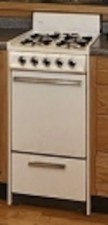
stove
In order to keep the space from feeling crowded, I’m pondering which kitchen basics are critical. Here’s the process I’m using to pare down to fit the space:

–If it can be done by hand, with an existing appliance or with a simple utensil, I don’t need an appliance for it. Bye, bye toaster, electric can opener, mixer, rice cooker, food processor, blender, breakfast sandwich maker, juicer, and crock pot. Hello French press.

–If it’s for baking, but won’t fit in the oven – it’s out. I’m thinking one covered casserole dish, one cake pan, and two cookie sheets will cover my regular cooking habits. I can use silicone cupcake cups in the baking pan when I want to make cupcakes or muffins. As rarely as I make pie, disposable pie pans purchased when needed should suffice.

–If it’s for the top of the stove, I’m carefully examining how many I need and what size. I want a large pot for soup or chili, but I’ll rarely serve more than 4 people at a time. A 4 quart sauce pot should be adequate. In addition, I’ll want at least one more saucepan and at least one skillet. I’m thinking that I may start with one of each and then determine how often I feel limited before buying more. With just one skillet on hand, I’ll probably go with cast iron.

–Two mixing bowls that double as serving dishes, a whisk, a spatula, a slotted spoon, one large and one small sharp knife, an adjustable measuring spoon, a measuring cup with multiple markings, a pastry blender, two dishtowels, and a cutting board fill out my general cooking needs.
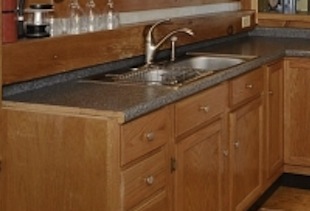
counter
As I envision my cabinets already swiftly filling, I recognize that it is wise to limit my dishes, flatware, placemats, napkins (I use cloth), coffee mugs, and glassware to service for 4.

–I should have just enough room to store salt, pepper, garlic powder, cumin, chili powder, curry powder, vanilla, cinnamon, nutmeg, cloves, Italian seasoning, shortening, honey, olive oil spray, balsamic vinegar, wax paper, aluminum foil, and zip top bags.

Your specific baking utensil and pantry choices will be different than mine. If you host ice cream socials every week, an ice cream maker may be more important to you than a large chili pot. The specifics of stocking the kitchen are much less important than the process of determining what’s important to make you feel as though you have enough.

In our consumer driven culture, we’re much more likely to stuff our shelves, drawers, and pantry with things we rarely, or never, use than we are to take the time to know ourselves well enough to be selective. Examining our relationship to the things we purchase, how we spend our time, what we value, what we hold onto that’s no longer useful, and what makes us feel safe can be a great step on the path to contentment and peace.

Before my first European trip, a fellow traveler advised me to pack my bag, remove half of what I had packed, and then divide that in half to get to the travel essentials I could carry without assistance. It was great advice for travel, great advice for home, great advice for choosing activities, and great advice for choosing relationships.

There’s no doubt it’s also good advice for choosing the kitchen basics when you value the view more than the size of the room.

Trees

Tales From the Road

Today I was going to give you a travel tip, but it’s turned into tales from the road. Perhaps it’s because I’m too road weary to focus. In the past month, I’ve driven more than 6000 miles and visited every time zone in the US. In fact, I’m still on the road due to storms along my route. The unintentional extension of my trip means I have few clean clothes left. In fact, I’ve decided to wear swimsuit bottoms instead of pants today.

Okay, okay. Don’t worry. These particular swim capris come from Coolibar and look like this:
swimsuit
See, they’re cute, comfortable, and provide plenty of coverage for a road trip.

Some of you may still be asking why I didn’t just wash my clothes? It’s a valid question given that many hotels now offer do-it-yourself guest laundry rooms. In fact, there’s one right down the hall in the Homewood Suites where I’m staying. I’ve also seen them in Holiday Inn Express, Hampton Inn & Suites, and Springhill Suites in various cities.

Not only that, there’s a Wal-Mart two blocks away that sells travel size liquid Tide for 97¢. I could use a portion of it to hand wash in the sink even if there were no laundry room here. But here’s the thing…I’m tired. One of my driving days this week covered 12 hours and two time zones. Losing two hours added to my fatigue.
Bowl & Chips
I suppose this is the point at which I could say it’s also been difficult to stick to a gluten-free regimen, what with all the planning and extra driving required to search out food I can eat. Fortunately, this hasn’t been the case. I’ve enjoyed some incredible food bookended on the east with a bowl from Crafted in Greensboro, North Carolina and on the west with a gyro plate from Greek House Café in Simi Valley, California. Both were delicious! In between I had a scrumptious California burger at the tiny Coyote Bluff in Amarillo and amazing Brussels sprouts at Limones in Asheville, North Carolina.
gyro
Last night I wanted to eat in my room and nod off early. A 15 minute stop at the ubiquitous Wal-Mart provided this dinner of microwaveable GF chicken strips, carrots & broccoli with Ranch dip, fresh blueberries, and tortilla chips with guacamole.
dinner
I cooked the whole bag of chicken strips and threw the extras in my ice chest for lunch on the road tomorrow. I also grabbed some prepackaged combos of fruit, nuts, cheese, and vegetables from the produce section. These make great road snacks.
snack packs
Even in a rural Oklahoma gas station near where Troy Aikman attended high school, I found portable protein packs filled with different combinations of meat, cheese, and nuts. With all the healthy snack options now packaged in convenient trays showing up here there and everywhere, I can’t really say the trip back required any planning at all – well, no food availability planning anyway.
protein pack
Storm avoidance planning, on the other hand, has been critical. After I got caught in the snow with sandals on my feet, I started to pay attention to the weather radar and made sure to stay well behind the storms. I hear that back home, my office building has flooded. And so I’ll return healthy, happy, and tired to a project needing immediate attention. And while that may not be my first choice of activities upon returning home, I’ll have the energy to tackle the problem. That’s one of the benefits of sticking to my regimen even when I’m on the road.

http://www.coolibar.com/

http://homewoodsuites3.hilton.com/en/index.html

http://hamptoninn3.hilton.com/en/index.html

http://craftedtheartofthetaco.com/

http://www.greekhousecafe.com/

http://coyotebluffcafe.com/

http://www.limonesrestaurant.com/

http://www.proteinproteinprotein.com/

Disclosure of Material Connection: I have not received any compensation for writing this post. I have no material connection to the brands, products, or services that I have mentioned. I am disclosing this in accordance with the Federal Trade Commission’s 16 CFR, Part 255: “Guides Concerning the Use of Endorsements and Testimonials in Advertising.”

A Baby Food Mill Can Provide Peace of Mind

kitIf you have a family history of food allergies or intolerance, a baby food mill can provide peace of mind because you know exactly what’s in the food your baby is consuming. My mom suffered from what we then called Hay Fever to the extent that her nose ran all the time and would get raw from wiping it with tissues. She solved the raw nose problem by walking around with silk panties hanging out of her nose. I kid you not and I wish I had a photo. Maybe you’ll believe me if I show you this current photo of her with a diaper on her head. She says she was cold. Don’t ask me.
mom
At the time, I can’t remember her attributing the, let’s call it, Silk Panty Situation to foods. It seemed to be more an allergy to ragweed or driving the truck when it was time to haul hay. The latter part resulted in me learning to drive very early and having my first wreck, passengers included, when I was 9. But that’s another story altogether. Back to our discussion of allergies…

When Ben was a tiny baby, he suffered from constant congestion. I mean significant congestion that made it difficult for him to breath through his nose. His pediatrician put him on asthma medication. That made him hyper, fussy, and kept him from sleeping. After a few exhausting weeks of a constantly awake, crying baby, I decided there had to be a better solution.

Through some trial and error, I figured out that if I would avoid dairy products in my diet, Ben’s congestion would disappear. This made some sense. By then we already knew that James did not tolerate dairy well. I decided that I could go without ice cream for a year while I breastfed if it meant Ben could breath without meds and I could get a night’s sleep.

James’ history, and subsequently Ben’s, wasn’t the only reason I followed the American Academy of Pediatrics (AAP) recommendations for food introduction to prevent allergies, my sister had a history of turning beet red when she consumed foods containing basil or magnesium. I wanted to make sure that I gave the kids the best chance I could to avoid problems in the future.

As they currently do, the APA then recommended breast milk only for the first 6 months. Once it was time to introduce solid food, I opted for the most control possible over the ingredients and invested in a baby food mill. That simple device allowed me to know exactly what I was feeding my children and it was easy on the budget. I could feed James & Ben the same food their dad and I were eating, but in a baby friendly form.
baby food grinder
Baby food mills are still a good option for the same reasons. While it’s now much easier to buy organic baby food from the supermarket, many brands are only 95% organic, some contain preservatives, and the cost ranges from 23¢ to 48¢ per ounce. When you get to Stage 2 foods, most prepackaged options are blends that may or may not appeal to your child thereby limiting your selection and their nutrient variety.
green grinder
There are many brands of food mills and they come in several shapes and sizes. Most are small enough to be easily carried along on an outing and some even come with a travel pack. In the most common design, you pull the top bowl section upward, fill the tube below with food and as you turn the handle, the food moves up into the bowl section ready to feed to your infant. The components then come apart to be cleaned in the dishwasher.
white grinder
If you want the option of using the mill for other food processing jobs, you can choose an OXO model with 3 interchangeable blades. There are electronic versions as well if you’re a fan of specialized power kitchen gadgets.
oxo
Once you’ve chosen the model that best suits the needs of your family, all you have to do is fill it with freshly prepared food – organic when possible and devoid of sugar, as well as excessive salt or fat. According to the AAP, new eaters only need one or two tablespoons of food at a time increasing to 3 – 4 tablespoons as the child grows. They also recommend that you avoid feeding an infant under 4 months old fresh spinach, beets, green beans, carrots, and squash because of the naturally occurring nitrates. If you follow their recommendation of breast milk only for a minimum of 4 months, this should not be an issue.

There is no evidence that introducing foods in a particular order will prevent allergies. In order to quickly recognize an allergic response, it is best to introduce foods one at a time and feed only that food for 2-3 days before moving to the next food. If your child experiences, diarrhea, rash, vomiting, congestion, hives, or irritability that disappears once a particular food is removed, your child may be allergic to that food.

For those of you who are celiac or have gluten intolerance in your family, your children are at increased risk of being gluten intolerant due to shared genetics. Because gluten intolerance causes an immune response, it is not the same as an allergy. It may be best not to introduce any baby cereals other than possibly rice and oats until the child is older, if at all.

While I can’t say James and Ben are a representative sample of kids who grow up eating table food rather than packaged baby food, they are both chronically healthy. Using a baby food mill helped keep me on budget and give me the peace of mind that I was providing them with the best nutrition possible.

Judging by these photos of James’ first meal of solid food, he was well prepared for the event and satisfied by the content!
jamesone
james 2
james 3

Check out these food mills:

http://www.kidco.com/products-page/preparation/f810/

http://ep.yimg.com/ty/cdn/happybaby/kidcofoodmillinst.pdf

http://www.kidalog.com/categories/Mealtime/

http://www.munchkin.com/fresh-feeding-starter-set.html

http://www.oxo.com/p-476-food-mill.aspx

For more information regarding infant feeding suggestions and guidelines, see these resources:

https://www.aap.org/en-us/advocacy-and-policy/aap-health-initiatives/HALF-Implementation-Guide/Age-Specific-Content/Pages/Infant-Food-and-Feeding.aspx

http://ebooks.aappublications.org/content/nutrition-0

https://brightfutures.aap.org/pdfs/Guidelines_PDF/6-Promoting_Healthy_Nutrition.pdf

http://www.healthychildren.org/English/ages-stages/baby/feeding-nutrition/Pages/Switching-To-Solid-Foods.aspx

http://pediatrics.aappublications.org/content/116/3/784.full

Disclosure of Material Connection: I have not received any compensation for writing this post. I have no material connection to the brands, products, or services that I have mentioned. I am disclosing this in accordance with the Federal Trade Commission’s 16 CFR, Part 255: “Guides Concerning the Use of Endorsements and Testimonials in Advertising.”

5 Easy Ways to Stretch The Menu When You’re Snowed In

Over the past week or so, I’ve had a chance to use these 5 Easy Ways to Stretch the Menu when you’re snowed in. We’ve been hit with three successive waves of ice and snow. Since I’m still hobbling on an injured knee, I haven’t been willing to brave even slightly slick stairs. This has kept me at home on the few days that I otherwise might have ventured out to the grocery store.
snow porch

In order to have satisfying meals, I’ve had to dig deep into the pantry. Some of you can probably pop open the freezer and have lots of choices. I, unfortunately, am not a good freezer of meat, soups, or casseroles. I know that if I freeze them, I’ll never get around to thawing them out and they’ll just end up being thrown away. Because of this, I use my freezer to store specialty flours, raw almonds, emergency coffee, an occasional batch of biscuits, and a couple of bags of frozen vegetables.

If you’re like me, you can use these simple ideas to stretch the menu when you can’t leave home:

1. Be inventive with seasoning.
If you run out of onion, use shallots and garlic, or take a look on the back porch. The rosemary may still be peaking out of the snow.
rosemary
If you have dried beans handy, but no meat or chicken stock around to add flavor, use water, salt, pepper, a couple of tablespoons of butter, peeled onion or shallots, a couple of cloves of peeled garlic, and a potato or sweet potato cleaned but with the skin still on. This is a great use of a sweet potato that’s been around a little too long. If the ends have dried up, just cut them off and use the center. It will flavor the broth even more, the skin will keep it intact, and you can eat the sweet potato separately when you serve your meal.

You can also use leftover pot likker (either the official version from collard greens and fatback, or a more generic version of vegetable broth from boiling green beans or carrots or potatoes) to flavor beans or rice. Pot likker is also a great soup base.
chard stems
Since fresh vegetables and herbs will be the first thing to disappear from your pantry, use them thoroughly. Instead of discarding the ends of greens of celery, stems of chard, stems of rosemary or cilantro or sage, greens from beets, stems of mushrooms, or even peels from potatoes, throw them in an airtight container in the refrigerator and use them to infuse flavor into soups, vegetables, pasta, or sauces. Remove the actual stems and peels from the broth before using it in your dish.

2. Stretch fresh or preserved protein by using vegetables, grains, starches, and pasta.
Rather than waiting until you’ve run out of chicken, make it last longer by adding rice. There’s no need to stop there, you can make it go even further by cooking some small white beans along with the rice. Adding the beans not only increases the number of portions, it also increases the protein in the dish.
rice with beans
Sauté onion, cubed chayote squash, cubed potato, and shredded Granny Smith apple in a cast iron skillet until the vegetables and fruit are soft. Season with salt, pepper, and Vietnamese cinnamon. Add left-over rotisserie chicken and continue to cook until chicken is hot. It’s not a particularly attractive dish, but it tastes great and is very filling.

Turn a can of tuna into a meal for 4 by creating a simple sauce made of butter, milk, garlic, and a blend of cheeses, add some frozen green peas and cooked pasta, then top with cheese and bake.
tuna
Don’t forget to have fun with this ’cause snow days should be fun! Serve fried chicken tenders with almond flour pancakes and real maple syrup or go the whole way and break out the waffle maker for a more traditional version of chicken and waffles. Pull open a can of sardines and eat them along with some saltine crackers as though you’re on vacation at your cabin in the mountains.

3. Focus on proteins other than meat.
When you’re eating every meal at home it doesn’t take long for all the steak, pork chops, roast beef, tilapia, salmon, or chicken breasts to disappear. Once they’re gone, other protein options have to take precedence.

Eggs, peanut butter, almond butter, other nuts and seeds including mixed nuts, milk, soy milk, yogurt (especially Greek style), cottage cheese, Mozzarella cheese, Swiss cheese, Cheddar cheese, Parmesan cheese, Romano cheese, paneer, tofu, lentils, edamame, green peas, quinoa, and a combination of beans and rice are all substantial sources of protein.

Baked goods can also provide protein. For instance, muffins made with almond, cashew, or hazelnut flour are high in protein as are cookies made with peanut flour or brownies made with black bean flour.

4. Keep an open mind about condiments and snacks.
It’s one of Murphy’s laws that you’ll only discover your mayo is outdated when there are 10 inches of snow outside. Don’t fret too much. Hummus can be used as a spread to add exotic flavor to your sandwich, or skip the spread altogether and use a few slices of avocado or leftover guacamole for that little extra somethin somethin.

Don’t let a lack of mayo trip you up when making tuna salad. You can always use plain yogurt and lemon juice instead or sour cream and sweet pickle juice if you prefer.

Create a delicious marinade for steak using nothing but a mixture of balsamic vinegar and soy sauce.

Make balsamic vinaigrette with a mixture of balsamic vinegar, water, olive oil, a pinch of salt, and a peeled clove of garlic. Instead of using equal parts vinegar, water and oil, I cut the oil in half for fewer calories. It’s just as delicious once you shake it all up in a jar.

Curb your salty snack craving with dill pickles or a handful of olives.

Need something sweet, crunchy and really easy? Make two minute trail mix using raw almonds, golden raisins, and semi-sweet chocolate chips then follow the trail right back to your recliner. You’ll probably have a minute left over.
muffins
5. Substitute quick breads, tortillas, or cheese for breads and crackers.
It is the rare household that doesn’t have corn meal on hand, so cornbread is a universally good choice to fill the gap when a before-the-snow rush leaves the store shelves bare of bread. If you don’t keep shortening on hand, fry some bacon and use the renderings instead. You can also use butter or olive oil. If your recipe calls for buttermilk, just splash a little vinegar in regular milk and voila, you’re good to go.

Muffins, biscuits, or pancakes can take the place of toast for breakfast or a roll with dinner. A corn tortilla will hold a breakfast taco better than just about anything.

Small piles of shredded Parmesan cheese turn into crunchy cheese crackers when baked for 6 minutes at 350º.

Sometimes I enjoy the disruption of weather or an injury (not the pain) because it reminds me that I can think about things differently and solve problems in fun ways. There’s a special feeling that comes with that. It’s better than the feeling of regular accomplishment.
arbir
I hope you find these tips helpful. With all the snow that’s falling this year, you may have even better tips than these. If so, we’d love to hear them!