Get To Know Your Food

Recent conversations with people who have recurring digestive issues make me think it could be time for another installment of Get to Know Your Food. Today, let’s talk about restaurant food.

Overhead shot of salad in plastic bowl.

It’s the general consensus that fast food may not be the healthiest for you. But we may believe that choosing the salad at a fast food restaurant is okay. The thing is, and this is true of food in your grocery store aisles as well, many packaged foods contain things you don’t think about – coloring, flavoring, preservatives – that serve to enhance flavor and lengthen shelf life.

If your fast-food salad is topped with deli meat, it may contain more sodium than you bargained for. If it is topped with fried protein, the make up of the fat content could be problematic. And fried is generally less desirable than grilled. Plus, salad dressings may be filled with artificial flavors. Any or all of it may irritate your digestive system.

So if we avoid fast food, then restaurant food should be fine, right? Well, it depends. Restaurant profits are reliant on turning tables. That means getting you in and out quickly helps the bottom line (in general, bars may benefit from you staying longer if your table is drinking heavily). Key to the turn is how long it takes to prepare your order.

If you order an omelet, the eggs may come from a carton – even in a small local restaurant. Liquid, sugared eggs may also be found in local baked goods. Liquid eggs make perfect sense from an efficiency and speed standpoint but may contain preservatives and come with a prop 65 warning.
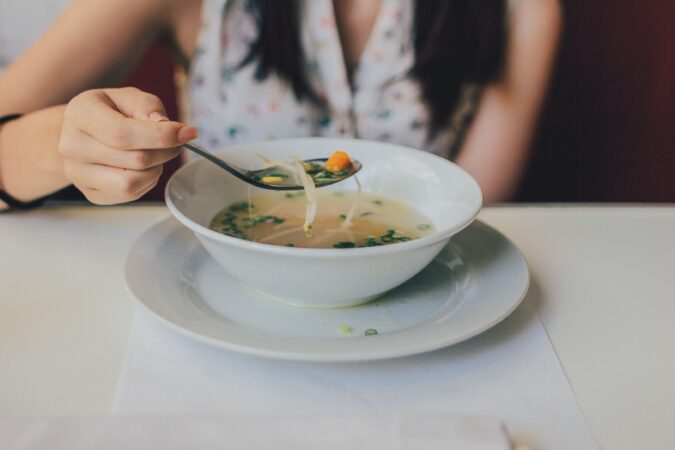
Spoonful of soup lifted from white bowl on white plate with partial torso of woman in background.

Soups are a healthy-sounding restaurant option. It’s easy to assume they’re made from left-over fresh ingredients that the kitchen doesn’t want to waste. They may be.

They also may begin with a base that includes hydrolyzed soy protein, coloring, corn starch, corn syrup, autolyzed yeast extract, and disodium inosinate. Even if the restaurant adds fresh protein and vegetables, you’re getting a dose of unexpected ingredients. Starting with a packaged base is faster and more efficient than slow-cooking stock from scratch. (The only ingredient in this list that will be tagged as an allergen is soy.)

Restaurant soups like chowder & potato, and even mac & cheese sometimes begin with a powdered cream soup base that gets mixed with warm water. This is another tool that saves prep time. Cream bases may contain palm oil, maltodextrin, modified food starch, modified whey, salt, soybean oil and fully hydrogenated soybean oil (with tbhq and citric acid for freshness and dimethyl polysiloxane [prevents foaming]), MSG, sodium caseinate, xanthan gum, dipotassium phosphate, mono and diglycerides, silicon dioxide (flow agent), natural flavor, sodium hexametaphosphate, and colorings. That’s a whole lot of added ingredients that aren’t required for a soup that can be made with water, potatoes, milk or cream, potatoes, salt, and pepper.

The gumbo you ordered may have begun with a packaged base as well. Ditto for mushroom soup and crab bisque. If a restaurant designates such soup as homemade on the menu, they could technically be considered correct if they’re adding fresh ingredients, but they probably shouldn’t claim from scratch.

We’ve only covered soup and salad and it’s easy to see how many unexpected things you may ingest in a single restaurant meal. I’m not advocating for eating every meal at home or never using boxed chicken stock. The point is that having restaurant food in the mix when you’re attempting to determine what’s messing with your digestive system can be like going into the search blindfolded.

Attempting to keep your diet healthy when eating restaurant food can be more difficult than you think. You’ll have the best luck by seeking out local, farm-to-table restaurants where questions are welcome and you can chat with the chef at less busy times.

If you’re frustrated by recurring digestive problems and can spare the time, try cooking all your meals from scratch (not prepared, packaged from the market) for a couple of weeks. Avoid any ingredients you think may be problematic. Write down how you feel each day.

Keep an open mind. Conventional wisdom can cause us to avoid the obvious because it goes against what most people believe. Go with your observations. A significant difference in how you feel can give you some insight into how restaurant food may be impacting your system.

The more you know, the easier it will be to increase the amount of time you feel good. That’s why it’s always helpful to get to know your food.

A Matter of Degree?

Is the difference between processed and ultra-processed food a matter of degree? Health experts have long railed against processed foods, but more recently seem to differentiate between processed and ultra-processed foods. This made me wonder, what’s the difference? Perhaps you’re wondering too.

peanut butter and jelly jar

The idea of ultra-processed food as a separate category began to circulate around 2009 when a Brazilian researcher, Carlos A. Montiero, coined the term in a scientific paper. The following year, he and his colleagues developed the NOVA Classification System for grouping foods according to level of processing. This system is currently used worldwide.

The NOVA Classification System has four categories: Unprocessed and minimally processed foods, processed culinary ingredients, processed foods, and ultra-processed foods. These categories range from fresh eggs, fruits, and vegetables to industrial formulations with five or more ingredients.

In spite of this widely used system, there is no set definition of ultra-processed. Other definitions include: foods changed by science until they’re almost unrecognizable from their original form; foods that have been altered to include fats, starches, sugars, salts and hydrogenated oils extracted from other foods; formulations not used in culinary preparations.

Why are ultra-processed foods relevant?

When you’re attempting to follow a healthy diet, these foods can be detrimental. They have been linked to increased risk of heart disease, type 2 diabetes, obesity, some cancers, and inflammation. And many are full of chemicals that may be harmful to some people.

For me, it seems many categories of processed foods have added ultra-processed options. And some long-standing processed foods have changed formulations or added ingredients that push them into the ultra category. And it isn’t always the cheapest food that contains the most additives.

What falls into the ultra-processed category?

Pretty much anything with a long list of additives and preservatives. When using the NOVA system, whole grain breads, lightly sweetened breakfast cereal or yogurt, and peanut butter may fit the criteria for ultra-processed. But as we know, not all breads, cereals, or yogurts are created equal.

Before you start throwing food in the trash, take a moment to review why you are choosing a particular product. If it’s for shelf-life or convenience, be realistic. If you eliminate a particular food, are you more likely to drive through a fast-food restaurant to fill the gap you created? If so, elimination may not be the best goal.

Is there a replacement you find appetizing, or can adjust to, that is processed, but not ultra-processed? If so, substitution may be a better goal. Some products, like peanut butter, are available in natural versions that contain only peanuts and salt. As long as the sodium content is reasonable, the natural version is a reasonable healthier replacement.

Plain yogurt that you sweeten with honey and top with fresh fruit is healthier than fruit-flavored, sweetened yogurt even though the yogurt itself is processed. Sparkling water with a squeeze of orange or lemon juice is healthier than canned flavored water which is healthier than a soda. Plain tortilla chips are healthier than nacho cheese flavored chips.

In fact, it can be helpful to know that processed simply means altered from its original form. This means common ingredients like the sugar, butter, and flour we use for scratch cooking are “processed.” Heating, pasteurizing, canning, and drying are also kinds of processing.

When I pick something from the garden, it’s unprocessed. Once I’ve cleaned it and removed any inedible parts, it’s been through the first stage of processing. After that, if I bake, boil, or freeze, it’s been through another stage of processing. But as long as I haven’t soaked it in salt or fat, it’s still a healthy food.

If I bake cookies, I am processing the flours with heat, plus combining them with fats and sugars. By definition, my homemade cookies can be called processed. The amount of fat and sugar will determine their level of healthiness, but they will most likely be healthier than a packaged version because that is all they contain. It is not uncommon for packaged products to include ingredients that are not on the label because they fall below the level required for listing.

Rather than being alarmed by the word processed or getting caught up in a war of definitions that causes you to eliminate convenience to the point it impedes your goals, choose products with fewer chemicals, additives, preservatives (including sodium, sugar, and fat), sweeteners, and flavorings. Cook and freeze when you can. Choose fresh as often as possible.

Remember that ultra-processed is a matter of degree. It’s the most changed and/or added to result of food production. When you regularly choose the least altered foods, you’ll automatically be on a healthier path. And we’ll be here cheering you on!