Looking Down The Road

Whether you’re driving, writing a book, planning your financial future, or cooking a new recipe, looking down the road can prevent a lot of problems. Remember learning to drive? Most new drivers focus just in front of the hood leaving every approaching danger out of their field of vision. Watching them attempt to navigate is terrifying.

The stakes aren’t as high when you’re cooking a new recipe, but the end result may be frightening if you’re out of a key ingredient or fail to temper the eggs. And it can slow down the process if some things aren’t prepped in advance. This can sabotage a timeline that would put everything on the table at the same time.

read recipe

When I was in 7th grade, you had to take either Home Economics (Family and Consumer Science) or Science. The year prior, my family had dinner at the Home Ec teacher’s house. After we arrived, she sent her husband to the store to get some ingredient she didn’t have. It was a lengthy wait for the food and none of it was done at the same time. When it came time to choose a class the next year, I chose Science.

And I practice the backward timeline across all endeavors. Yes, it seems cumbersome and like a waste of time when you’re in a hurry to get started, but I promise it’s worth it. It’s the equivalent of looking down the road when you’re driving.

With cooking, this means reading the recipe and compiling an ingredient and utensil list prior to going to the store. If you’re planning a whole meal, you’ll also want to go backward from serving time to make a plan for when to put each dish in the oven or on top of the stove.

I have a single oven, so I have to factor in oven temperature and cooking time. Some dishes can be cooked at a lower temperature for longer without affecting the quality. That means I can adjust time and temp to cook two items at the same time so that they are both ready to serve simultaneously.

There’s a bit of an art to making these adjustments because the more you put in the oven, the longer it takes everything to cook. And sometimes, you’ll need to switch a dish from the top rack to the bottom in the middle of cooking so that it will cook evenly or brown properly. Don’t worry if you don’t know exactly how to do this the first time. Just use your senses and check things more often.

Making a plan that anticipates and orchestrates these adjustments will make cooking easier. You can make a visible timeline or a list – whatever works for you. And it can all be in your head if you like a memory challenge.

Last Thanksgiving, I had a clogged drain that required two plumbers in the kitchen while I was cooking. I couldn’t use the sink at all. To say that was distracting is an understatement. But I had a timeline in my head and managed to get everything done and on the table at the same time except for one item I totally forgot until everything else was done.

Luckily, it was a quick item I was doing for the kids so there was no disaster. The adults were able to fill their plates while I finished up. I’ll also say my execution was less than ideal, but if I had not had a plan, it could have been a total chaos!

I’m not cooking today. I’m working on other things here at Cooking2Thrive. I still have a plan. I may get interrupted. There may be unanticipated delays. I may have to pivot. But it will be calm. Chaos will not reign. And progress will be made.

That’s the advantage to looking down the road.

Our Thanksgiving Recipes Are Safe From AI for Now!

Looks like our Thanksgiving recipes are safe from AI for now! There’s a running joke in my family about not angering the bots because they will come for you…or your job. Artificial intelligence has now entered the recipe creation game. So maybe it’s not really a joke?

It’s certainly tempting to include AI to generate inventive ideas, ingredient lists and measurements, cooking instructions, and photos! That would save us a ton of time. At Cooking2Thrive, we test, test, and retest our original recipes. We taste them hot. We taste them cold. We tweak and sometimes start over from scratch. No matter how efficient we make the process, it is time consuming!

From years of experience, we know that 1/8 tsp of this or that can make a difference. And we measure until we get consistently delicious results. But we also know that cooking is both art and science. Sometimes your senses let you know that today you need less moisture in a batter because it doesn’t look or feel right even though you carefully measured. How can this be?

My previous job involved press checks of four-color process printing. For years, the control boards on sheetfed presses have had the ability to record readings so that you can use them on a reprint to get consistent color. But ask any good pressman whether he relies on a recording to match a previous run and he’ll tell you, no.

Why? As one pressman told me – you go make the temperature, humidity, paper surface, and mechanics of the press exactly the same and I’ll use a recording for consistent color. Otherwise, those levels are meaningless. I have to adjust for conditions that exist today. His job is part art and part science as well.

And the same principles apply to cooking. Cooks and chefs must adjust to the conditions that exist in the moment. If we don’t, the result won’t be as good. Some people may find that frustrating. They may be more tempted to include AI in their cooking in the future.

Currently, artificial intelligence can gather data from millions of sources, add personal preference, and create something innovative, but it cannot simulate the perception that lets a cook or chef know that something’s not quite right. That’s the art of the job. It’s intuitive and incorporates all the senses.

Artificial intelligence may learn to incorporate something that mimics the art of cooking at some point because it’s always learning. And I can see using some AI functions as tools at some point. But I’m not sure how AI will ever inject the love that we know makes food taste better. Is artificially generated love the same as real love?

Whoa, let’s pull that question back or we’ll be into many more areas than cooking. With Thanksgiving upon us, many are pulling out family recipes. Others are looking for a new idea to impress the in-laws. All of us are recognizing the time we must carve out to create the meal.

While it may be tempting to rely on AI to save us time, don’t expect equivalent results this year. Traditional recipes are the safe bet for now so stick with those. And don’t forget to add the love!

Treasures Among the Trash

recipeYou never know what treasures you’ll find among the trash when you begin to clean out clutter. I’m sure the reason most of us have clutter is that we think too many things are treasures. Marie Kondo is making sure we know how to see the difference. But when we clean out an incapacitated or deceased relative’s home, we don’t have the luxury of choosing what is saved. We only have the opportunity to discover treasures among the trash.

Every month or two I spend a couple of days in my 98-year-old cousin’s house cleaning out the compilation of trash and treasure that includes: bank records from 1972, unopened mail from 1987, family photos from 1896, report cards from 1910, a wedding invitation from 1919, and a baby book from 1920. Because these items are mixed in with junk mail, decaying candy, promotional products, and wadded Kleenex, it is an arduous and sometimes icky process. I love it when I find some treasure that makes the effort worth it!

Recently, I’ve been working my way through the den toward the kitchen. Kitchens have the best variety of memorabilia. A few years ago, I discovered my grandmother’s ceramic green pepper spoon rest in my mom’s kitchen. I was thrilled. Now it’s on my counter by the stove. I love that visual reminder of my grandmother.
pepper
I also love finding old recipe cards. Not only do they give me a chance to prepare my favorite family dishes, there’s something charming about the varying shapes, sizes, and legibility of old recipes. Some assume you are extremely knowledgable about cooking techniques. Some have an ingredient list. Some do not. Many are spattered with remnants of food. Some are in handwriting I recognize. Some have clearly been handled more than others.

This look into the past seems more enticing to me than an old photograph or a tarnished silver service. Perhaps it’s because the recipes are a living memory. They can be created again and again. They can be shared with generation after generation along with stories of previous times they were enjoyed! If you think your kids don’t appreciate those stories, tell them to your grandkids.

At 2-and-a-half, JD loves any story about my experiences; he asks me to repeat them over and over. He never tires of hearing the details again and again. Adding food into the mix creates an indelible experience that he will no doubt share with his children and grandchildren. The recipe cards may not be preserved, but hopefully the recipes will find their way into his heart and his smart appliances or voice-activated replicator or whatever generates food in 2077.

Experimenting with unfamiliar flavor combinations is fun for me, but when I’m tired and hungry or it’s my birthday I’ll take my grandmother’s beef and noodles and a lemon meringue pie any day. Throw in some fresh green beans with new potatoes and I can smell the dirt from the garden when I helped my grandmother dig potatoes. These memories bring with them a sense of belonging to my family and to the earth. I had a place and a purpose.
pie
Such simple things can have a large and lasting effect. In this era of disconnection and short attention spans, we are often lacking a feeling of belonging and purpose. If you can provide that for your family by sharing the stories and food that you loved, is time spent in the garden or the kitchen worth it? I think so! I know time spent connecting is.

https://konmari.com/

https://ideas.ted.com/finding-our-way-to-true-belonging/

http://www.cooking2thrive.com/blog/the-benefits-of-cooking-part-1-the-food/

http://www.cooking2thrive.com/blog/the-benefits-of-cooking-part-2-the-fun-2/

http://www.cooking2thrive.com/blog/the-benefits-of-cooking-part-3-the-lessons/

Disclosure of Material Connection: I have not received any compensation for writing this post. I have no material connection to the brands, products, or services that I have mentioned. I am disclosing this in accordance with the Federal Trade Commission’s 16 CFR, Part 255: “Guides Concerning the Use of Endorsements and Testimonials in Advertising.”

My Heart Will be Filled With Love and My Tummy With Chocolate for Valentine’s Day

My heart will be filled with love and my tummy with chocolate for Valentine’s Day! I’ll be keeping DJ, my 18-month-old grandson on Valentine’s Day this year. Along with a card, I’m giving him a real, working stethoscope. He’ll get to listen to his heart while we talk about hearts and lungs and friendship and love. Valentine’s Day holds many natural lessons. The chocolate, I’m saving for myself.

If your Valentine is gluten-free, you may be tempted to shower him/her with flowers, jewelry, movie tickets, or stethoscopes rather than food. There’s nothing wrong with any of those. Sometimes they’re my choices as well. But if you really want to score points, take on the challenge of cooking a homemade gluten-free dessert. It won’t be as hard as you think, and the thoughtfulness and effort are certain to touch the heart!
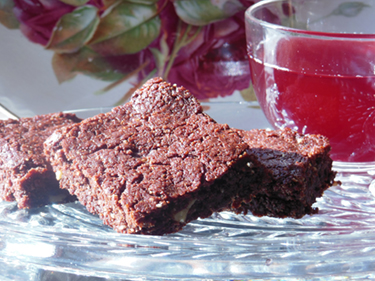
brownie and punch
Since chocolate is a tradition for Valentine’s Day, brownies can be a good choice. The only specialty products needed for the following recipe are a small amount of almond flour and coconut flour. These flours are widely available in regular grocery stores. (The almond flour may be called almond meal.)

If you cannot find almond or coconut flour in your area, they are available from Nuts.com, King Arthur Flour Company, Inc. or big box online retailers like Walmart and Amazon. All of the other ingredients are regular baker’s chocolate, brown sugar, butter, and the like.

There’s no special equipment needed to make this gluten-free Cooking2Thrive recipe, but a heart-shaped cookie cutter can add some romance to the finished product. Just wait until the brownies are cool before you cut them.
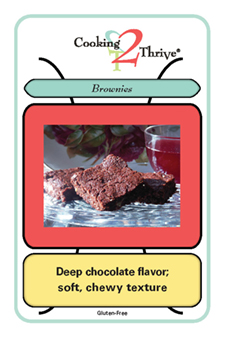
recipe card
Brownies
12 brownies

4 tbsp unsalted butter, cut into small pieces
4 oz semi-sweet baking chocolate, rough chopped
1/2 oz unsweetened baking chocolate, rough chopped
1/3 cup milk chocolate chips
1/4 cup honey
1/3 cup blanched almond flour
3 tbsp coconut flour + enough to flour baking pan
1/4 tsp salt
1/4 tsp baking powder
1 tsp vanilla
1/4 cup firmly packed brown sugar
1 egg
1/3 cup walnut pieces

Instructions
Preheat oven to 350º. Grease and flour 8 x 8 inch baking pan.

Place butter, chocolate, and honey in sauce pan.  Heat over low until melted, stirring frequently. Remove from heat and cool for 3 or 4 minutes.  

While chocolate is melting, whisk together almond flour, 3 tbsp coconut flour, salt, and baking powder in a bowl.  

Once chocolate mixture has cooled slightly, add vanilla, brown sugar, and egg to it and mix well. Add chocolate mixture to bowl with flour mixture and combine. Stir in walnut pieces.  

Pour batter into prepared 8 x 8 pan. Bake in 350° oven for 18 – 22 minutes. Cool on rack for 15 minutes. Slice and serve.

It’s always comforting to have a gluten-free dish prepared by someone you trust, and food really does taste better when it’s prepared with love.

Wishing you a Happy Valentine’s Day filled with love and chocolate!

https://nuts.com/nuts/almonds/flour.html
https://nuts.com/cookingbaking/flours/coconut-gluten-free.html
https://search.kingarthurflour.com/search?w=almond%20flour&af=type:products
https://search.kingarthurflour.com/search?p=Q&view=grid&deftab=products&w=coconut+flour

Disclosure of Material Connection: I have not received any compensation for writing this post. I have no material connection to the brands, products, or services that I have mentioned. I am disclosing this in accordance with the Federal Trade Commission’s 16 CFR, Part 255: “Guides Concerning the Use of Endorsements and Testimonials in Advertising.”