
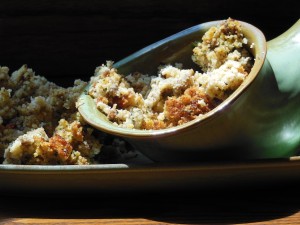
 You hear that the food always tastes better when it’s made with love! It seems to be true, but why mention it now? A lot of us are tying ourselves in knots preparing for this week’s Thanksgiving meal. In our heads, we hold an image of a large harmonious family gathered over a delicious meal composed of perfect replications of our great grandmother’s traditional recipes. We work ourselves into a frenzy to create a real world experience that matches this image. We focus on our expectations and feelings of obligation, then learn too late that along the way we have lost any feeling of connection and joy.
I’m thinking about this because I have a friend who just abandoned his car 2000 miles from home in a city where he was temporarily working, bummed some frequent flyer points and flew across the country to see family who had begged him to come home for the holiday. They picked him up at the airport and within five minutes began blasting him for not doing well because he doesn’t have as much money as he used to have before he lost his job of 15 years, his wife, and his large house. Soon after this berating, he called me.
For the first 8 minutes of the conversation, he mentioned none of this. He did not disclose that he was 2000 miles from where I thought he was, or that he was changing the plans we had made for this week. He accidentally let the story slip when I asked why he was breathing so loudly. As it turns out, he was walking 4 miles to get a ride from a friend. I was taken by surprise. He began explaining that he had made a last minute trip because his mom wasn’t doing well. I felt alarmed, assuming she must be in the hospital. Then he told me about the scolding she’d given him at the airport and how the guys at the gym were giving him trouble. Soooo, obviously, mom was well enough to go to the airport and he had been home long enough to work out. I felt confused. I started asking questions to try to make sense of the story. He still did not address our plans. As the details slowly revealed themselves, I was not pleased with him for failing to notify me of his change in plans and I may, or may not, have said, “There’s no excuse for that!” If I said it, I meant it. I believe I was right and I feel just fine about feeling angry with him.
At the same time, I recognize that it doesn’t matter how right I am, how disappointed, angry, annoyed, unimportant, or betrayed I feel. The bigger truth is that he is afraid and struggling, and, in spite of that, trying to accomplish the impossible task of pleasing all of the people he cares about. This often leads him to over promise and under deliver. While that could be called creating his own problem, my “no excuse” response did not make him feel loved, accepted, or supported. Reviewing the conversation, it seems clear that I have created a space in which I happily confirm for him that he’s not living up to expectations causing him to feel even more worthless and afraid to tell me the truth. That is a bigger problem than anything specific he has done. So while I may be technically right about the situation, I am woefully wrong at the same time.
This is a spot in which we often find ourselves. We are both right and wrong at the same time.
A coworker refuses to take on a task at work that belongs to a slacking worker and the company loses a customer because this task was left undone. What she did may have been technically right, but her choice was detrimental to the team overall.
A friend plans a move to Nashville to become a songwriter, but a mutual friend discourages him because for fear he may eventually have to move back home. Whether he stays home or moves back home isn’t really all that different, is it?
With her kids playing in the room, a neighbor screams to her best friend that her lousy husband cheated and she’d like to kill him. She may be right to feel the betrayal this strongly and to seek support from her friend, but expressing it this way in this situation, creates an environment of insecurity for her children. Can that be right?
A husband gets his kids every other Thanksgiving and it’s his year. He refuses to negotiate when the kids mom asks if he can switch out holidays this year so the kids can visit with her extended family that’s rarely together. Of course he’s within his rights to refuse, but is it the wrong thing to do?
Every time Uncle Paul sees his nephew, he reminds him, and the rest of the family, about the time he slept through Thanksgiving ’cause he was drunk. No matter that it was 10 years ago, then 12 years ago, then 15 years ago and he’s been sober 14 of those. Is Uncle Paul right about the facts, yes! Does it accomplish anything positive to bring it up now?
A woman in your Sunday School class doesn’t like her son’s girlfriend so she treats her politely while making sure to inform family and friends with a big eye roll that the girlfriend was once homeless, hasn’t finished college, uses bad grammar, and has been to, gasp, jail – all correct facts. She fails to remember to mention that the girlfriend has also had the same job for 5 years, is still in school, can sing like an angel, is an incredible artist, supports herself and the nephew she took in, and has never been charged with a crime. Does the portrait she has painted give the right impression?
A man misses his daughter’s evening wedding because his current wife’s daughter loses her house in a fire. Everyone lives in the same town, there were no injuries, and there is a 12 hour window in between events. Is it wrong to celebrate a joyous event in the face of a tragic one?
Aunt Betty never misses an opportunity to tell your sister she’s fat whenever there’s a family meal. She pointedly passes artificial sweetener when she asks for sugar and brings her an apple when she’s passing out pie to everyone else. Aunt Betty says she’s worried about your sister’s health. Your sister cringes every time Aunt Betty enters the room.
I’ll admit it’s sometimes difficult to determine when to challenge an affront and when to let it go because sometimes things that look the same on the surface are exactly opposite underneath, but let’s face it, most of the time it’s just easier for our egos to cling to being right, feeling angry, and lashing out than it is to admit we have been wrong or shortsighted. It takes insight, courage, and commitment to keep your heart open when loved ones let you down or make sure to let you know you’ve let them down. It may help to remember that we can all be right and still be wrong.
You’ll know you have a Thanksgiving made with love and served with kindness when:
• You feel no need to join the chorus when your mom and sister find fault with your brother’s wife who insisted on bringing cherry pie even though your mom told her not to. She also brought her big smile and warm hugs. The pie was just, you guessed it, the cherry on top.
• You notice that your grandmother always finds another place at the table for an unexpected guest without ever missing a beat.
• You discover that you want to forego a large menu and choose a few family favorites that you rarely have time to cook. If your husband loves slow-cooked ribs, you fix ribs! If your daughter has been raving about her friend’s mom’s chocolate lava cake, you forget the pecan pie and make chocolate lava cake. If your son likes pizza better than anything on the planet, you serve mini pizzas as an appetizer. And you make sure to include your favorite roasted cauliflower as well. You make these choices to deliberately show your family that you know and value their preferences. You feel at peace with your decision even when you happen to overhear a snide comment regarding the menu from a traditionalist cousin.
• You enjoy seeing your cousins so much that you hardly notice that your mom, who is angry with you, hasn’t put a single gluten-free item on the table other than turkey.
• You find yourself taking time to absorb the gratitude your family expresses for your efforts. You feel free to sit down and let your kids serve coffee and dessert or wash the dishes.
• You feel comfortable saying no to an 8 hour drive home for Thanksgiving during a time when you have been over obligated and feel that you need quiet renewal time. Will Aunt Helen say a few ugly things to your mother when you don’t show up? Possibly, but you know you are able to choose to let the bad behavior stop with her. You view your decision to stay home as a loving gift to yourself and your housemates.
• You feel more excited than disappointed when your mom encourages the family to volunteer at a shelter that feeds the community instead of maxing out a credit card to meet the expectation of a fancy meal.
• You find that you are beginning to show up for holiday events with your courage and boundaries intact and your defenses down.
• You feel free to gracefully let your reluctant relatives refuse your invitation to dinner and easily shift your focus to providing a fun experience for some close friends.
• You find that you are able to feel grateful for the gifts given you by your most difficult moments.
I am grateful for the insight I gained from the recognition of my shortsightedness. We wish you a holiday full of love, kindness, joy, gratitude, and delicious food!
Happy Thanksgiving!