Your Gut Has a Mind of Its Own

If you feel like your gut has a mind of its own, it’s because it does. The billions of neurotransmitters in your intestine are of the same type as those in your brain and house the Enteric Nervous System. The gut is capable of a level of independent intelligence equal to that of your dog.
diet
Does that mean our stomachs can be trained?

It’s kind of a funny idea, but it’s one that’s currently being explored. Some scientists hypothesize that we can treat stomach pain using hypnosis — essentially curing our tummies by talking to them.

The gut is host to 100,000 billion bacteria. When researchers mapped the DNA of one study participants’ microbiomes, they first reported that each of us falls into one of 3 enterotypes.

Subsequent research has called this limited number and the specific characteristics within each type into question. Things may be a bit more nuanced and complicated than originally indicated. Research continues and will bring a clearer picture over time.

We do know that the gut communicates with the brain via the vegas nerve and can affect our emotions. That could be why it feels like the gut has a mind of its own that sometimes controls us.

Ninety-five percent of the seratonin in our bodies is produced in the gut where it regulates the immune system and sets the pace for intestinal transit. Seratonin is also released into the bloodstream acting on the hypothalamus and registering in the upper brain as a sense of well-being.

With conditions like irritable bowel syndrome (IBS) in which there is no observable organic malfunction, it is theorized that there could be a problem between brain and gut communication. One of the brains may send the wrong message or a message may be misinterpreted resulting in the symptoms experienced.

Learning more about this possible process may lead to innovative treatments for the 1 in 10 of us who suffer from IBS. It also has potential benefit for those who have become hypervigilant as a result of trauma.

An examination of the microbiome can increasingly assist in diagnosis and treatment of disease. The microbiome can show a propensity for Type II diabetes, heart disease, and liver disease and may influence obesity. Patients with inflammatory bowel disease (IBD) show an increase in pro-inflammatory molecules and a decrease in inflammatory dampening bacteria. Altering microbial composition could possibly be used to reduce inflammation or calm down the immune system.

Researchers have successfully diagnosed Parkinson’s disease through intestinal biopsy paving the way for additional exploration of the possibility that the gut and brain share diseases. This could be key to a greater understanding of autism spectrum disorders and alzheimer’s disease.

Dr. Michael Gershon, Professor of Pathology and Cell Biology at Columbia University Irving Medical Center who is sometimes referred to as the father of neurogastroenterology has, along with Dr. Anne Gershon, demonstrated that shingles can occur in enteric neurons and may be the cause of several gastrointestinal disorders currently of unknown origin.

It’s a little unclear whether the DNA of a microbiome is a set entity that changes slowly over time or whether researchers were simply mapping a DNA moment in a constantly changing microbiota. Studies have shown that the microbiota can change within one day with a change in diet.

That sounds like great news to me! It’s possible that a change in diet could bring symptom relief fairly quickly once we better understand what in the diet needs to be altered.

The possibilities are huge and the research has just begun. Changing the microbiome through diet, prebiotics, and probiotics may have a much greater effect in preventing and reducing disease than we previously believed. Diet may not just be fuel to keep the body strong, it may be real medicine that can be used to reduce inflammation, revise autoimmune response, and change the messages transmitted from the gut to the brain.

Knowing that my gut has a mind of its own sounds like relief to my upper brain!

https://www.pathology.columbia.edu/profile/michael-d-gershon-md

http://sales.arte.tv/fiche/3707/VENTRE__NOTRE_DEUXIEME_CERVEAU__LE_

http://stm.sciencemag.org/content/1/6/6ra14.short

https://www.mdedge.com/jfponline/article/105514/gastroenterology/targeting-gut-flora-treat-and-prevent-disease

https://www.ncbi.nlm.nih.gov/pubmed/25786900

https://www.pathology.columbia.edu/profile/michael-d-gershon-md

Travel Tip #18 Push the Limits?

Travel Tip #18 Push the Limits is written with you in mind if you suffer from IBS, IBD, Crohn’s Disease, Celiac Disease or other conditions that may lead to a sudden need for bathroom facilities. I just got back from LA. During Sunday brunch I had a sudden reminder of how uncomfortable it can be to travel with a gastrointestinal condition. This travel tip deals with a subject that’s difficult to discuss in public.
cypress
If your guts are constantly in a knot and you can’t predict when diarrhea, gas, or pain may suddenly hit, it can be hard to imagine taking a long trip on an airplane or even in a car full of people. A fear of embarrassment or discomfort can lead to a gradual withdrawal from family outings and vacations.

Reluctance to disclose the real reason for resistance to certain situations often leads family and friends to misinterpret what’s happening. I mean who really wants to say, “I just can’t face the chance that I’ll poop myself during a 3-hour plane ride?” I don’t. It really doesn’t matter how close we are, I just don’t want to discuss that with you.

So, what should I do?

Pretend to be too busy, too sick, or too angry with Aunt Jane to attend?
Insist on a different trip that no one else is excited about?
Wear adult diapers?

Sometimes saying no may be the best choice. If your only motive is to take care of yourself, you’ve explored all the options that might make the journey enjoyable for you, and you still can’t find a way to make peace with attending, then say no. It’s only when you have an ulterior motive or when continual refusals begin to limit your access to a full life that saying no becomes detrimental.

Say yes within limits. If it’s hard for you to take care of yourself, establishing certain parameters in advance can make it easier to decide in the moment when presented with an invitation. For instance, you may want to have a rule that you only agree to car trips in areas with ample facilities. You may want to limit flights to 1 hour at certain times of the day. You could have a rule that you will not stay at friends’ houses so that you have the privacy of your own space. Along those lines, you can have a rule that you don’t share hotel rooms. If you know you usually have fewer problems an hour after eating, join the family after the meal rather than for the meal.
breakfast
Make sure you eat properly and/or take your medication on time. When you’re willing to say yes, there’s no reason to tempt fate. Adhering to the regimen that works best for you while varying your activity can make all the difference. Investing a little time in research and advance planning can make it possible for you to have plenty of medication on hand even when you miss a connection.
It can also mean that you have plenty of tummy friendly snacks on hand when meal times or restaurant options unexpectedly change.
orange tree
Focus on the good stuff. A beautiful view, a warm hug from your favorite cousin, or the smile on your grandson’s face when he meets LeBron James can all mitigate a little discomfort. After all, you may not feel perfectly well at home. If you can feel equally good and add some great memories, it may be worth risking possible inconvenience or embarrassment. If things turn out badly, you can make a different choice next time. If you always stop yourself before you start, you’ll miss out on a lot of good stuff.

Bring the party to you. If you need to be in your own space to be comfortable, make your home the place everyone gathers. Let the travel be someone else’s problem. Instead of missing out on memories and contact with people you enjoy, develop your hosting skills.

That doesn’t mean you have to do a lot of work and throw a party. Just establish that you’d like to see everyone at a certain time and invite, invite, invite. When someone visits, relax and enjoy them. It may take some time to develop momentum, but eventually word will spread that your place is the place to be. Making your guests feel welcome is all it really takes to be a great host.

If you suffer from IBS, IBD, Crohn’s Disease, or Celiac Disease, should you push the limits and travel or should you stay home? There’s no right or wrong answer. What’s right for today may not be right for tomorrow.

The important thing is to always, always take very good care of yourself. For some of us that is in and of itself pushing the limits.

Navigating Medical Care

mazeNavigating medical care can be an exhausting process as any celiac, IBS, Crohn’s, diabetic, or cardiac patient knows. As this year draws to a close, I’m looking forward to the renewal a new year promises.

I spent the past few days with my mom in a rehab facility. She is a dialysis patient and last week had 3 small strokes. On the phone from the ambulance as she was transported to the hospital, she sounded ok, but said her right arm and hand wouldn’t work right. Five days later, she arrived at a facility where she could receive physical therapy multiple times per day. It was Christmas eve.

Of course holiday staffing varies from the norm. On Christmas day, our nurse was in charge of 60 patients. There are 480 minutes in an 8 hour shift. That means, she could spend 8 minutes per patient even if she didn’t take a single break. We used more than 8 minutes of her time when my mom passed out in the wheelchair from low blood pressure. Needless to say, there is no time for the staff to make sure Mom eats or gets enough fluids.

My mom is lucky because at least one of us has been able to be there for a portion of every day. In spite of that, it has been difficult to get enough information together to assess whether a bad day is just a bad day, or the beginning of a downward trend. It’s hard to know whether we need to quit worrying about the food on the cafeteria tray and just get some Power Yogurt down her. We know she’s not getting enough protein to fend off infection for long. Unfortunately, our experience is not unusual.

I learned long ago when I had a rare parasite that caused recurring pneumonia that when you’re weak and in pain, you must have an advocate with you every step of the way or you can quickly be dismissed and become lost in the system. My lawyer boyfriend was with me when I was trying to get a referral to a large diagnostic clinic. He could barely contain his laughter watching me bite my lip when my pulmonologist said, “If you didn’t have an intelligent boyfriend here with you, I’d say this is all in your head.” And he wasn’t the first physician to say that during my two year ordeal.

I was young, healthy, went to the doctor promptly and still almost died with the first pneumonia after having been diagnosed with a bladder infection. I actually had psittacosis from Chlamydia psittaci which had become encapsulated in a recently capped tooth. This experience made me acutely aware that navigating medical care is best played as a team sport.

During that two years, I read all of my medical charts. This was also an eye opening exercise. The history recorded in the charts often wasn’t even remotely related to the history I gave. I realize my symptom group was unusual. Well, actually it wasn’t for someone with psittacosis, but it was unusual enough for one nurse to determine that I was just a bad historian.

At some point, most of us will need the expertise of the medical system. Without it, we do not have the depth of knowledge, necessary labs, sophisticated testing equipment, or access to medication that may be necessary to get us through a crisis and put us on a path to improving health. Is there anything we can do as patients to make sure we have the best chance of getting optimum results from medical care?

While nothing will guarantee a certain health outcome, here are 5 things you can do to facilitate a more positive journey in the healthcare system:

1. Choose a friend or family member you trust to act as your advocate in any major medical event.
The best advocates care about your well-being, can remain calm in a crisis, are good listeners, can process and prioritize information, are unafraid to ask questions, and will tell you the truth in a kind manner.

Be sure to identify your advocate as someone who has your permission to view healthcare information so that your care providers will not worry about a HIPAA violation. http://www.hhs.gov/hipaa/for-individuals/guidance-materials-for-consumers/index.html

journal2. Keep a daily journal of your condition.
Try to record facts without interpretation. For example, if you feel your energy level has significantly dropped, record how much sleep you get, when you get it, how many fluids you consume and what kind, what you are eating, how much and when, how much exercise you get, what kind, and when you get it, then note how tired you feel on a scale from 1 – 10.

Doing this every day will help you have a realistic picture of what is happening over time. It will also help identify areas in which a change in routine may help improve your symptoms. If you are too weak to do this, your advocate or caregivers can make notations for you and record their observations as well.

3. Be informed. Ask questions. Make decisions.
You are ultimately in charge of your healthcare. If you do not ask questions, you may be passively agreeing to treatment you would never actively choose. It can be helpful to think of yourself as pilot in command.

In an airplane, the pilot in command (PIC) is the person who makes the final decision about what will happen in an airplane. He can accept or refuse instructions from air traffic control and he is in responsible for all operations of the plane until he actively turns over command to another pilot by saying something like, “your plane or your aircraft”, and hearing “my plane” as a response. He then repeats, “your plane”. This is called a Positive Exchange of Controls.

If air traffic control says, “23 Charlie Tango cleared to land 22 left” it does not mean that the PIC must land the plane. He can request a different runway. If he is not cleared for the requested runway, he can initiate a go-around.

You are the pilot in command of your healthcare. You will receive lots of information from instruments and personnel. The more informed you are, the better the quality of questions you can ask and the better resulting decisions you can make. Your doctor is air traffic control. From his vantage point, he can see traffic and the runway better than you can, but he won’t know that you had a fuel leak and do not have enough glide distance to make the runway without input from you. You have the best odds of a safe landing when you work with your doctor as a team to identify alternative landing areas. Once determined, you decide the destination with which you feel most comfortable. You inform the doctor where you prefer to go from here, then you focus on the procedures that will result in your best chance to safely reach the landing area.

Just as it is common to think that air traffic control actually means the tower is in control, many patients do not recognize that they have the choice to request a plan that fits them. More typically, they defer to whatever initial plan the doctor proposes while they’re in her office and then fail to follow that plan once they get home and it doesn’t fit their lifestyle. This can be detrimental to any long-term progress.

4. Treat everyone kindly beginning with yourself.
When you have a chronic condition rather than a medical emergency, it can slowly eat away at your energy and attitude. A desire for relief may lead to impatience with medical staff. While you may feel justified in taking your frustration out on nurses, techs, or aides, doing so will not encourage them to treat you kindly.

The simplest way to prevent reaching the point at which you lash out is to recruit consistent, adequate social, emotional, psychological, and spiritual support. These needs are very individual, so a high level of self-awareness will be helpful in determining what and how much you need.

Incorporating a regular exercise, meditation, or yoga practice can strengthen your connection to internal resources. You may also find restoration in activities like gardening, cooking, writing, reading, fishing, walking, painting, woodworking, swimming, dancing, volunteering, or playing with your children or grandchildren.

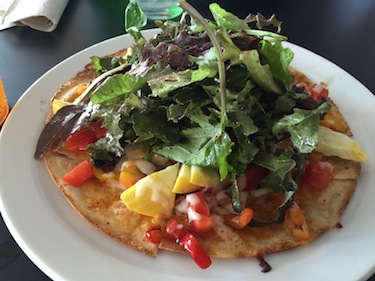
flatbread5. Decrease the need for medical intervention.
You don’t have to worry about navigating the medical system when you’re healthy enough to only require routine check-ups or regular monitoring. In some cases, significant lifestyle changes can minimize the need for medical intervention. The effects of regularly eating a balanced diet of fresh foods, drinking plenty of water, getting adequate sleep and exercise, and filling our lives with passion and laughter should never be underestimated.

The new year is always a great time to wipe the slate clean and do things differently. I hope you’ll find these tips helpful the next time medical care is required.

As we approach the change to 2016, I wish you an abundance of health and hilarity!

Happy New Year!

No Grain, More Gain

Ever wonder why your digestive system seems to be rebelling even though you’ve been meticulously gluten-free?  Me too.

Being quite the social butterfly, I used to think I must be getting bad information from waiters on a regular basis allowing minute amounts of gluten to infiltrate my diet.  I no longer believe this.

Lacking a definitive scientific study on which to rely, I will simply tell you what I’ve learned through trial and error.  The less gluten-free grain I consume, the better I feel.

Mind you, the effect is not immediate, but it is quick.  It takes about a week of eliminating complex carbs from my diet for me to suddenly feel 10 pounds lighter, have my bowel function to return to normal, have less sudden energy drops from low blood sugar, and to feel totally free of intestinal discomfort.

It is possible that Elaine Gottschall had it right when she wrote “Breaking The Vicious Cycle” outlining the Specific Carbohydrate Diet.  While not widely accepted by the current medical and nutrition community as significant, Elaine’s book was not written by an untrained, uneducated, or uninformed lay person.

Elaine was a biochemist and cell biologist whose daughter was a patient of Dr. Sidney V. Haas. As you may know, Dr. Haas was a pediatrician and researcher who in 1924 published a medical paper detailing his use of the banana diet for treatment of Celiac Disease.  His research led to the development of the Specific Carbohydrate Diet (SCD).  During his career, Dr. Hass treated over 600 cases of Celiac Disease and in 1951, along with his son, published a medical textbook entitled “The Management of Celiac Disease”.

The basic premise of the SCD is that the elimination of all carbohydrates that are polysaccharides (complex carbs) from the diet in favor of monosaccharides (simple carbs) can correct malabsorption and reverse the course of many intestinal disorders by starving out an overgrowth of bacteria or yeast from the system.

The first time I followed, yes that’s right I said the FIRST time, the SCD, I ran a 101º fever for a week.  After that week I began to improve.  After a year on the diet, my belly felt better than it ever had in my adult life, and my skin, which had always been prone to breakouts, was completely clear.  After a year and a half on the diet, I began to add back complex carbs – yummy tortilla chips, gluten-free crackers, arrowroot cookies – oh yeah!  Except that after a while I went from oh yeah to oh OWWW!

No matter what I would like to be true, I feel better without grain.  I feel better without potatoes.  I feel better when I limit the chocolate, sugar, milk, and soybeans in my diet.  When I consume tortilla chips, my belly hurts.  When I bake with potato starch, my belly hurts.  When I eat gluten-free pasta for 3 days in a row (I make a mean mac & cheese and the leftovers are awesome) my diarrhea returns.

I don’t know if all grains act as toxins to my system triggering a brain response or whether my symptoms are attributable to bacterial overgrowth or whether it’s a combination of the two.  I’m not sure I need to know.  I know that my system responds positively on the SCD.  I know it makes logical sense because eliminating foods that are harder for my digestive system to break down takes a load off my body.  My body can then redirect its energy to healing and proper functioning.  What more do I really need to know?

Of course I need to know what I can and cannot eat.  That’s easy.  I can buy “Breaking the Vicious Cycle”, or visit http://www.breakingtheviciouscycle.info/legal/legal_illegal_a-c.htm.

Waiters and chefs in restaurants will need to know what I can eat, so I’ll carry Cooking2Thrive® SCD server cards with me to communicate the information easily.

That covers what I need to know.  You may want to know if there are good SCD recipes available.

That answer is easy as well.  Cooking2Thrive will soon release a series of chef-tested recipes that are SCD compliant and scrumptiously tasty.  These recipes include: Empire Waist Cheese Crackers, Health Nut Applejacks (pancakes), Lemon Kiwi Muffins, Coconut Pound Cake, Cheesecake, Cinnamon Shortbread Cookies, 3 Pepper Fried Chicken Tenders, Meat Loaf, Pistachio Encrusted Chicken, Personal Pizza Margherita, Gorgonzola Tarragon Deviled Eggs, Stuffed Summer Squash, Apple Slaw, and many more.

Hopefully science will eventually support the trends many of us already anecdotally observe.  In the meantime, if you’re gluten-free and experiencing recurring digestive problems, please consider taking the burden off your body.  Follow the SCD for awhile (if it’s SCD compliant, it’s automatically gluten-free).  You too may find that with no grain you see more gain.