If You Don’t Like the Heat   

If you don’t like the heat, you can get out of the kitchen as they say, but we want you to stay in the kitchen AND get out of the heat! That may be easier said than done. We set a high temperature record in March. I no longer know when to plant my garden or prune anything. What I’m learning is that excessive heat is more than just annoying, it ages you!

Each year, the heat and humidity bother me more. That’s annoying, but a new study published in Science Advances suggests that it’s not just making me uncomfortable, fussy, and sluggish. It could be phenologically aging me. If that’s true, it’s probably physiologically aging me too. That sounds bad.

It’s a given that excessive heat creates the danger of heat stroke. We also know it can adversely affect heart problems and age your skin. I guess it stands to reason that longer numbers of days with temperatures exceeding 100° Fahrenheit would affect us in other ways. My body certainly tells me to get out of the heat!

A friend who lives closer to the equator experienced 60 consecutive days of temperatures over 110° last year. As she tells it, she would get up and do her outside work knowing that it would be too hot later in the day. Her plan was to then come in and do paperwork and volunteer hours after that.

Instead, once she finished the farm work, she found herself lying on the concrete floor for hours until the sun went down. She simply didn’t feel like moving. Trying to figure out if she was getting old, lazy, or old and lazy, she finally realized that the heat seemed to be aggravating her heart problems and affecting her blood pressure.

This year, she’s moving further north for a month to see if she feels better. If that works, next year she’ll expand her heat vacation to three months. I have a neighbor who leaves in June and returns in September. Seems they are onto something.

Here’s an excerpt from the study:

“For example, one-unit increase in heat days at the caution+ level is associated with a 1.15-year increase in PCPhenoAge acceleration over a 7-day window (95% CI = 0.63, 1.67); this means that 10% more heat days corresponds to a 0.115-year PCPhenoAge acceleration. This association remains significant over 30-day (B = 1.08, 95% CI = 0.53, 1.62), 60-day (B = 0.98, 95% CI = 0.40, 1.56), 1-year (B = 1.66, 95% CI = 0.56, 2.77), and 6-year (B = 1.87, 95% CI = 0.68, 3.06) windows. Comparable results are observed for heat days at the extreme caution+ level; for example, a one-unit increase in heat days over a 6-year period is associated with a 2.88-year increase in PCPhenoAge acceleration (95% CI = 1.28, 4.48).”

The bottom line is that people who experience more heat over the long-term age faster biologically than people who live in cooler environments.

I will add that quality of life decreases when the heat index is over 100°. Gardening may become exhausting. It’s harder to stay hydrated. And sitting on the porch visiting with neighbors sounds like sitting in an oven baking with potatoes.

Not all of us can move or go away for months at a time. We may have to alter our schedules to garden at first light, walk for exercise indoors, and grill in instead of out.

I’m sitting in a stuffy RV with wind gusting up to 49 mph outside. Humidity is 86%. The temperature is only 68 outside, but it’s way hotter in here and it’s only April 2. I am dreading August.

Now’s a good time to practice staying in the kitchen where there’s air conditioning. And if you don’t like the heat…I’m with you!

ad

If You Can’t Take the Heat

If you can’t take the heat, as they say, get out of the kitchen. My kitchen is on the west side of my house. On summer afternoons, it’s hot in there. I’ve added a/c vents, but the heat still gathers. When I can’t take the heat, I opt for salad.

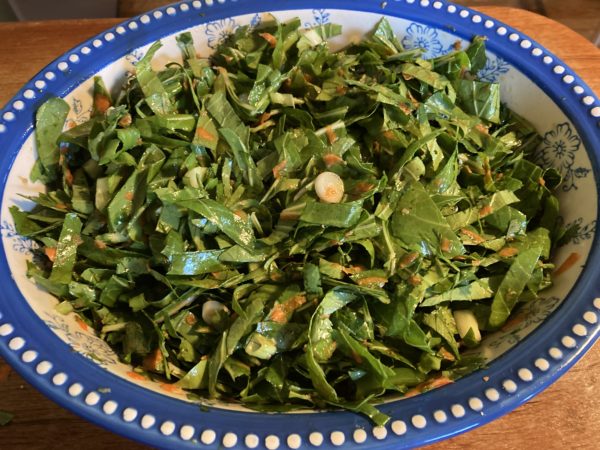
Many of my salads have been based around bok choy and romaine this summer because I’m growing those in the garden. I also grow arugula and Swiss chard which I add to some salads. The arugula adds a wonderful peppery dimension.

Once the greens are chosen, the toppings are a wonderland of experimentation. Sometimes the combination feels just right. Other times, one ingredient stands out more than it should. No matter, the kitchen stays cool and the crunch is satisfying.

Another way to get out of the kitchen is to eat from someone else’s. Restaurant salads have a  more predictable composition. That means there are some that become favorites. Here are a few that stand out:

GP’s Classic-ish Cobb from Goop Kitchen: It features a 7-minute egg, avocado, tomatoes, Point Reyes blue cheese, roasted golden beets, Mama Lil’s peppers and house pickled shishito mix, maple glazed bacon, little gem, radicchio, and a side of GCC Dijon mustard vinaigrette. The combination is perfection!

The Iceberg Wedge at The Olde Pink House: This one keeps it simple. An iceberg wedge with blue cheese dressing, tomatoes, and cucumbers. When done right, it doesn’t get better than a wedge salad. A great one begins with a chilled triangle of lettuce. I like that this version doesn’t include bacon. I often think bacon detracts from the cool light flavors that receive just the right balance from bleu cheese. I like the addition of cucumbers here though – another light note.

Peck’s Salad from Trio’s: The recipe for the dressing on this salad came from the Sam Peck Hotel that operated from 1935 – 1972. The light, sweet vinaigrette tops leaf & romaine lettuce with roasted pulled chicken breast, toasted almonds and bacon. I often opt for dressing on the side, but the portion here is exactly right.

Cucumber Salad from Zankou Chicken® : I always order extra and eat it for days! Cucumber, tomato, red onion, and parsley tossed in lemon juice and oil. This is the perfect side for soooo many things.

MoMa Arugula and Proscuitto: I don’t think they serve this anymore, but they should. It was so simple and full of bold flavor. I think it was just the two ingredients with some coarse ground black pepper and a light drizzle of dressing, perhaps balsamic? It felt like it belonged with the impressionists. But, just like trends in art, menus change.

There are other standout salads that have disappeared – a Greek salad at a storefront restaurant on the north edge of Albuquerque and the Medite, made of organic quinoa, spinach, garbanzo beans, artichoke, fire roasted peppers, grape tomatoes, feta, lemon and extra virgin olive oil at The Pantry West in Little Rock.

There are salads that may still be served if I could remember the restaurant name or location closely enough to check. I had a wonderful tableside Caesar in Manhattan and a soaked salad…somewhere.

Salads with seasonal fruit entice me. I also like salads with crunchies like tortilla strips. While the heat continues, I’ll be searching for even more standouts to add to my list of salads that can help me get out of the kitchen when I can’t take the heat.

Disclosure of Material Connection: I have not received any compensation for writing this post. I have no material connection to the brands, products, or services that I have mentioned. I am disclosing this in accordance with the Federal Trade Commission’s 16 CFR, Part 255: “Guides Concerning the Use of Endorsements and Testimonials in Advertising.”

ad

Antidote for the Heat

We’re looking at another week of excessive heat warnings; we must find an antidote for the heat! I live in an early 20th century house. It has 12-foot ceilings and a variable speed dehumidifying heat & air system. I added vents in the kitchen/sunroom area. It should be relatively cool where I’m sitting. It is not. And it will get hotter as the sun sinks directly into the west windows.

When it feels like (checks phone so as not to exaggerate) 110˚ outside, there’s only so much you can do to cool the house. Of course there are things you can do to cool your body – sit in front of a fan, put a wet towel on the back of your neck, sit in a bathtub of cool water, and eat and drink cold foods.

The past week, I’ve been turning almost everything into a salad topping. Pork tenderloin – shred some and throw it on a salad. Baked beets – serve those puppies cold on top of a salad. Blackened Brussels sprouts – you guessed it; chop them up for a salad. In fact, I combined those three atop shredded bok choy, arugula, and Swiss chard yesterday for lunch.

The thing I like about salads is the variety of tastes you can achieve by using the same ingredients paired and dressed differently. This works especially well for families who have different tastes. You can pre-make salad to each person’s preference or get out some colorful serving bowls and let everyone mix their own. This is especially advantageous for families with multiple differing allergies or intolerances.

When I purchase greens, I like to have a lighter lettuce option – butter, romaine, or iceberg – to pair with bitter or peppery greens. My favorite mild salad green is mȃche, also known as corn salad, but it’s not easy to find. Baby book choy and baby Swiss chard are also delicious mild salad greens. I may also offer spinach as an option.

Many like to include greens with bigger flavor. Popular bitter greens include frisée, radicchio, and dandelion greens. Watercress is great in salads. It may be bitter or peppery. Arugula is also bitter and peppery and grows like crazy in my garden.

I recently made a quick happy hour appetizer by topping crostini with cheese, salami, shredded arugula and balsamic drizzle. Arugula, prosciutto, and cantaloupe also play well together. Tomorrow I may make a salad with those flavors. I could also add a little fresh mozzarella, basil, and the same balsamic drizzle. Yum! The perfect salad for a hot afternoon.

The sweetness of fruit helps balance salads that begin with bitter greens. Apples, pears, and blueberries are some of my favorites. Oranges, strawberries, pineapple, mango, and cantaloupe are also great fresh choices.

Fruit doesn’t have to be fresh to top a salad. Dried cranberries, raisins, figs, or apricots add delicious layers of flavor and texture.

And fruit salads don’t have to include greens. They can just be fruit. I like to make dressing for fruit salad by mixing orange juice and mayonnaise or orange juice and plain yogurt. I also like to top fruit salads with a dollop of plain yogurt sprinkled with cinnamon. Fruit is so flavorful it doesn’t need much.

My grandmother loved to mix vegetables and fruit in carrot, raisin salad. Some home cooking restaurants serve this. They often try to fancy it up by adding pineapple. I prefer the simpler version.

When you’re choosing vegetables for salad, you may automatically think of all the things that can be served raw – celery, radish, carrot, squash, cucumber, tomato, cauliflower, broccoli, bell pepper, or onion. But blanched and lightly cooked vegetables can be delicious as well.

A local Mediterranean restaurant serves a salad that’s shredded lettuce topped with sautéed yellow squash, red bell pepper, and onion as well as beef/lamb gyro. I like to add English peas and apple to salads topped with chicken. And sugar snap peas are a great salad addition raw or steamed.

The vegetables can even be canned. Kidney beans, green beans, black beans, and corn from cans can all be used in salads. Bean salads and pasta salads are refreshing cold foods during the summer heat.

Even if you feel like you’re just throwing things together, there’s no harm in topping a salad off with a little extra crunch or yum. Nuts, seeds, cheese, croutons, parmesan crisps, tortilla strips, potato sticks, and bacon all serve this purpose well.

The final element can be light, medium, heavy, or not needed. Some like their dressing creamy. Some like it acidic, citrusy, or sweet. The hotter the weather, the lighter I like it.

Not weighing myself down with hot, heavy food helps counteract the heat, but finishing with a bite or two of sorbetto or granita leaves me feeling cool as a cucumber. And that’s a great antidote for the heat.