TooGood

With no indication that prices are coming down, you may be looking for bargains like toogoodtogo in 2026. I stumbled on this app accidentally. Participating stores and restaurants in your area will offer bags of food at discounted prices.

Sometimes the bag will be a Surprise meaning you’ll have no idea what’s in it when you order. Whole Foods sometimes categorizes into Bakery Bags, Produce Bags, or Prepared Food bags in addition to the Surprise Bag. In my area, a Whole Foods Bakery Bag contains about $21 worth of baked goods for about $7 and a Prepared Food bag is about $10 for $30 worth of food.

Items typically have dates that are about to expire and are not customizable. This can be dicey if you have food restrictions. But with specialized foods costing more, a household that has some members without restrictions can help keep the budget balanced by taking advantage of these savings.

Rescuing this food is also a way to reduce food waste. Your profile lets you track the reduction in CO2e emissions and water use you contributed to as well as the money you saved. Using this app is a good way to have a positive impact on the environment even if you’re short on time and money.

There are obvious advantages for those who live in larger metropolitan areas. Here, there are a handful of participating stores and restaurants. In Los Angeles, there are many more. For a full list of participating stores, you have to download the app.

Toogoodtogo isn’t the only app for securing discounted food. Flashfood is available in some markets featuring deals up to 50% off from stores like Kroger, Loblaws, Meijer, Gelson’s, Family Fare, Piggly Wiggly, Martin’s, VG’s Grocery, Lucky California, Tops Friendly Markets, and Giant Eagle.

Flashfood’s 2024 Impact Report says 32,154, 406 pounds of food were diverted from landfills while saving customers $80,031,034. It also lists the reduction in CO2e emissions. I don’t know where that falls as a percentage of all food waste, but reduction is reduction and that seems like a good thing.

There are also apps that focus less on food waste and more on saving money. These include your local grocery store’s app. Stores like Target, Safeway, Walmart, and Costco offer deals, rewards, and coupons.

Other apps like Ibotta and Checkout 51 allow you to scan your receipt and submit it for cashback. Fetch awards points when you scan receipts. Eventually you can turn the points into gift cards. Flip lets you find the best deal on a specific item by letting you browse digital flyers from nearby grocery stores. You can then add it to an in-app shopping list.

As you implement your plans for 2026, be sure to take advantage of apps that will help you save money and have a positive impact on the planet. How can doing good ever be too good?

Disclosure of Material Connection: I have not received any compensation for writing this post. I have no material connection to the brands, products, or services that I have mentioned. I am disclosing this in accordance with the Federal Trade Commission’s 16 CFR, Part 255: “Guides Concerning the Use of Endorsements and Testimonials in Advertising.”

https://share.toogoodtogo.com/storelocator/

https://www.toogoodtogo.com/en-us/press/too-good-to-go-in-los-angeles

https://flashfood.com/en/locations

https://cdn.sanity.io/files/7topkt8d/production/2c0c26898774a4ce798aa6d3220bd861c45a7232.pdf

ad

Different Times, Different Timetables

We seem to be in an era of throwing things out quickly – different times, different timetables, I guess. While I have to be conscious of histamine levels in food, I don’t have as much a compulsion as the interwebs say I should about shoving things in the refrigerator immediately.

I also think leftovers can be good for longer than 3 days. I’m not trying to promote unsafe food, but some households’ safety precautions seem to be based on the guesses of someone else rather than any solid science.

There are a few things we never worried about when I was a kid. Salted butter stayed on the countertop, not in the refrigerator. Bacon fat sat in a container, sometimes embossed with the word GREASE, on the stove waiting to be used again and again. Pumpkin pie sat out all afternoon without anyone thinking they’d die from eating a piece.

The other night, I accidentally left a small container of cooked rice on the stove all night. The next morning, I considered eating it for breakfast. I ultimately opted not to, but I’m still not sure why other than a lot of bot-delivered information is floating in my head. Sell by, best by, and use by dates have been so confusing and erring to the side of caution so common that we throw away lots of food that is most likely edible.

My grandmother was a stickler about foods containing mayonnaise, but fried chicken could sit out for a long time without her growing concerned. I say that, but even in her day we carried potato salad to the river for a picnic in an uncooled basket. That was a 30-minute drive in an unairconditioned car plus time to unpack and get settled. The amount of time the salad spent out in the elements given the conditions would send some of my current associates into panic.

Added preservatives give food a longer shelf life, but I suppose at this point they also serve to reassure the hypersensitive consumer. We no longer need root cellars or spring houses, but we have an increase in food intolerance.

We place food that’s been trucked around in all sorts of conditions in refrigerator containers designed to preserve edibility when something grown on the back porch would last longer without anything special. And I think that’s the crux of the difference between then and now.

In many communities, the fresh food available to us isn’t as fresh as it once was so we have to be more concerned about its condition once it’s in our hands. I’ve bought celery before its sell-by date, opened it immediately and been met with a foul smell. Grocery delivery often brings me meat that says to cook it by the next day.

These days, you have to be on your toes to avoid food spoilage. There are green boxes, produce life extender bags, and bluapple® freshness saver balls to help fruits and vegetables last longer. You can always throw meat in the freezer. Just be sure to note on the package how many days you have to cook it once it thaws.

Given the changes that have taken place in agricultural operations, food transportation, and food storage, we have less time to relax on the front end before using food and more time to be worried about food spoilage on the back end. It’s no wonder we waste food. Different times, different timetables.

Safety First & Forever – in thriver words (cooking2thrive.com)

Debbie Meyer Innovations | Official Site

Keep Produce Fresh, Reduce Food Waste, Save Money – Bluapple (thebluapple.com)

Disclosure of Material Connection: I have not received any compensation for writing this post. I have no material connection to the brands, products, or services that I have mentioned. I am disclosing this in accordance with the Federal Trade Commission’s 16 CFR, Part 255: “Guides Concerning the Use of Endorsements and Testimonials in Advertising.”

Waste Not

I’m sure you know the cliché – waste not, want not. In the past year of grocery shortages, the progression of food moving through my kitchen has felt different. I’m not sure I’ve wasted less food, but I’m acutely aware of how many orders it can take to get a replacement. That means I’m always looking for opportunities to use ingredients a different way so they don’t go to waste.

It seems like every time I buy a jar of almond stuffed olives or banana peppers for an event or recipe, I end up using only a fraction. They last a long time, but they’re not something I use in my everyday recipes. I have the same issue with baby artichoke hearts.

Perhaps the easiest way to use all of these is on pizza. I sometimes keep a gluten-free dairy-free cheese pizza in the freezer for convenience. With the almonds removed from the olives, any of those items makes an appropriate pizza topper.

With the right combination of other ingredients, they are a great addition to salads, flatbread, and chicken dishes. Olives add salt, peppers add heat, and artichoke hearts add a light lemony tang.

This week, my dilemma was what to do with artichoke hearts. After a quick survey of the refrigerator, I sliced some onion and red bell pepper into thin strips, rough chopped some white mushrooms and sautéed all of them in olive oil.

Once everything was tender, I added chopped baby artichoke hearts and kept heat cooking until they were warm. Seasoned with a bit of salt and pepper, the lemony top note of the artichokes added just that little somethin-somethin that took this combination to another level. It was delicious!

The following day, I used the leftovers in a chicken wrap by thinly slicing herbed chicken breasts, placing them on a gluten-free chickpea flour tortilla and topping with the onion, pepper, mushroom, artichoke mixture. I then rolled and heated it. I didn’t add cheese, but it’s an easy option if you like cheesy goodness.

After the wrap is warm, you can add some fresh leaf lettuce for contrasting cool crunch if you like that in your wraps. You may even like a drizzle of Ranch dressing on top.

The same idea can be used for a delicious fajita wrap using left-over steak or roast beef. Sprinkle the beef with garlic powder, cumin, and chili powder and slice thin. Heat in a skillet along with onion, pepper, mushroom, artichoke heart mixture until warm. While cooking, place corn tortillas over the mixture so that the steam generated in the skillet heats them.

Once everything is warm, assemble the wraps. Add a dollop of guacamole or some sliced avocado, a squeeze of lemon, cilantro, salsa, sour cream or Ranch dressing. Make it your own with whatever toppings you prefer.

The artichoke hearts are gone. I have avoided any guilt that would come with them going to waste. A new grocery order will arrive on my doorstep momentarily. And the whole cycle will begin again.

My plan is to waste not.

Cooking for One

Right Sized Relish Tray

Curb the food waste when you use these products to create a right sized relish tray! I recently cleaned out my refrigerator and threw away open jars of green olives, Kalamata olives, sweet pickles, and dill pickles. I hated to do it, but they had been open way too long. When you live alone, it’s easy to tire of something before it’s used up.

Many of my get-togethers are impromptu. I like to be able to reach in the cupboard and refrigerator and quickly assemble a relish tray. The problem with that is that many of these gatherings are just two or three people including me. A full-size jar of pickles, one of olives, and one of banana peppers is waaaay too much for 3 people especially when you add some carrot sticks & celery or nuts & fruit. The result is that jars get opened, but not emptied.

I’m always attempting to right size my purchases which requires constant reevaluation. Buying yogurt in single servings is not cost efficient because I can consume a larger container in a few days. Buying two peeled boiled eggs in a package also makes no sense because I use eggs often. I may as well buy a dozen and boil a few here & there. On the other hand, a half gallon of any kind of milk is way too much for me to consume before it spoils.
relish
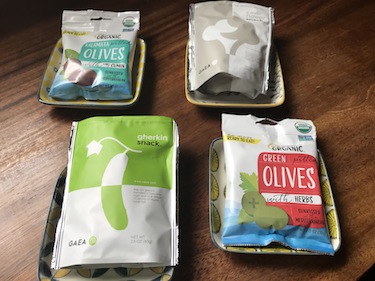
Immediately following a refrigerator purge, I’m especially uneasy about refilling pantry space with things I just had to throw away. The other day, I was walking slowly by the pickles in Natural Grocers trying to decide whether or not to purchase anything when I happened upon a great solution. Sitting right in front of me were small packages of olives, gherkins, and marinated cauliflower!

The packaging bills these as snacks. Each resealable bag contains 3 to 4.5 servings without liquid which makes them great for snacking, but I immediately saw the potential for solving my relish tray waste problem! I love it when a solution is just a matter of paying attention!

The Gaea cauliflower and gherkin snacks are vegan, gluten-free, and contain nothing artificial. The cauliflower is marinated in extra virgin olive oil and lemon essential oil. The mini gherkins are marinated in extra virgin olive oil and vinegar enhanced by salt, garlic, and coriander. A serving of either one equals a half serving of vegetables and has 5 (gherkins) or 10 (cauliflower) calories.

All of that sounds good. How do they taste? I like the crunch of the cauliflower. It leaves a lemony aftertaste on the palate. The gherkins are teeny tiny and adorable. They are not the traditional sweet, crunchy gherkins you’re used to. The most prominent flavor is salt and the texture is less crisp. Both of these would benefit from a pairing with something to balance the saltiness.

The Mediterranean Organic olives are pitted, organic and non-GMO. A serving of green olives has 20 calories and is flavored with salt, parsley, basil, and thyme in addition to olive oil, sunflower oil, and white wine vinegar. The Kalamata olives have 40 calories per serving and are flavored with salt, red pepper, oregano, thyme, and cumin in addition to the same oils and vinegar.

Both olive selections are more traditional in taste, but have an oiliness not found in jarred olives. I don’t mind this so much because it keeps the olives feeling moist. It might be a bigger issue if I were eating these as a car snack. I’d have to be sure to have a napkin handy.

As far as packaging goes, I wasn’t very successful using the tear tab on the olives. I either ended up ripping the entire side of the package rendering it unsealable or I pulled so lightly that I had to use scissors just to get the thing open. The pull up tab on the Gaea packages was much easier to use.

If you prefer to have more flexibility, you can also choose PearlsR Olives to Go. Four individual serving cups per package allow you to customize the ratios of black pitted, pimento stuffed green, and pitted Kalamata olives on your relish tray. The flavor selections have recently expanded to include Sriracha, Taco, and Italian Herb infused ripe olives.

It’s been awhile since I’ve eaten Olives to Go and I’ve only tried the sliced black olives. The flavor was exactly like jarred olives, but they were drier. I don’t mean dried out, just drier. I have not tried the new infused flavors. The Olives to Go cups cannot be resealed, but they are easy to open.

Have I found a right size relish tray solution? I have made progress. Keeping the Gaea cauliflower and Mediterranean Organic Kalamata olives on hand gives me two good small serving choices. The Sriracha Olives to Go sound like something interesting to add as well. I like the idea of having a spicy choice on the tray.

At this point, I’ll probably stick with a sweet, crunchy gherkin. I may not use all of them in a reasonable amount of time, but at least I’ll have accomplished my goal of keeping relish tray ingredients on hand while reducing my food waste. I feel good about that.

https://www.mediterraneanorganic.com/med_organic_product_description?upc=81498500224

https://www.mediterraneanorganic.com/med_organic_product_description?upc=81498500225

https://www.olives.com/pearls/product-locator.php

http://www.cooking2thrive.com/blog/haste-not-waste/

http://www.cooking2thrive.com/blog/whats-worth-preserving/

Disclosure of Material Connection: I have not received any compensation for writing this post. I have no material connection to the brands, products, or services that I have mentioned. I am disclosing this in accordance with the Federal Trade Commission’s 16 CFR, Part 255: “Guides Concerning the Use of Endorsements and Testimonials in Advertising.”
ad