Gluten-Free. Back to Basics. Prohibited Foods.

Last night, I was invited to join a going-away dinner for a friend that reminded me how easy gluten-free basics can be.  She wanted to meet at her favorite Italian restaurant.  The menu is not online, so there was no way to prepare in advance for possible ordering options.  Armed with a server card, I went without a back-up plan, trusting that I could find a suitable option. As it turns out, this restaurant offered gluten-free pasta, so ordering was easy.

The simplicity of my interaction with the waitress piqued the interest of the woman to my right.  She asked, “Is it pretty easy to follow that diet?”

My answer was yes.  All I have to avoid are foods containing wheat, rye, barley, malt and their derivatives.  I also avoid oats unless they’re certified gluten-free.  The list of foods I can eat is much longer than the list of foods I cannot.  The only area in which I feel limited is processed food.

Now let’s get to the Gluten-Free. Back to Basics. Prohibited Foods. For those of you who are considering a zero gluten way of living and are wondering what will be prohibited, you must avoid foods listing any of these items on the label:

Barley

Barley Grass

Barley Malt

Beer (there are GF varieties)

Bleached Flour

Bran

Bread Flour

Brewer’s Yeast

Brown Flour

Bulgur Wheat

Cookie Crumbs

Cookie Dough

Couscous

Durum wheat

Edible Coatings

Edible Films

Edible Starch

Enriched Bleached Flour

Enriched Bleached Wheat Flour

Enriched Flour

Farina

Farina Graham

Farro

Filler

Flour

Fu

Germ

Graham Flour

Groats

Hard Wheat

Hydrolyzed Wheat Gluten

Hydrolyzed Wheat Protein

Hydrolyzed Wheat Starch

Kamut

Maida

Malt

Malted Barley Flour

Malted Milk

Malt Extract

Malt Flavoring

Malt Vinegar

Matza

Matzo

Matzo Semolina

Orzo Pasta

Pasta

Pearl Barley

Triticum

Roux

Rusk

Rye

Semolina

Semolina Triticum

Spelt

Sprouted Wheat or Barley

Tabbouleh

Unbleached Flour

Vital Wheat Gluten

Wheat

Wheat Bran Extract

Wheat Germ Extract

Wheat Nuts

Wheat Protein

Whole-Meal Flour

The following items sometimes contain gluten:

Artificial Color

Baking Powder

Boxed Cereals

Broth

Caramel Color

Caramel Flavoring

Clarifying Agents

Coloring

Dextrins

Dextrimaltose

Dry Roasted Nuts

Emulsifiers

Enzymes

Fat Replacer

Flavoring

Food Starch

Food Starch Modified

Glucose Syrup

HPP

HVP

Hydrolyzed Plant Protein

Hydrolyzed Protein

Hydrogenated Starch Hydrolysate

Hydroxypropylated Starch

Maltose

Miso

Modified Food Starch

Modified Starch

Natural Flavoring

Salad Dressing

Natural Flavors

Non-dairy Creamer

Oats

Seasonings

Soba noodles

Soy Sauce

Soup

Stabilizers

Starch

Tomato Paste

Vegetable Gum

Vegetable Starch

Vitamins

Wheat Starch

To fully eliminate gluten from your diet, it is important to review the ingredient list on all foods before you decide to consume them. If you live in the US, you’ll even need to read the ingredients on products that say “Gluten-Free”.  Why?  The FDA has never established a standard for foods to qualify as gluten-free.

When I eliminated gluten from my eating plan, label reading quickly became part of my daily routine. It’s not too time consuming, and it doesn’t take long for it to become a habit.  It’s one of the few simple steps required for gluten-free living. Print out this list, and give it a try!

Server card ad


If you want to read more about safe or prohibited items, visit www.celiac.com.

You are how you cope!

Don’t you mean you are what you eat?  After all, this is a cooking blog, right?

Well, yes, Cooking2Thrive® is about cooking, but it’s also about thriving.  Don’t worry we’ll tie it all together for you by the dessert course.

Soup

It is no secret that our intimate relationship with food sometimes takes on a life of its own. When we vow to modify our diet, eat healthy, lose weight, reduce our intake of sweets or carbs or protein or gluten, we can suddenly feel out of control, or obsessed. It feels like the vow has taken control of us.  Why is that?

Salad

Take a moment to crunch on this idea:  Long before we were ready, some of us had to perform tasks that were much too advanced for our age and ability. When things didn’t turn out well, we blamed ourselves or someone else blamed us. Through this process, we learned to cope in a manner that encouraged the overdevelopment of an inner critic. This critic became such an integral part of us that we do not feel like ourselves unless we are thinking: “I’m too fat!”; “I ate too much!”; “I should have eaten slower!”; “If only I had planned in advance, I wouldn’t have had to eat that doughnut at the office, but I was just so hungry!”  As we begin to eat more healthily, this monologue no longer fits, but when it’s turned off we don’t feel like ourselves.  When we don’t feel like ourselves, we begin to feel anxious. Anxiety leads us to seek comfort.  We feel comforted when we eat carbs, so we pick up a cheese roll, criticize ourselves for choosing the food we have vowed to avoid, and breathe a sigh of relief because our familiar coping pattern has been restored.

C. Thriver

Entree

Our inner critic may be alive and well and keeping us from doing our best, but it can go relatively unnoticed while our lives roll predictably along. Enter a stressful disruption, and the war we are constantly fighting within can keep us from making changes that are critical to our health and longevity. For instance, let’s say that we’re suddenly served a huge heaping portion of diabetes. Now the carbs we run to for comfort can literally be our undoing. If we continue to cope in our old way, we will significantly decrease our lifespan. And yet, the added stress we feel may pull us even more strongly toward a familiar coping strategy. We want to become more healthy – it just feels as though we can’t. We may begin to feel ashamed or defeated or that critic may pipe up and say, “You’re not worth the trouble anyway, loser.”

Whatever the specifics of your situation may be, when you go back to coping through the use of strategies from the past that do not allow real change, you are stuck. 

Many of us remain stuck for a very long time while our health and quality of life slowly deteriorate. We begin to believe that we’re destined to be sick and then sicker. We focus on alleviating symptoms rather than controlling, healing, or curing an underlying disease process. This seems sane and normal because we’re surrounded by a host of other people who are following a similar path.  But if sane and normal actions cause us to live more limited, painful, or shorter lives, how sane and normal can they really be?

A part of us may sense that this is a question worth asking, but when we are in a weakened or pain-filled state the asking may feel beyond our reach. Without a side dish of support and encouragement, we may be left to cope in the usual manner.

Dessert

Now for the sweet part! Cooking2Thrive can help support healthy change. Don’t feel like challenging the status quo? That’s okay; we love a good challenge.  Don’t feel you can make progress because you don’t have enough support?  That’s okay; we’re here to encourage you.  Know where you want to go, but don’t know how to get there?  Don’t worry; we will provide a roadmap of practical tools you can use in order to progress.

At Cooking2Thrive, we believe that good health begins with nutritious, fresh food. We believe that with proper nutritional and emotional support, many disease processes can be reversed. We also believe that we all need encouragement and practical tools to develop new ways to process our feelings so that we can discard the coping mechanisms that hold us back in order to live a more rich, full life.

If you currently feel stuck and can’t seem to avoid your inner critic, don’t worry. Things can change.  You can heal!  We can help.

Server card ad

Strippaggio – A Tasting Adventure!

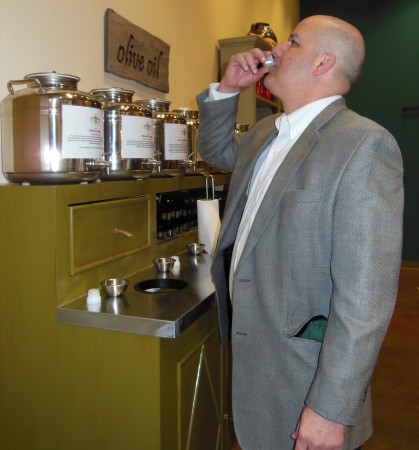
My first experience with Strippaggio turned out to deliver unanticipated excitement.  Strippaggio is both the name of a local retail establishment and the Italian word for the process of filling your mouth with oil and then slurping so air spreads the oil up your nasal passages coating the taste buds with flavor.

I love any shopping experience that involves tasting something exotic or unusual, so I decided to make Strippaggio the first stop in an evening of birthday dining. My friends Chris and Heather joined me. The boutique offered around 50 varieties of fused or infused olive oil, roasted oils, and flavored vinegars.

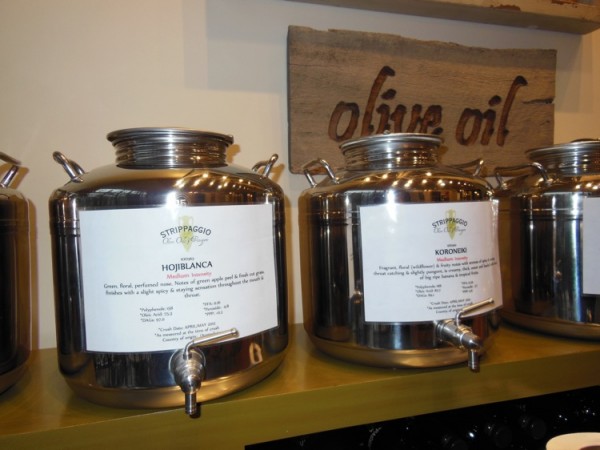
jugs

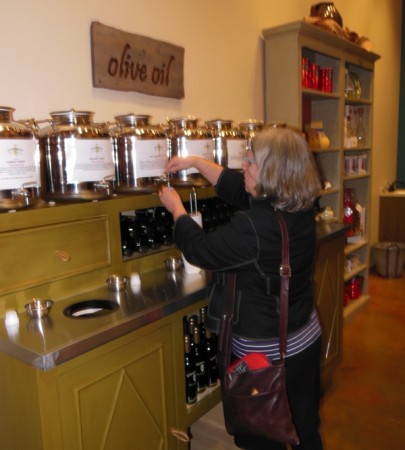
Neat rows of stainless steel jugs with spigots sat atop counters that conveniently contained small plastic cups, rolls of paper towels, and a waste bin along with already bottled portions of the top selling varieties.  Each jug was labeled with a description of the contents and flavors letting us know what to expect before choosing our next taste.

We began with a lime infused olive oil that was bright and fresh, then followed it with infused wild mushroom and sage.  The wild mushroom variety turned out to be one of my favorites and one that I had to take home with me. After a few more slurps of infused oil, I was ready to mix it up with some of the vinegars.

counter

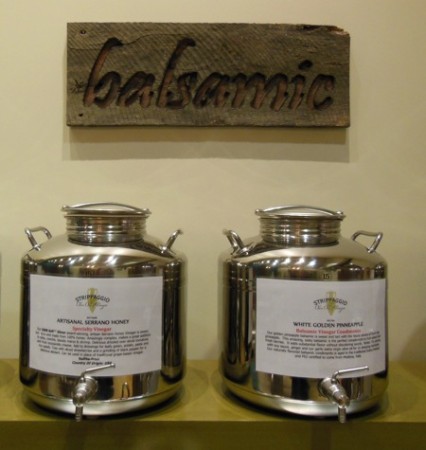
Our host cautioned us not to slurp the vinegars, just to taste them.  We tried white pear and cranberry, blueberry, chocolate, espresso, fig, maple, raspberry, and a spicy serrano honey vinegar.  After three or four sips, we returned to the oils.  Then back again to the vinegars lingering over the sweetness and dessert appropriate chocolate balsamic and pondering a pairing of raw pecans with the maple balsamic.

Things were going well until Chris slurped a vinegar, coughed choked, cried, and laughed. I felt for him, but I was laughing too.  One more caution from the host and we resumed our tasting by buying a package of pecans and dipping them in maple, blueberry, and chocolate balsamic.  The maple was definitely the best.

Chris

Finally, I was ready for one last review of my favorites so I could decide which to purchase. After a quick taste of roasted sesame oil, I returned to the serrano honey vinegar.  While I can’t tell you for sure what I did, I assume I slurped it as I swallowed.  The vinegar burned the back of my mouth and my throat immediately closed. I could not move air in or out.  It was as if I had something blocking my airway, but there was nothing there.  I paced, Heather worried, the host asked if I was alright, Chris stood in the back of the room and waited to see if laughter or 9-1-1 was the next appropriate move.

Cheri

After a few seconds that felt like an hour, I was able to loudly force air back through my throat.  I sounded asthmatic.  A few more breaths like that and I could cough, cry, then laugh.  Everyone laughed. I felt glad to be alive.

killer vinegar

I wasn’t willing to buy the serrano honey vinegar this time, but I will.  Instead, I went home with two other varieties and a survival story.  I wouldn’t have missed the experience for the world.  I highly recommend the tasting – just make sure you pay close attention to whether you’re tasting vinegar or oil.  If you don’t, you may get an unexpected adventure as well.

Server card ad

Don’t Like Peeling Butternut Squash? Then Don’t!

I love butternut squash.  I like it oven roasted, mashed, as part of a tart, as a soup, boiled in beef stew – you name it, I’ll gobble it up.  I love it in spite of the fact that my knives always seem to be dull and it has a tough covering.

Some of my friends tell me they avoid cooking this squash because it’s just too much trouble to peel.  To this I say, then don’t peel it.  A moderately sharp knife should cut a butternut squash in half when you use a little elbow grease. Once you’ve managed that, you’re well on your way to using it in some tasty preparations like these:

One of my favorite ways to prepare butternut squash is to oven roast it. I preheat the oven to 425º, clean the skin, remove the seeds, and cube it in one-inch cubes with the skin left on. Then I place the squash on a cast iron baking sheet skin side down, drizzle with olive oil, top with a few sprigs of fresh thyme and roast for about 40 minutes. The skin gets brown and adds some pleasing texture to the squash.

Oven roasted squash is delicious by itself, but it becomes decadent when I take the hot squash from the oven, remove the thyme, then toss the squash with bleu cheese crumbles and Sahale Valdosta Pecans. This pecan blend contributes a bit of tart, sweet, and spice to the dish with its addition of cranberries, black pepper and orange zest.

If you like to share, this combination makes a great choice for a potluck contribution. You can roast the squash while you’re getting dressed for a party, then toss with the cheese and pecans just before you walk out the door.

Yesterday, I included butternut squash in some beef stew that I simmered for about an hour before serving. I prepared one-inch cubes in the same manner I described above, leaving the skin on. After an hour of cooking, the skin was perfectly tender and added enough body to the squash for it to hold its shape and keep from disintegrating into the broth. Because I had added a significant amount of red pepper, it was nice to have the natural sweetness of the squash to balance the heat.

Even though butternut squash is a winter squash, I find it in the supermarket all year long. That means it’s available in the summer for a bit of barbecue variety. Just clean the skin, slice in half, remove the seeds and core, then slice in large wedges, season, and throw on the grill.

The more experience you gain wielding a knife against this pale orange nemesis, the more comfortable you may become peeling the squash. That will open the door for a whole new set of preparations. In the meantime, don’t hesitate to throw one in your shopping cart.  It doesn’t have to be peeled to be delicious!