
Feeding an infant with Down Syndrome can require tough choices. I’m writing this post between trips to the hospital to see my new granddaughter, EM, and taking care of her 22-month-old brother, DJ. EM was born on April 24 and had her first heart surgery May 1. She’s currently living in CVICU trying to learn to eat from a bottle while struggling with oxygen levels and respiratory rates the doctors can’t quite regulate. Alongside the significant medical events, the fact that she has Down Syndrome feels somewhat like an afterthought.

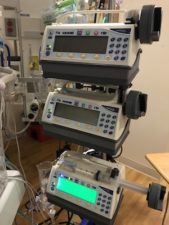
There’s so much equipment, so much beeping, and such a high level of activity in EM’s room, it’s impossible to simulate the typical newborn experience. Soft soothing sounds, cuddling, and nursing are often limited, sometimes impossible. Everything is geared toward surviving.
Critical to survival outside the hospital is EM’s ability to take in nutrition. Right now she is being fed breast milk through a feeding tube. Twice a day, she attempts to nurse from a bottle. We’re lucky. Her sucking instinct is still strong, but a side effect of the surgery was damage to her vocal cords and now she cannot swallow breast milk. She needs something thicker.
If you’re interested in healthy eating, good nutrition, and real food, you probably agree with the American Academy of Pediatrics that breast milk is superior in providing nutrients for rapidly developing bodies and minds. A child with Down Syndrome already has some obstacles, so superior nutrition seems especially important for EM.
The problem is, how do you prioritize getting breast milk and being able to swallow? It seems like the intuitive idea is to thicken breast milk with some natural substance. You’ll find this idea promoted on plenty of websites.
As it turns out, thickening breast milk safely and effectively isn’t as easy as it sounds and our doctor doesn’t feel comfortable with any of the thickeners available on the market. There’s a lack of data showing gel and gum thickeners are safe for use in infants. At least one of these products has been associated with necrotizing enterocolitis, a bacterial infection of the intestine which can cause death of intestinal tissue possibly leading to blood poisoning (1).
Some web forums will recommend thickening breast milk with rice cereal or oatmeal. This may work for feeding through a G tube (feeding tube), but is impractical for nipple feeding in an infant with difficulty swallowing. The enzymes in the breast milk quickly break down the cereal. These infants eat slowly. The purpose of using cereal to thicken is defeated soon after a feeding begins.
What that means for babies like EM, is they must rely on formula thickened with rice cereal or oatmeal. Our occupational therapists use rice. They conducted a swallow study through which they determined the consistency of nectar is EM’s best option. I have no idea how to describe the consistency of nectar, but they’ve converted that to mathematical ratios so we’ll know how to create it.
If you have a baby with Down Syndrome and difficulty swallowing, you may have some difficult decisions to make. Will you switch to thickened formula and supplement with a few drops of breast milk each day to provide antibodies while working toward the possibility of breast milk alone? Will you give up pumping and switch to thickened formula until you can begin solids? Will you thicken with rice cereal or oatmeal? Will you try to stay in the hospital longer to see if feeding can progress or will you accept a G tube and/or portable oxygen to go home sooner?
It’s a tough spot to be in. All you want is to provide the best possible nourishment for your child so he/she can develop and you can’t use the most nutritional food available because the baby can’t swallow it. And there are other considerations.
Research has shown a higher incidence of Celiac Disease in patients with Down Syndrome than in the general population — possibly as high as 18.6% as compared to 1%. Currently, the US does not screen infants with Down Syndrome for Celiac Disease, and thickening formula with oatmeal could be harmful to a baby with undiagnosed celiac disease.

The issues don’t end there. Rice cereal may contain arsenic. Some brands of formula have ingredients like soy or gums including carrageenan which is banned from infant formula in Europe per recommendations from the World Health Organization and the United Nations.
With my children, I was adamant about only feeding breast milk for the first 6 months and then introducing foods one at a time. I felt really strongly about it. As it turned out, this process helped us quickly determine that each of them had an allergy to cow’s milk. My middle grandson shares this allergy. None have suffered ill effects at length.
This is often not the case. Many children endure sneezing, coughing, congestion, swelling, nausea, vomiting, dizziness, tummy pain, rashes, or diarrhea for months or years due to food sensitivities. It can be difficult to pin down the culprit.
Of course we don’t want any of these complications for an already vulnerable infant, but we have to keep things in perspective. If a baby has congenital aortic valve stenosis, immediate surgery may be required. Although surgery will interrupt feeding, it will only be recommended in order to save the baby’s life. If that surgery leads to extra difficulty with bottles if is unfortunate, but choosing feeding over surgery makes no sense.
Babies with other common heart defects associated with Down Syndrome will tire easily when nursing and may have to be fed more frequently. Some of these babies will have surgery when they’re a few months old. This can help endurance, but may detrimentally affect swallowing. Still, surgery is a better option than the extreme fatigue experienced without it.
Not every baby born with Down Syndrome will need heart surgery, but most will have less neck and muscle control than other babies. They may also have a thicker tongue. This combination can make eating difficult. Breastfeeding may be possible although proper latching may take some time and patience.
Bottle feeding poses similar latching problems, but has the advantage of a variety of nipple options and the possibility of dispensing thickened formula if your baby tends to aspirate breast milk. A swallow study may be needed to determine the best solution.
The overall goal has to be getting nutrition into the baby’s system. If we do not accomplish that, it doesn’t matter what we’re feeding. When EM can finish a tiny 10 ml bottle, it feels like such a triumph that it’s hard to be upset by the fact that there’s formula and rice cereal in it.
Sometimes reasonable, healthy goals don’t line up with available options. This can be frustrating and difficult to accept, especially if we’re planners. Remaining a flexible advocate for your baby when presented with difficult choices requires courage, character, and grace. It is not easy, but it is important.
1)https://well.blogs.nytimes.com/2013/02/04/warning-too-late-for-some-babies/
https://medical-dictionary.thefreedictionary.com/necrotizing+enterocolitis
https://www.ncbi.nlm.nih.gov/pmc/articles/PMC5535317/

