Back to Basics

Today we’re getting back to basics by using the wayback machine to repost this piece.

While my mom didn’t cook much when I was growing up, my grandmother did. I spent enough time cooking fresh food and baking from scratch to feel comfortable with the tools and the terms. That’s not true for everyone my age and certainly not for everyone my kids’ age.

In some circles cooking has come to mean popping a packaged meal in the microwave or heating precooked entrees or vegetables in the oven. I’ve seen posts in which a description of baking from “scratch” included a cake mix.

Reducing the amount of prepackaged, convenience foods you eat can help lessen your consumption of chemical additives, sodium, manufactured fats, and sugar. It also means you may have to perform a few additional “cooking” related tasks.
eggshells
If you’re not familiar with cooking terminology, translating a recipe into a dish may seem daunting. Removing some of the mystery can help you get past the feeling that you can’t cook because you don’t even know what the words in the instructions mean. Today, let’s explore some basic cooking terms and techniques so you can be on your way to becoming a great cook!

You don’t need a lot of fancy equipment to prepare a wide variety of foods for boiling, steaming, baking or broiling. Peeling, slicing, chopping, dicing, and mincing only require a knife. But what are they?
Definitions:
Peel – Remove the outside skin from vegetables or fruits.
Slice – Cut a thick or thin, flat piece of something like fruit, vegetable, bread, or meat.
Chop – Cut food into irregular pieces of similar size to each other. Chopped pieces are typically larger than diced or minced.
Dice – Cut food into cubes between 1/8″ and 1/2″ in size. If size is not specified, use 1/4″
Mince – Mincing is like dicing, but the pieces are smaller.

When preparing vegetables and fruits, you’ll use these techniques over and over again.

Sometimes you may not want a cooked or raw vegetable to retain its shape at all. You can then use a food chopper or processor to grind or purée it. Grinding reduces the food to tiny particles. Puréeing means the food is processed until it’s smooth. You don’t have to have an electronic appliance to do this. A cooked vegetable can be mashed, then put through a sieve to create a purée.

Once you’ve prepped vegetables and meats, you may want to add heat in order to boil, steam, sauté, bake, broil, roast, grill, or braise.
Definitions
Boil – To submerge in a boiling liquid at or above the boiling point of water.
Steam – To place food above boiling water in a pot or pan using some kind of rack or basket and a cover so that steam cooks the food.
Sauté – To cook a food quickly in oil and/or butter over high heat.
Bake – To cook using dry heat in an oven or on heated metal or stones.
Broil – To cook quickly using high heat from above the food.
Roast – To cook using dry heat with a temperature of at least 300 in an environment in which hot air from an open flame, oven or other heat source envelops the food, cooking it evenly on all sides.
Grill – To cook directly over live, high heat flames.
Braise – To cook slowly in a small amount of liquid in a covered container in the oven or on a burner.
Brown – To give a cooked surface to meat or flour. Also to turn a brown color in the oven.

Sometimes you’ll want to parboil, blanch, simmer, scald or blend.
Definitions
Parboil – To briefly boil in water until food begins to soften.
Blanch – To briefly place food in boiling water, then immediately move it into cold water. 
Simmer – To cook in liquid at a temperature just below a boil. 
Scald – Refers to both dipping into boiling water, and heating milk to just below the boiling point.
Blend – To mix ingredients together thoroughly often using a beater, mixer, or blender.

You may be instructed to dot a casserole with butter before baking it, or to baste a turkey while it roasts. If so, here’s what to do:
Definitions
Dot – Cover the top with small pieces of butter.
Baste – Spoon, brush or pour drippings or liquid over a food before or during cooking.

When you begin baking from scratch, you’ll commonly see instructions to sift, mix, cut in, whisk, flour, fold, and knead so let’s prepare for that:
Definitions
From Scratch – To make from the very beginning without using already prepared ingredients.
Sift – Use a device made of a metal cup with a screen at the bottom that contains a mechanism to force the flour through the mesh.
Mix – Combine items to form one mass.
Cut In – Work solid fat into dry ingredients with a pastry blender until evenly distributed.
Whisk – Beat or stir with a whisk.
Flour – To dust a pan the shortening in a prepared baking pan with flour.
Fold – To delicately incorporate one substance into another substance without releasing air bubbles.
Knead – To work a dough by mixing, stretching, and pulling with the fingers and mashing with the heel of the hand.
grate
Other common actions are grating, whipping, and garnishing. Let’s explore those terms:
Grate – To rub firm food on a tool with small, rough, sharp-edged holes grater to create small pieces.
Whip
 – To beat vigorously to incorporate air and cause expansion.
Garnish – To decorate a dish with something attractive and flavorful.

Now that you have a guide to more than 30 common cooking terms, you can build on this knowledge as you gain experience and confidence.

Never feel bad about having to look something up. Many chefs have used books and kitchen experience to become successful. And remember, you don’t have to be a chef to be a great cook!

Happy Belated Birthday, Crock-Pot!

Join me in wishing your crock-pot a happy belated birthday. About a week ago, this slow cooking device turned 50. Well, technically the device itself is a little over 80, but its incarnation with the name crock-pot began in 1971.

I’ll confess that I primarily use my crock-pot for parties. I’ve owned the brand name and something similar that doubled as a griddle. Both work similarly. They cook food at a slow pace.

My first crock pot lived in my college dorm room. We used it to make cheese dip out of cheddar cheese soup and RotelR tomatoes and peppers that we greedily dipped original Doritos into. While the thought of that cheese dip now makes me cringe, I miss the buttery flavor of those original tortilla chips.

Next, came the wedding gift crock pots. I think I received three. One was huge. I still have it. As much as I like one pot meals, you’d think I would have put a lot of miles on these pots through the years. I haven’t, which seems odd since I love one pot meals. I think it’s because I view one pot meals as something quick I can throw together last minute. Crock-pot cooking requires forethought.

Perhaps that’s why many of us opt for the convenience of fast food rather than the convenience of a crock-pot. But there’s no question that crock-pot cooking can be healthy and easily adapted to any dietary restriction.

As a recent convert to braised beef, which I’ve discovered is much like my grandmother’s pressure-cooked beef, I increasingly appreciate slow cooking. It’s great for pulled pork, ham & beans, chili, and vegetable soup. The home economists who developed recipes for the crock-pot swear it’s the best way to bake cheesecake.

It can also be used to bake pineapple upside down cake, chocolate lava cake, banana nut cake, and breakfast foods like cinnamon rolls, French toast casserole, and scrambled or boiled eggs. Clearly, I have not allowed my crock-pot to fulfill its potential.

Like any small electric appliance, part of that is due to access. A crock-pot is the kind of thing that needs a place to live that’s convenient or I forget to use it. Out of sight, out of mind, I guess and mine lives near the back of a shelf in a closet in the dining room.

It seems fitting to attempt a cake in the crock-pot to celebrate its birthday. Although I’d love to test that claim that it makes the best cheesecake. And I used to ask for lemon meringue pie for my birthday, so birthday cake doesn’t have to be birthday cake!

Anyway, I’d like to salute Irving Naxon who patented the Naxon Beanery that became the crock-pot. He created an efficient way to slow-cook food that costs only pennies a day to operate and does not heat up the house. His machine may not have been a commercial success until it was bought by Rival, but without him we might not be able to buy one of the 12 million units that are still sold each year – 50 years later.

So, thank you Irving Naxon and happy belated birthday, crock-pot!

Braise then Graze

This year, I’ve been known to braise then graze. Most often, I bake fish; broil or bake beef and pork; and bake or boil chicken, but my favorite preparation may be to braise! Earlier this year, I braised some steak I dredged in gluten-free flour and cooked with a flavorful broth. The result inadvertently mimicked my grandmother’s beef and noodles. In fact, my sister, who thought this was a deliberate replication said, “You nailed it! You can fix this for my birthday,” when she sampled the dish. I confessed it was a happy accident.

One of the benefits of braising is the tenderness of the meat when it’s done. My grandmother used a pressure cooker to achieve this effect. Pressure cookers scare me. I always visualize food on the ceiling that has spewed through the valve at the top. I think I’ll stick with braising.
ribs
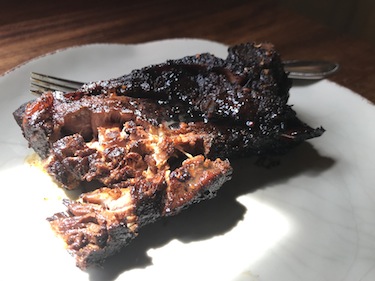
The other day, I had some country style pork ribs on hand and lots of rain outside. I wasn’t willing to fight the elements to use the grill so I decided to braise the ribs. I can’t say this was a well-thought plan. It is more aptly described as a few decisions based on convenience. I threw some balsamic vinegar, tamari, and a splash of olive oil in an enameled cast iron pot and added a little sugar. The mixture tasted pleasantly salty with a subtle tang.

I placed the pot over medium heat and allowed it to come to a boil while I stirred until the sugar melted. I then placed each rib, unseasoned, into the liquid and immediately turned it so that both sides were coated. Once all of the ribs were in place, I added a large stem of fresh mint leaves for an aromatic top note.

As I began the braising, I had the thought that the flavor profile would have been a good choice for lamb. I wasn’t sure how it would play with pork, but I always throw things together and hope for the best. Usually, it works out.

Braising can be done in the oven or on top of the stove. I used the top of the stove. The idea is to keep the heat low and cook for a long time. I placed the covered pot over a very low flame and set the timer for an hour. Once the hour had passed, I turned the ribs again, sprinkled in a little cayenne, mignonette pepper, and garlic powder for good measure, gave it a stir and continued to cook for another hour.

The results fall off the bone as expected with this cooking technique. The color is dark, almost black, and the flavor rich. There’s plenty of salt from the tamari. There’s no noticeable sweetness, but the sugar has helped create the illusion of caramelization that makes the burned edges of barbecue so appealing.

The flavor is not wholly familiar. It’s lacking any mustard or tomato base that would be typically associated with country style ribs. And of course there’s no smokiness. Nonetheless, the ribs are satisfying and delicious.

I’ll make these ribs again to nail down the actual measurements for a recipe, then we’ll test that recipe a few times to make any needed changes before it is approved for publication. All Cooking2Thrive original recipes are tested a minimum of three times. Some are tested many more.

Once the recipe is perfected, all you’ll have to do is follow the instructions to braise then graze!
ad