
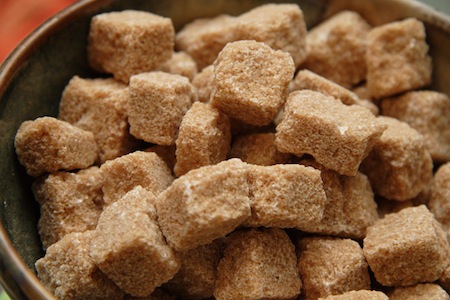
 I’ve been comparing tans to brown sugar which led me to wonder – where does brown sugar get its tan?
I know that sounds like a weird comparison, but I’m going to a wedding in Santa Barbara this summer so I’ve been focussed on getting some sun on my legs. At some point, I may or may not have been gawking at some tan legs in the grocery store thinking that’s the shade I want. Next thing you know, I’m wondering about the different colors of brown sugar – a leap not that unusual in my world. It happens.
Soft, moist, caramel tasting brown sugar comes in many shades – light brown, dark brown, and even darker pilonchillo. Ever since I was a kid I’ve loved the way it feels to pack it into a measuring cup and then watch it easily break apart again when poured into a bowl of cookie dough. It seems that it’s time to learn more about this delightful ingredient.
The short answer to where does brown sugar get its tan is…molasses. The darkness of the brown is directly related to the percentage of molasses it contains. Light brown sugar contains about 4.5% while dark brown sugar contains about 6.5%.
Brown sugar begins just like white sugar as a syrup most often made from crushing sugar cane to squeeze out juice, then evaporating that cane juice to form a thick syrup. A similar syrup can be derived from sugar beets. The thick syrup is full of molasses. Sometimes the syrup is further evaporated and then spun in a centrifuge to remove the molasses. This is how Turbinado and demerara sugars are made. You may know them as Raw Sugar.
Other natural brown sugars are not refined (put in a centrifuge) and retain a higher degree of molasses. You may know these as panela, rapadura, chancaca, jaggery, or piloncillo. These sugars are commonly boiled in open pans on wood fires until the sugar cane juice is reduced by 70% and begins to form crystals. The sugar is then poured into a mold or is cooled and beaten to produce granulated brown sugar.
In the Philippines, partially centrifuged evaporated and crystallizing cane juice is used to create a mush that’s allowed to drain using gravity creating a natural brown sugar called muscovado. A similar process is used in Japan to produce kokuto.
While natural brown sugars retain molasses from the partially evaporated cane juice, brown sugar can also be made by adding molasses to refined white sugar. This is how commercial brown sugar is commonly made. Adding molasses back to white sugar allows the ratio of molasses to be carefully controlled. It is also a less expensive process.
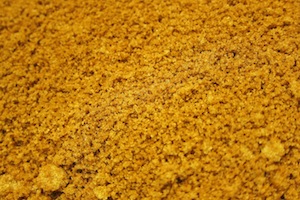
For a fun experiment, buy a cone of pilonchillo at your local mercado and a bag of commercially produced brown sugar from your neighborhood market. Wash a small amount of each with water in a bowl. After the water turns brown, pick up a few sugar crystals from the bottom of the bowl with your fingers. Notice how the sugar crystals that remain in the bowl of washed commercial brown sugar are white, but the remaining pilonchillo crystals are darker. That is because there’s molasses within the crystals.
What’s all that pretty brown sugar used for? It sweetens many baked goods and is used as a substitute for maple syrup or maple sugar. It is slightly lower in calories than white sugar. To further reduce calories and carbs in a recipe you may want to consider using coconut crystals.
Now that we’ve gotten to know brown sugar a little better, it’s time for me to get back outside and get some sun on my legs. I don’t want them to be scary white when I hit the beach!